Balancing User Experience and Security

May 20, 2025
-minute read
Director of Product Marketing

Between long hours at work and time spent on devices outside of work hours, digital interactions have become a dominant and permeating force in the lives of people all over the world. Organizations and businesses have now become hyper-focused on boosting user experience (UX) to ensure customers, partners, and employees can easily engage with all their digital properties, supporting and driving business growth. Unfortunately, this digital shift has also created new attack vectors for fraudsters, who can exploit even the smallest security gaps and missteps.


These trends have created a difficult paradox for IT teams, begging the question: is it possible to balance UX and security in a way that creates a smooth experience for the user and a secure environment for your organization?


With the right identity and access management (IAM) strategy, it is. Let’s explore how you can help your organization achieve it.

UX vs Security

Historically, the concepts of UX and security have been seen as competing forces within the digital experience, enhancing the one will negatively impact the other.


Take passwords for example. If you’re hyperfocused on UX, you may allow users to choose passwords that are easy to remember, with few characters and no requirement to change their password at set intervals. You could argue that this practice provides a better UX. However, doing things this way presents a big (and unnecessary) security risk.


On the other hand, if you make security your top priority, you might require long, complex passwords that are much stronger. The drawback to this, of course, is that users may forget their passwords or become so frustrated with the process that they abandon a transaction.


To balance UX and security, you need to eliminate the tension that exists between a pleasant UX and strong security for your organization. A well-thoughtout identity strategy can help you achieve this balance (more on that later).

4 Key Insights to Achieve UX Harmony

1. Security by Design

Historically, the concepts of UX and security have been seen as competing forces within the digital experience, enhancing the one will negatively impact the other.


This is because security is often treated as an afterthought. The UX team might develop an incredible app that’s easy to access and use, but when the security team steps in, they quickly realize there are risks and gaps that weren’t accounted for during the development stage.


When security is integrated from the beginning of the design process, it minimizes the friction that typically arises from bolting on a security solution later. By taking a “security by design” approach from the beginning, and not treating it as a burden on UX progress, organizations can find the right balance between a smooth experience and a secure one.


2. Friction Isn’t Always Bad

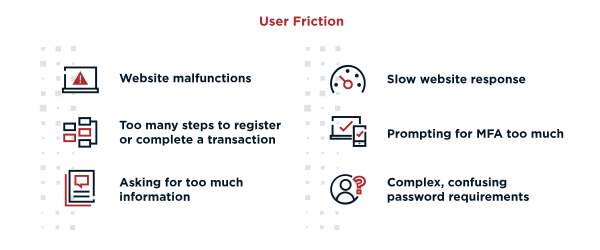
The best thing an organization can do to boost UX is to eliminate friction in how users interact with digital properties. Anything that causes a complication, delay, extra step, or any frustration constitutes friction. A few examples of friction are as follows:


user friction examples


However, friction doesn’t always equal poor UX - It’s about context. For example, if you're a bank customer trying to transfer a large sum of money, you probably expect (and are glad) to go through some additional security steps.


The question then becomes, “how do organizations keep these additional steps to a minimum?”, ensuring the user is reassured, but not frustrated, by the security layers they encounter when interacting with your digital channels. One key way is by leveraging invisible security capabilities.


3. Invisible Security

Through modern IAM capabilities like journey orchestration, contextual risk analysis, and behavioral analytics, organizations can add additional security layers that have little to no impact on a legitimate users’ experience. 


While we tend to think of added security as just more steps, these “invisible” layers can actually make your UX more seamless, especially in sectors like retail, where long-lived sessions go a long way in preventing cart abandonment. 


Additionally, less is actually more when it comes to passwords, which are one of the leading causes of data breaches and fraud. By moving to a passwordless experience, businesses can simultaneously increase security and UX without compromise.


4. Bad UX Actually Leads to Worse Security

While we tend to think in terms of security impacting UX, sometimes the inverse is true. Poor UX can lead to users taking short cuts and finding workarounds that can compromise security by creating entry points for bad actors.


For example, if a contractor or third-party partner frequently accesses multiple vendor portals, they may reuse the same password across systems. This creates a single point of failure that puts both their credentials and your enterprise systems at risk. Poor user experience, like overly complex login requirements, often pushes users toward insecure behaviors that ultimately weaken your security posture. The same can be true in workforce use cases, employees may stay logged in indefinitely, leave their computers open while they’re not actively working, or write down their passwords on a sticky note on their desk to avoid having to remember them, especially if their employer doesn’t offer single sign-on (SSO), or they’re forced to re-authenticate every time their device goes to sleep or they leave their email application to complete other work.


The relationship between UX and security works both ways, and to find the right balance, they have to compliment each other, not work against each other.

The Importance of UX

As digital interactions continue to rise, the ways users expect to interact with businesses online will continue to evolve. Perhaps due to the sheer volume and frequency of those interactions, today’s users tend to evaluate their digital experiences based on the principle of “last best one,” rather than comparing businesses in the same industry. 


For example, a user may compare their experience paying medical bills online to their experience with buying shoes through one of their favorite brand’s mobile app. Even though those are bound to be two very different experiences, users simply expect every experience to be as easy as the best one they remember. If it isn’t, they may be reluctant to come back, especially when they have so many other choices. 


No matter the industry, users have three main expectations for the brands they interact with: convenience, security, and privacy. Based on those criteria, they will choose not only their favorites, but which ones to avoid.


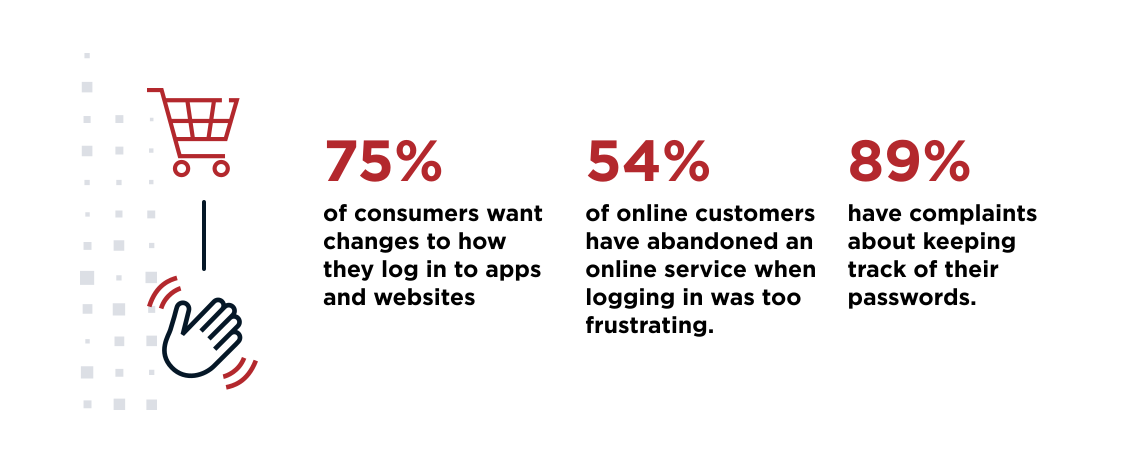
Consider the following statistics from Ping Identity’s 2024 Global Consumer Survey:


Statistics from Ping Identitys 2024 Global Consumer Survey


While friction causes would-be customers to give up on you and go elsewhere, providing a great UX is key to keeping users engaged with your brand. 


However, this phenomenon applies to much more than the consumer experience. The usability of your internal systems determines how quickly and easily employees and suppliers can access the tools they need to do their jobs, which can massively impact productivity. And the ease with which your dealers and distributors can access your systems can have a direct impact on revenue. 


The Advantages of Balancing UX and Security

A cohesive IAM strategy helps you eliminate the tension between the seemingly opposing forces of UX and security, enabling them to work in tandem so that every digital touchpoint is both convenient and secure. A comprehensive identity security solution gives you the best of both worlds, along with more efficient digital delivery. 


Building Seamless Experiences

With security measures that rely on identity security to assess risk signals in real time to make intelligent authentication decisions over always relying on frustrating security checks like passwords, your business can dissolve friction in the user journey. This approach allows organizations to reduce friction and appropriately adapt the UX in response the level of risk a user poses and whether they


This creates a comprehensive yet unobtrusive layer of security that helps users do what they intend to do without unnecessarily getting in their way.


Identity security isn’t only for streamlining authentication; it can simplify user interactions across the digital journey through:


  • Only asking for the right amount of information during the first interaction, leveraging progressive profiling to avoid asking for too much information too soon

  • Enabling self-service to make it convenient for users to reset their accounts, change passwords, or update information themselves

  • Removing redundant authentication checks when users contact support


All of these factors result in less friction in the UX, making it convenient for users to keep engaging with your digital platforms. 


Preventing and Mitigating Threats

With identity security, you’ll know who your users are and what they should have access to, ensuring the protection of the business, its partners, and its customers. 


Identity security is key to preventing data breaches, detecting and mitigating fraud, and protecting user data. There is constant pressure on the teams responsible for securing digital interactions and ensuring compliance. They must be able adapt to new threat technologies rapidly, and identity security can help increase their agility to meet those demands.


Identity security can help you evaluate signals from a wide variety of identity services, detecting user behavior anomalies to identify bad actors from the moment they arrive on your website. With identity security, you can also keep bots and fraudsters out while rolling out the red carpet for genuine users with a pleasant experience. 


Accelerating Digital Delivery

If you want to boost the agility of your teams, modern IAM can help them efficiently optimize both UX and security.


A comprehensive identity security solution eliminates the need for hand-coded integration between identity services. Using no-code integration, your team can orchestrate components from multiple vendors into one cohesive, seamless workflow with enhanced security. 


Building security into your user journey using identity can reinforce a great UX rather than pulling against it. A convergent approach to identity security integrates identity proofing, access management, and fraud detection across all your digital properties in a single, cohesive solution that helps you achieve business goals.


Is UX Friction Rubbing You The Wrong Way?


Explore how to create a seamless journey without sacrificing security.

Share this Article:
Related Resources

Start Today

See how Ping can help you deliver secure employee, partner, and customer experiences in a rapidly evolving digital world.