
CIAM for Fraud Prevention
Prevent Identity Fraud. Keep Customers Moving.
Continuously verify trusted customers at every interaction without creating unnecessary friction.
We work with the world’s top brands


The Challenge
Fraud Doesn’t Only Hit Login
Organized attackers exploit every gap across the
customer journey, from registration to login to support.
AI Attacks Outpace Defenses
Fraudsters target onboarding, login, recovery, and support using AI-powered deepfakes, bots, and synthetic identities that move faster than static security controls.
Every Step Is a Target
Fraud isn't limited to account takeover. Fake accounts, stolen credentials, social engineering, and recovery abuse all lead to financial loss and brand risk.
Too Much Friction. Too Little Trust.
Blanket security frustrates legitimate customers. Weak security gives attackers room to operate. The challenge is knowing when to step in and when to stay out of the way.
The Challenge
Fraud Doesn’t Only Hit Login
Organized attackers exploit every gap across the customer journey, from registration to login to support.
AI Attacks Outpace Defenses
Fraudsters target onboarding, login, recovery, and support using AI-powered deepfakes, bots, and synthetic identities that move faster than static security controls.
Every Step Is a Target
Fraud isn't limited to account takeover. Fake accounts, stolen credentials, social engineering, and recovery abuse all lead to financial loss and brand risk.
Too Much Friction. Too Little Trust.
Blanket security frustrates legitimate customers. Weak security gives attackers room to operate. The challenge is knowing when to step in and when to stay out of the way.
The Solution
Verify Every Customer.
Trust Every Interaction.
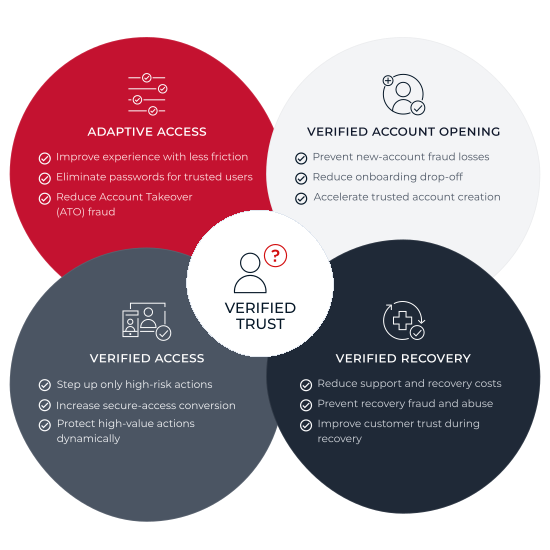
Trust shouldn't expire after login. With Ping, you can continuously evaluate identity, device, behavior, and risk throughout the entire customer journey, so you can stop organized fraud while keeping legitimate customers moving.
From account opening to authentication to recovery, every interaction is verified in context, not assumed. The result is less fraud, less friction, faster recovery, and better customer experiences.
How Our Customer Fraud
Prevention Works
How Our Customer Fraud Prevention Works
Build Continuous Trust
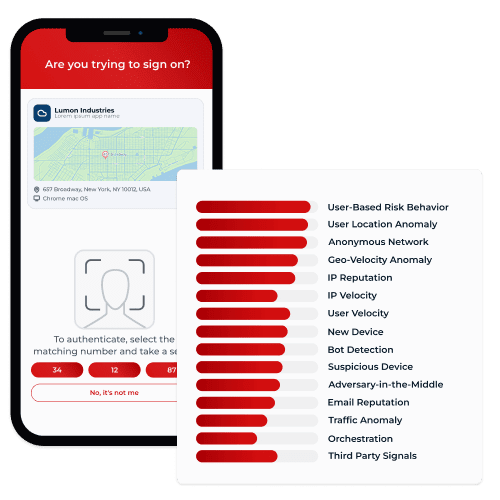
Respond to changing risk in real time while keeping trusted customers in flow. Signals like device fingerprint, geo-velocity, IP reputation, bot activity, and behavioral anomalies work together to determine whether to allow, step up, or block. So you can reduce MFA prompts and apply just the right amount of friction at the right moment.
Stop Fake Accounts
Catch bots, synthetic identities, and fraudulent applicants before they ever open an account. Progressive identity verification combines risk intelligence, document verification, biometric matching, and liveness detection to establish trust from day one. Then, bind verified users to strong credentials so that trust can carry forward into every future interaction.
Add Protection, Not Friction
Replace blanket MFA with adaptive verification that continuously evaluates behavior, device, and contextual risk signals, and responds in real time. Privacy-preserving biometrics, phishing-resistant authentication, and device binding stop account takeover while creating faster, passwordless experiences for legitimate customers.
Recover Helpdesk Confidence
When customers lose access, they shouldn't lose trust. Replace SMS OTPs, knowledge-based questions, and manual reviews with biometric, risk-aware self-service recovery that verifies the same trusted customer who originally enrolled. Recovering accounts and access becomes faster, safer, and dramatically less expensive.
A Tier-1 European retail bank turned call center account recovery and high account takeover (ATO) losses into:
$4.1M
Saved in call center and help desk costs
79%
Reduction in ATO fraud
Stop Assuming Trust. Start Verifying It.
Take the next step toward protecting your customers better, from account opening to access to recovery. Give your teams the tools they need to verify every customer, reduce fraud, and keep digital experiences smooth.
Helpful Resources
Frequently Asked Questions
When it comes to securing customer identity, you need more than point solutions. You need continuous trust across every interaction. Here are answers to the most important questions about verifying trust in customer identity.
Ping Identity’s approach to establishing high-confidence identity across the customer journey takes continuous verification instead of relying on a single login event. It combines identity verification, authentication, and real-time risk signals to confirm the right person is behind every interaction.
Traditional CIAM focuses on authentication at login. This new approach goes further by continuously validating the real person through identity verification, device trust, and behavioral signals, reducing fraud while preserving a smooth customer experience.
Our solution establishes and verifies trust using adaptive, risk-based decisioning in real time. Low-risk users move through experiences seamlessly, while higher-risk interactions trigger step-up verification, strengthening security without slowing legitimate customers.
Identity verification creates a high-confidence link to a real, biological person at critical moments such as account creation, recovery, or high-value transactions. That foundation supports stronger authentication and better risk decisions throughout the journey.
Yes. This solution is designed to work with either Ping as the IdP or standards-based, homegrown identity infrastructure. Through orchestration, it brings together verification, authentication, and risk signals without requiring a rip-and-replace migration.
Using strong identity verification and real-time risk signals, this solution securely restores access and prevents account takeover. By continuously proving the real person behind the interaction, it’s better equipped to stop AI-driven attacks that can mimic behavior or exploit stolen credentials.