What Are Behavioral Biometrics? Types, Benefits & Use Cases

With the advancement of technology, it has never been easier for cybercriminals to access compromised credentials, deploy convincing social engineering attacks, or use deepfake media to defraud and exploit organizations.


The quest for more effective and efficient fraud prevention methods is ongoing. Traditional security methods can come with tradeoffs, like increased friction for your users or limited adaptability to new threats. But emerging technologies like behavioral biometrics offer a dynamic approach to fraud prevention, promising a more streamlined and frictionless experience for both organizations and users.

Key Takeaways


  • Definition: Uses typing, mouse, touch, and motion patterns to help confirm the same person remains active.
  • How It Works: Passive signals build a baseline, then models compare sessions and produce risk scores for each action.
  • Security Value: Adds continuous protection that helps detect bots, remote access abuse, and session anomalies after login.
  • Best Fit: Works well for onboarding, account access, and high-value transactions that require low friction and strong assurance.
What Are Behavioral Biometrics?

This approach evaluates user activity patterns and device interactions to distinguish trusted individuals from fraudsters. By analyzing habits like mouse movement, typing rhythm, touchscreen pressure, and device handling, systems use AI and machine learning to build unique profiles for every user.


This technology matters because compromised credentials account for a significant share of breaches today.1 Traditional authentication alone is no longer sufficient. Adding a passive, continuous layer of security makes it extremely difficult for attackers to replicate legitimate user actions.


Behavioral Biometrics vs. Physical Biometrics

Physical biometrics (fingerprints, facial geometry, iris patterns) verify identity based on static, inherent traits, typically at the point of login. In contrast, behavioral systems analyze dynamic, acquired patterns continuously throughout a session. Physical methods confirm who you are, while behavioral analysis confirms that it is still you. Together, they create a layered defense that is far stronger than either approach alone.

How Behavioral Biometric Authentication Works

Behavioral biometric authentication follows a three-step process that runs passively behind the scenes, building confidence in every interaction without adding friction for the user.


1. Data Collection: Behavioral data is gathered passively as users interact with apps or websites. No extra steps are required from the user. Multiple sessions are typically needed to build an accurate baseline.


2. Pattern Analysis: AI algorithms process the collected data to build a profile for each user. Advanced techniques identify patterns that would be invisible to rule-based systems. The model refines itself with each subsequent session.


3. Real-Time Risk Scoring: When a user acts, their current behavior is compared against the baseline model. Each action receives a risk score. Low-risk actions proceed seamlessly, while high-risk actions can trigger additional verification or session termination.

Types of Behavioral Biometrics

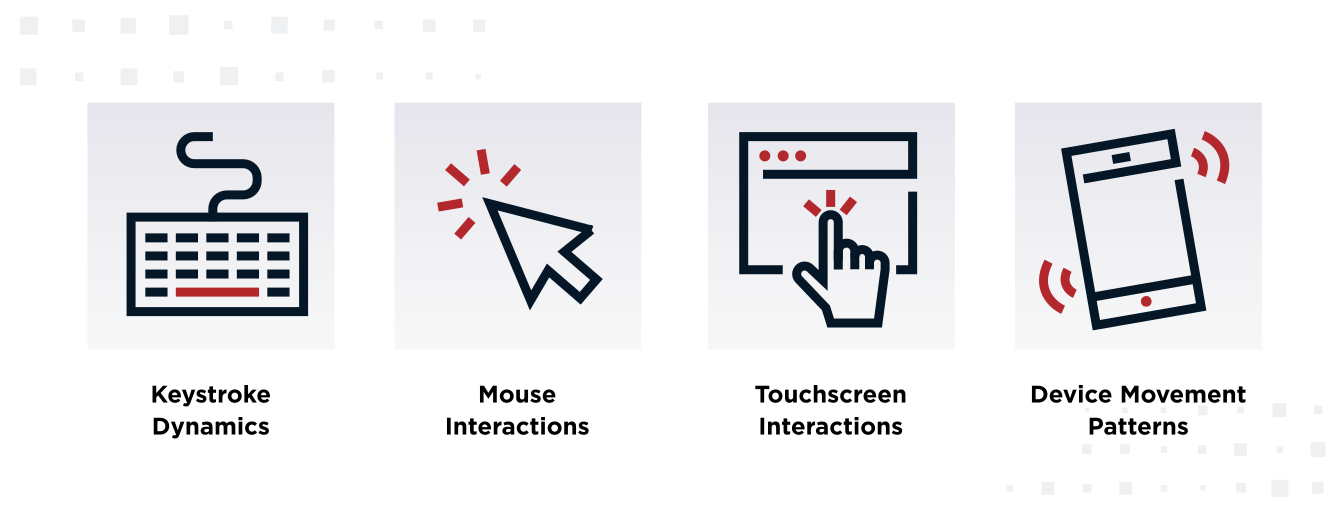
Infographic titled Types of Behavioral Biometrics illustrating four distinct categories of behavioral metrics

This technology encompasses several signal types, each capturing a different dimension of how users interact with their devices.


Keystroke Dynamics

Measuring typing speed, rhythm, dwell time (how long a key is held), and flight time (the gap between keystrokes) creates a unique profile. This method can identify bots by detecting typing patterns that are too uniform or too rapid compared to typical human capabilities.


Mouse Interactions

Systems track cursor speed, movement fluidity, scroll patterns, and click pressure. Each user has distinctive mouse habits. Unnaturally straight movements or robotic patterns often signal bot activity or remote access tools.


Touchscreen Interactions

Swipe speed, pressure, screen area used, and gesture patterns indicate traits like dominant hand and grip style. Sudden shifts—such as a left-side scroller suddenly using the right side—can trigger security alerts.


Device Movement Patterns

Gyroscope and accelerometer data reveal how a user holds and moves their device. Tilt angle, walking gait while holding a phone, and positional habits form a unique profile that helps verify identity.


Location & IP Address

Users tend to access accounts from consistent locations and IP addresses. Logins from unexpected regions, or IP addresses that conflict with a stated location, can indicate a compromised account or cyberattack. This is especially useful for remote access scenarios in professional and financial contexts.

Behavioral Biometrics Use Cases

These systems are often deployed to help reduce online fraud by detecting abnormal activity patterns that point to automation, impersonation, or account compromise.


Account Opening Fraud Prevention

Fraudsters use synthetic or stolen identities to open fraudulent accounts. Systems can detect nonhuman behavior during registration, such as unnatural typing cadence or robotic form navigation. Even for first-time users, the system identifies patterns statistically associated with fraudulent activity to stop new account fraud.


Account Takeover Protection

Attackers who steal credentials still cannot replicate a user's established patterns. Continuous monitoring after login can flag anomalies like unfamiliar mouse behavior or sudden device changes, providing robust account takeover protection.


Social Engineering & Scam Detection

In social engineering attacks, the legitimate user performs the transaction under coercion. Traditional tools miss this because the device and credentials check out. Behavioral analysis can surface indicators like hesitation, segmented typing, repeated corrections, or unusual session length that suggest the user is being guided by someone else.


High-Risk & High-Value Transactions

For sensitive operations like large money transfers, behavioral signals can serve as a step-up verification trigger. If actions deviate from the baseline, the system requires additional authentication before processing the request.

Benefits of Behavioral Biometrics

Behavioral biometrics deliver meaningful advantages across security, user experience (UX), and operational efficiency. Here's what makes them such a valuable addition to your identity and access management (IAM) strategy.


  • Frictionless UX: Operates passively in the background with no extra steps or passwords to remember.
  • Continuous Authentication: Verifies identity throughout an entire session to catch threats that slip past initial login.
  • Adaptive Security: Adjusts to evolving user behavior over time, making it nearly impossible for attackers to replicate patterns accurately.
  • Stronger Fraud Detection: Identifies bots, remote access trojans, and emulators based on nonhuman signatures, including newly emerging threats.
  • Reduced False Positives: A well-tuned model distinguishes genuine users from threats with greater precision, reducing unnecessary friction.
  • Layered Defense: Works alongside physical biometrics and adaptive multi-factor authentication (MFA) to create a robust identity security posture.

Privacy & Implementation Considerations

Continuous monitoring of user activity raises legitimate privacy questions. Organizations implementing this technology should consider several key factors.


First, practice minimal data collection by gathering only the signals necessary for fraud prevention. Avoid scope creep into marketing or profiling. Apply strong encryption to all stored data, treating it with the same rigor as any sensitive personal information.


Transparency and informed consent build trust. Clearly communicate to users what data is collected, how it is used, and retention policies. Ensure alignment with applicable frameworks such as GDPR, CCPA, and industry-specific regulations.


Finally, recognize that models can produce false positives when users change devices or environments. Ongoing tuning is essential to maintain accuracy and fairness. Many of these challenges can be mitigated by selecting a purpose-built, cloud-based solution that handles infrastructure and compliance requirements. Pairing behavioral biometrics with no-code journey orchestration makes it easier to adapt policies and verification flows without redeploying code.

The Future of Behavioral Biometrics

As digital interactions multiply and AI capabilities expand on both sides of the security equation, this technology will play an increasingly central role in identity protection. Regulators in some markets are already recommending continuous authentication as a complement or alternative to traditional methods like SMS passcodes.


The trajectory is clear: static, point-in-time authentication is giving way to context-aware verification that adapts in real time. For organizations focused on building trust with their customers, behavioral analysis offers a path to security that users genuinely benefit from. When security works invisibly, building trust with your customers becomes effortless. Combining behavioral biometrics with advanced threat protection and continuous identity verification creates a layered IAM approach that keeps pace with evolving threats without sacrificing the UX.


Stop ATO. Restore Trust.

Discover the best practices for preventing account takeover attacks before they cost you millions.

Frequently Asked Questions

We hear a lot of the same questions about behavioral biometrics. Here are quick answers to the most common ones.


Traditional biometrics authenticate users with inherent physical traits like fingerprints or facial geometry. Behavioral systems analyze acquired patterns, such as typing rhythm and mouse movement, to verify identity throughout a session rather than only at login.

Keystroke dynamics is one of the most widely adopted types. It profiles users based on their unique typing speed, rhythm, and pressure patterns, making it especially effective at distinguishing humans from bots.

It supports identity verification by passively analyzing how users interact with their devices during registration, login, or transactions. If patterns deviate from the established baseline, the system can flag the session or trigger additional verification steps.

Share this Article: