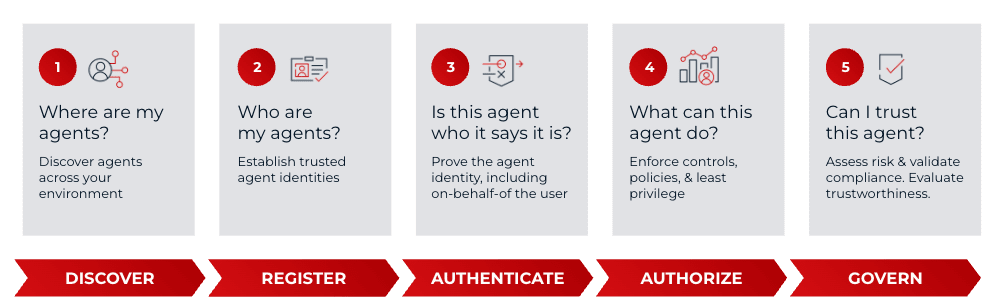
AI agents create value only when they can act. To act, they need access to data, tools, and systems. That makes identity the control point for the agentic era, and it makes the gaps in today's standards a security problem, not a theoretical one. Enterprises are already embedding agents across customer, workforce, and developer workflows faster than the standards meant to secure them can mature.
The scale is already significant. Machine identities now outnumber human identities by a wide margin in the enterprise, and AI agents are the fastest-growing part of that population. They behave differently from the machine identities that came before them.
Agents are not deterministic scripts. They reason, chain tasks, call other services, and change their plan at runtime based on what they find. A traditional service account follows a fixed path, but an agent decides its own.
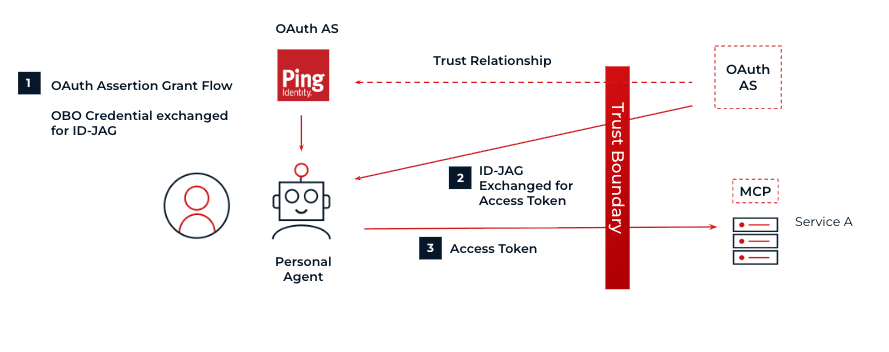
Each agent also acts on behalf of someone else, rarely representing only itself. It carries the authority of a user, a team, or the business, which raises a hard question. When an agent acts, whose authority is it using, and who is accountable for the result?
The specifications themselves are also moving targets. Multiple bodies, including the Internet Engineering Task Force (IETF), the OpenID Foundation, and the Model Context Protocol (MCP) community, are defining agent identity in parallel. Their drafts change often, and the pieces do not yet fit together cleanly.
This is not about waiting for perfection. It is about recognizing that agents are already in production. The controls have to travel with them today, not arrive with a finished specification in a few years.
Dimension | Human user | AI agent |
|---|
Speed | Comparatively slower and more deliberate. | Very fast; they can act at machine speed. |
Scale | Usually limited to a smaller number of concurrent actions. | Many agents can operate across many systems simultaneously. |
Accountability | Individuals generally have direct organizational and legal consequences for their actions. | No intrinsic legal or organizational accountability; responsibility must be assigned to owners and operators. |
Acting on behalf of others | Most often act for themselves, although delegation also occurs. | Often act on behalf of a user, business process, or upstream agent. |