Article


Identity as a Service (IDaaS)


01

What is Identity as a Service (IDaaS)?

Enterprises are embracing cloud and mobile technologies. As they do, they’re moving beyond traditional network boundaries and the capabilities of their legacy identity and access management (IAM) solutions.


Identity as a service (IDaaS) is a cloud-based subscription model for IAM, where identity and access services are rendered over the internet by a third-party provider rather than deployed on-premises. IDaaS can contain a range of services, but typically includes single sign-on (SSO), multi-factor authentication (MFA) and directory services that provide organizations with simple and cost-effective identity and access management capabilities. SSO typically uses either Security Assertion Markup Language (SAML) or OpenID Connect (OIDC).


Gartner defines IDaaS as, “a predominantly cloud-based service in a multi-tenant or dedicated and hosted delivery model that brokers core identity governance and administration (IGA), access and intelligence functions to target systems on customers' premises and in the cloud.”


Gartner states that the core aspects of IDaaS are:


  • IGA: Provisioning of users to cloud applications and password reset functionality.
  • Access: User authentication, SSO and authorization supporting federation standards such as SAML.
  • Intelligence: Identity access log monitoring and reporting.


IDaaS vs. IAM


IAM encompasses all aspects of managing identities and controlling access to digital resources, and it can be implemented on-premises or in the cloud. IDaaS, on the other hand, refers specifically to IAM capabilities delivered as a cloud service and managed by the IDaaS vendor. While many organizations operate hybrid environments with some IAM services managed locally and some cloud delivered, IDaaS is gaining in popularity for its scalability and cost-effectiveness, along with the flexibility to integrate with various cloud services and applications.


What is Identity as a Service
02

Why is IDaaS Growing in Importance?

The goal of IDaaS, as with a traditional identity and access management solution, is to determine that a user is who they claim to be and then grant access to applications once the user has been authorized. However, with current trends of a more mobile workforce and the proliferation of SaaS apps such as Salesforce.com, managing identities is much more complex and costly than it used to be.


IDaaS is the Scalable IAM Future


Identity as a service allows an organization to let a specialized third-party vendor manage the operational nuts and bolts of an identity and access management solution, saving administrative overhead for the organization because there is no longer a need to manage infrastructure, provide security, install and upgrade software, back up data, etc. IDaaS offers a scalable IAM solution that accelerates digital transformation while reducing cost and risk.


Applications of IdaaS


IDaaS has a wide range of applications that enhance security, streamline user access, and improve operational efficiency. Some of these applications include:
 

  1. Adaptive Multi-factor Authentication: IDaaS solutions use adaptive MFA to enhance security by requiring additional verification based on factors such as user behavior, location, or device. It provides a dynamic approach, adjusting authentication challenges based on the risk profile of each login attempt, reducing friction while maintaining robust protection.
  2. Single Sign-on (SSO): With SSO, IDaaS allows users to access multiple applications and services with a single set of credentials, streamlining authentication and reducing password fatigue. This enhances user experience while simplifying authentication management for IT teams by consolidating access control to a central platform.
  3. Identity Governance and Compliance: IDaaS platforms facilitate identity governance by enabling organizations to manage user access, roles, and permissions across various systems. They help ensure compliance with regulatory requirements by automating audits, tracking user activity, and enforcing policies to prevent unauthorized access.
03

What are the Types of IDaaS?

IDaaS platforms offer various capabilities to secure and manage user identities across cloud and on-premise applications. Below are the key types of IDaaS solutions:


Multi-Factor Authentication (MFA)

MFA IDaaS solutions are designed to secure user logins by requiring more than just a username and password. These platforms offer adaptive MFA that evaluates the risk of each login attempt and triggers additional authentication steps such as biometrics, one-time passcodes, or push notifications. MFA IDaaS ensures that even if a password is compromised, unauthorized access is still prevented, significantly reducing the risk of identity theft and breaches.


Single Sign-On (SSO)

SSO IDaaS solutions simplify the user authentication process by allowing users to log in once and gain access to multiple applications and systems without needing to re-enter credentials. This centralized authentication service not only improves user experience but also helps IT departments by streamlining access management and reducing the overhead of password resets. SSO enhances both security and productivity by ensuring consistent and secure access to cloud and on-premises resources.


Directory Services

Directory services in an IDaaS context provide cloud-based directory management for storing and organizing user identities and resources. These platforms act as the central hub for managing user profiles, roles, permissions, and access to various applications. Cloud directories integrate seamlessly with other identity management solutions and support scalability, enabling organizations to efficiently handle identity management across distributed environments while maintaining security and compliance standards.


Overview of IDaaS Capabilities and Configurations

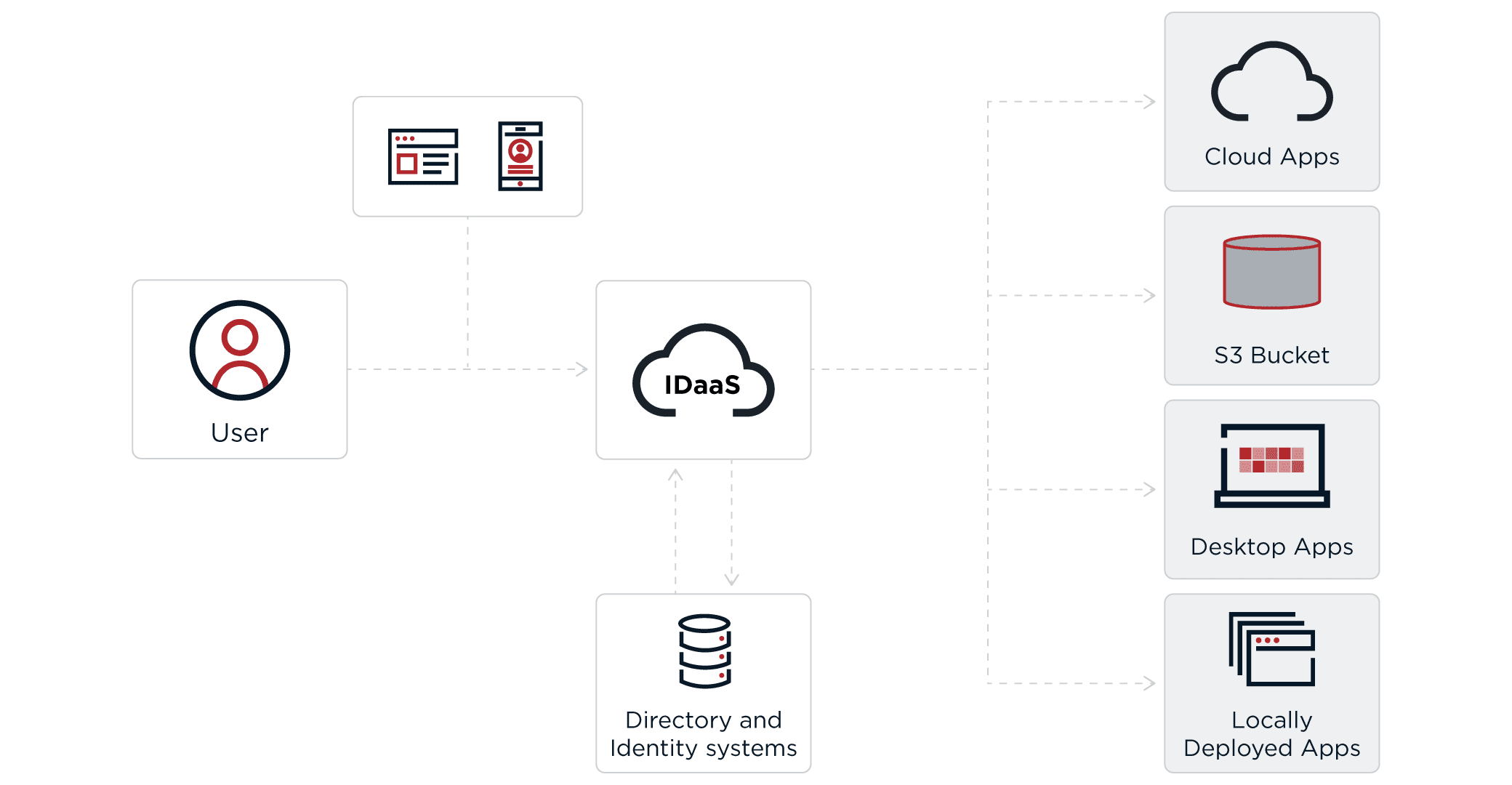
From a user's point of view, IDaaS provides similar capabilities to an on-premises deployment of identity and access management, assuming the user has access to the IDaaS cloud solution. The biggest difference is that IDaaS is hosted in the cloud by a third-party provider, which allows users to securely access their account from anywhere via different devices. This is done through a combination of single sign-on, multi-factor authentication and directory solutions.


There are many different types of IDaaS solutions. Some IDaaS providers support only one piece of the puzzle (e.g., providing only a directory) while other IDaaS providers deliver a more comprehensive suite of functionality encompassing multiple pieces of the puzzle (e.g., combined SSO, MFA and directory).


In addition to these different configurations of IDaaS solutions, different categories of IDaaS cater to different end users. Classes of end users include customers, employees and business partners.


Basic IDaaS

Basic IDaaS solutions are well-suited for small businesses or organizations that primarily use cloud-based applications and have minimal on-premises infrastructure. These solutions are lightweight, easy to implement, and cost-effective, offering essential identity management features that are ideal for companies with straightforward IT needs.


Key Features and Capabilities:


  • Cloud-Focused: Primarily designed for cloud applications, making integration with SaaS platforms (e.g., Office 365, Salesforce) seamless and straightforward.
  • Simplified User Management: Provides intuitive, user-friendly interfaces and setup wizards, enabling fast onboarding and minimal administrative overhead.
  • Basic Security: Includes simple multi-factor authentication (MFA) options like SMS, email, or mobile app-based tokens for securing user access to cloud apps.
  • Scalability: Suitable for SMBs, providing flexibility to scale as the organization grows without complex infrastructure requirements.
  • Minimal Customization: Out-of-the-box configurations and standard policies are typically enough for small businesses, with fewer customization options.


Enterprise IDaaS

Enterprise IDaaS is tailored for large organizations with complex, hybrid IT environments, where integrating on-premises systems, cloud platforms, and third-party services is crucial. These solutions offer a wide range of advanced features to support intricate access management, enhanced security, and compliance.


Key Features and Capabilities:


  • Hybrid Environment Integration: Provides seamless connections between on-premises directories (e.g., Active Directory), SaaS applications, and other enterprise systems, supporting both cloud and legacy infrastructures.
  • Advanced Security & Compliance: Includes sophisticated multi-factor authentication (MFA) methods like adaptive authentication and biometric verification, as well as robust encryption and auditing tools to meet compliance requirements.
  • Granular Access Control: Offers fine-grained access policies such as role-based (RBAC) and attribute-based (ABAC) access control, ensuring users only have access to the resources they need.
  • Customizable Workflows and Policies: Enterprise IDaaS platforms allow organizations to customize authentication flows, user provisioning processes, and access policies, offering more flexibility to meet business-specific needs.
  • Scalability and Performance: Designed to support large-scale environments, these solutions can handle millions of users, complex integrations, and global access requirements with high performance.

The connectors, bridges and integrations provided by IDaaS solutions for enterprises allow for a more comprehensive solution. This additional functionality is combined with more fine-grained administrative controls to better customize solutions to an enterprise's specific needs.

04

IDaaS Implementation Considerations


Enterprise IDaaS Requirements


Five key capabilities are required to make enterprise IDaaS solutions possible:


  1. Single Sign-on (SSO): With single sign-on, employees, partners and customers can log in just one time to gain fast and secure access to all SaaS, mobile and enterprise applications.

  2. Multi-factor Authentication (MFA): MFA typically includes adaptive authentication methods—options to step up as risk increases based on situational changes, user behavior or application sensitivity.

  3. Access Security: Access security is policy-based access management for applications and APIs to enhance security beyond SSO.

  4. Directory: While most enterprises prefer to integrate IDaaS with their existing user stores, they may use a cloud directory, especially to support customers and/or partners.

  5. Provisioning: Through SCIM support and integration with on-premises provisioning, user data is synced with web and enterprise applications.

05

API-first IDaaS for Development Teams

Another way enterprises can leverage IDaaS is through API-first developer platforms. Often used for customer identity and access management (CIAM), these platforms expose all IDaaS capabilities through APIs. This approach allows enterprises to give their development teams a common IDaaS platform that makes it easy for them to embed identity services into their applications. It’s also important to ensure these platforms can meet broader enterprise requirements across all of their applications with:


  • A focus on security and reliability.

  • Support for common identity standards (OAuth, OpenID Connect, SAML).

  • Integrations that allow for coexistence with their on-premises identity infrastructure.

  • The ability to model their existing identity architecture in the IDaaS platform.

06

What are the Benefits of IDaaS?

IDaaS helps organizations save money and time while taking advantage of specialized IT expertise. It enables users to securely and easily access needed apps on a variety of devices while on the go or at the office.


  • Reduce costs. Using a cloud-based IDaaS solution eliminates the need for equipment purchases, specialized IT staff and ongoing training, allowing your IT team to stay focused on day-to-day operations.
  • Better user experiences. Single sign-on and multi-factor authentication let users login with a single set of credentials, which reduces friction and password reset assistance.
  • Increase revenue and customer loyalty. A good first impression from a smooth login process leads to more customer interactions and sales.
  • Strengthen security. Outsourcing your IAM solution to experts limits the ability of bad actors with compromised credentials from entering your system and stealing data.
  • Scalable to meet your needs. Cloud-based subscription services adapt easily to changing user bases, such as an influx of new customers for events and promotions.
  • Risk mitigation. Identity solutions reduce your risk of a data breach, which could cost your organization millions of dollars.
07

How do IDaaS Solutions Help Your Bottom Line?

Just about every cloud-delivered service can claim its ability to deliver business value through efficiencies and reduced infrastructure costs. These are key cloud benefits. But IDaaS can do a lot more than that.


With capabilities such as multi-factor authentication and AI-driven threat prevention, IDaaS can reduce the risk of a costly breach. With automation and self-service capabilities, it can drive down helpdesk tickets and costs.


IDaaS can even help businesses grow through faster customer acquisition and personalization that keeps customers engaged longer and reduces shopping cart abandonment. Consumers are increasingly concerned about the security and privacy of their data, and sophisticated IDaaS capabilities can provide the assurances that build loyalty and increase customer lifetime value.


Start Today

See how Ping can help you deliver secure employee, partner, and customer experiences in a rapidly evolving digital world.