The Benefits and Limitations of a Multi-cloud Strategy

Sep 29, 2022
-minute read

Introduction

How many cloud providers does your business work with? If it’s more than one, then you’re in good company. Today, 89% of companies have embraced a multi-cloud strategy, according to the Flexera 2022 State of the Cloud Report.


Opting for a multi-cloud approach brings undeniable benefits, giving companies the flexibility to optimize performance, avoid vendor lock-in, and use best-in-class solutions. But the decision to move beyond a single cloud provider also brings challenges and complexity—especially when it comes to security, data protection, and identity management. 


In this article, we’ll explore exactly what it means to have a multi-cloud strategy, how multi-cloud works, and how the right approach to identity management can help you overcome the challenges and maximize the benefits of a multi-cloud approach. 

What Is Multi-cloud?

Multi-cloud is the use of cloud computing services from more than one cloud vendor. It can be as simple as using multiple software-as-a-service (SaaS) solutions from different providers, like ServiceNow or Salesforce. 


For most enterprises, though, multi-cloud means running platform-as-a-service (PaaS) or infrastructure-as-a-service (IaaS) solutions from multiple cloud service providers, such as Amazon Web Services (AWS), Microsoft Azure, and Google Cloud Platform (GCP).


A multi-cloud solution is a cloud computing solution where you can deploy applications and services across multiple cloud infrastructures in a vendor-agnostic manner. Multi-cloud solutions are usually built on open-source, cloud-native technologies such as Kubernetes, which allow you to run workloads on any cloud without getting locked into a specific platform.

How does Multi-cloud Work?

Organizations that opt for a multi-cloud architecture can use any combination of public clouds together with private cloud deployments and traditional on-premises infrastructure—and these environments don’t necessarily need to be integrated.


With a multi-cloud strategy, organizations get to choose their preferred services from each cloud provider based on costs, technical requirements, geographic availability, and other factors. For example, a company could use GCP for development/test environments, AWS for disaster recovery, and Microsoft Azure for business intelligence workloads.


Multi-cloud vs. Hybrid Cloud: What’s the Difference?

Multi-cloud sometimes gets confused with hybrid cloud, but there are key differences between the two. A hybrid cloud approach uses a combination of public cloud, private cloud, and/or on-premises platforms, with some form of integration or orchestration between these environments. 


In contrast, multi-cloud involves deploying systems on cloud platforms sourced from multiple different providers. It doesn’t necessarily require coordinated operations or integration between different cloud environments.

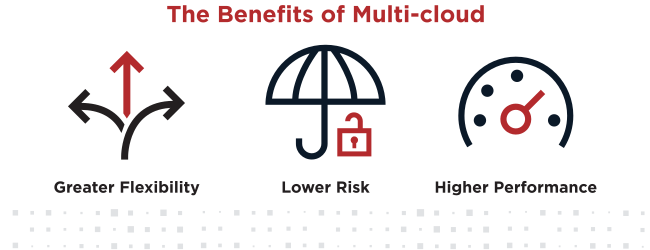
What Are the Benefits of Multi-cloud?

A multi-cloud strategy has many advantages for enterprises, including:


Greater Flexibility

A multi-cloud strategy gives companies the freedom to choose where and how to deploy workloads. This helps prevent vendor lock-in–that is, increased risk or unnecessary costs that can result from using only one vendor. It also means that you aren’t limited to the offerings or functionality that a single cloud provider offers at a given time. Instead, you can pick exactly the services you want from different vendors, based on your specific pricing, performance, security, and compliance requirements.


Lower Risk

Multi-cloud deployments enhance business continuity and data availability by being less susceptible to distributed denial-of-service (DDoS) attacks and single point of failure (SPoF) incidents. Many enterprises also use distributed and redundant deployment across multiple clouds to allow for seamless failover and disaster recovery. By spreading your workloads across multiple clouds, it means that if there’s an outage on one cloud, you can avoid the risk of key applications and data becoming unavailable. 


Higher Performance

Another clear benefit of a multi-cloud strategy is the ability to geographically distribute apps and services. Organizations can minimize latency and other performance issues by choosing a cloud provider with data centers that are geographically close to their business users or customers.


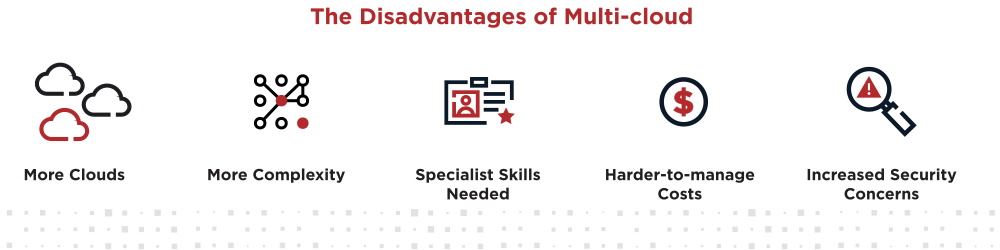
What Are the Disadvantages of Multi-cloud?

Despite the many benefits that multi-cloud can bring to a business, this approach isn’t without its challenges, especially from an identity management perspective. Potential problems include:


More Clouds, More Complexity

The decision to expand from a single provider naturally brings increased complexity. It’s hard enough to manage access to applications and environments safely and consistently when everything is running on a single cloud platform. Doing it across two or three providers adds to the challenge.


Multiple Specialist Skilled Teams Needed

Because multi-cloud deployments are more complex, you’ll need a highly skilled team to design, implement, and manage them. Additionally, using multiple cloud vendors requires using duplicate teams with specialist skills across these vendors. Given the ongoing IT skills shortage, hiring and retaining experts with the required level of cloud security expertise can be a tough challenge.


Harder-to-manage Costs

Cutting costs is a big reason why many companies choose to move to the cloud in the first place—but without careful planning and management, multi-cloud can end up being a costly endeavor. Flexible charging models can make it difficult to predict costs, especially if you don’t have a good handle on which users will be accessing which systems and resources. 


Increased Security Concerns

It’s much more difficult to protect data and enforce access control policies across a multi-cloud architecture, which opens up a wider range of security vulnerabilities. Without a rigorous, centralized approach to identity management, governance and security, organizations open themselves up to a higher risk of data protection issues and security breaches. 

 

Managing Identity in a Multi-cloud World

A multi-cloud strategy has many advantages, but it undoubtedly adds an extra layer of complexity to operations. As companies move more workloads to the cloud and spread them across platforms from multiple providers, they must also ensure that their identity and access management framework evolves in lockstep. 


To secure diverse environments, applications, and users, businesses need an identity platform that’s made for a world where multi-cloud is the norm. And that’s exactly what the PingOne Cloud Platform offers. It delivers a comprehensive set of cloud identity and access management services that empower you to provide single sign-on (SSO) for all your users across all your applications, regardless of which cloud they are running on. 


Moreover, PingOne makes it easy to orchestrate multi-cloud services into coherent, user-friendly journeys, so you can give your employees and customers friction-free user journeys without compromising on security. You can easily integrate best-in-class identity services from Ping and other vendors into your multi-cloud login flows, without interdependency constraints or vendor lock-in. 


The PingOne Cloud Platform is the key to being efficient and secure from the start in the cloud. Visit our product page to find out more about how it can help you optimize authentication in your multi-cloud environment for greater productivity, agility, and peace of mind.

Share this Article:
Related Resources

Start Today

See how Ping can help you deliver secure employee, partner, and customer experiences in a rapidly evolving digital world.