Eyebrow Text
EBOOK
Title
Identity for Insurance: 3 Steps to Building Verified Trust
Subtitle
Securing access across customer, workforce, third-party, and agentic AI insurance journeys
title
Table of Contents
theme
default

Why Verified Trust Matters for Insurance Identity

Insurance is moving from a policy-and-claims model to a trusted, data-rich, prevention-led ecosystem model. Insurers must now deliver secure, seamless digital engagement across quote, bind, onboarding, servicing, claims, renewal, account recovery, broker access, partner collaboration, and artificial intelligence-assisted workflows. That shift is happening as global insurance premium growth is expected to slow to 2.3% in real terms in 2026, down from 5.2% just two years prior.¹ Customer experience is also a strategic gap: only 5% of life insurers globally deliver best-in-class customer experience, and those leaders achieve 38% higher net promoter score, 11% lower expense ratios, and 6% higher growth.²

Verified Trust is the strategic response. By using identity as the connective control layer, insurers can bring together authentication, fraud signals, identity verification, authorization, governance, consent, risk, and audit evidence across the moments where insurance value and risk actually materialize. It’s not just about stronger login. It is runtime identity: identity operating in the flow of every customer, employee, broker, agent, partner, contractor, administrator, and artificial intelligence-agent journey.

centered
false
heading
body
Read the full GEICO customer story at https://www.pingidentity.com/en/customer-stories/3966-geico.html
heading
stat-1-value
2.3%
stat-1-description
Total global insurance premium growth expected in 2026, down from 5.2% just two years prior.
stat-2-value
5%
stat-2-description
Life insurers globally delivering a best-in-class customer experience.
stat-3-value
70%
stat-3-description
Expected underwriting artificial intelligence adoption within three years, up from 14% today.³

1. Solidify Trust Across Insurance Customer Journeys

Insurance customer identity is no longer just a registration and login function. It is becoming a revenue, risk, and experience layer across the full policyholder lifecycle. Customers expect insurance to be easier to buy, access, use, claim, and trust, but many insurers still operate across fragmented product lines, legacy cores, acquired systems, regional identity stores, call centers, broker channels, and product-specific portals. The result is repeated registration, duplicated verification, separate credentials, avoidable step-up friction, weak self-service adoption, and abandoned journeys.

Implementing Verified Trust helps insurers create adaptive customer access across quote, bind, onboarding, servicing, claims, renewal, and recovery. Low-risk journeys can move faster, while high-risk moments such as account recovery, beneficiary changes, payment updates, claims submission, payout authorization, or call center support can trigger stronger verification, privacy-preserving zero-knowledge biometrics, and policy-based authorization. Verified credentials can also help reduce repeated proofing by allowing trusted identity attributes to be issued, reused, and revoked under policy.
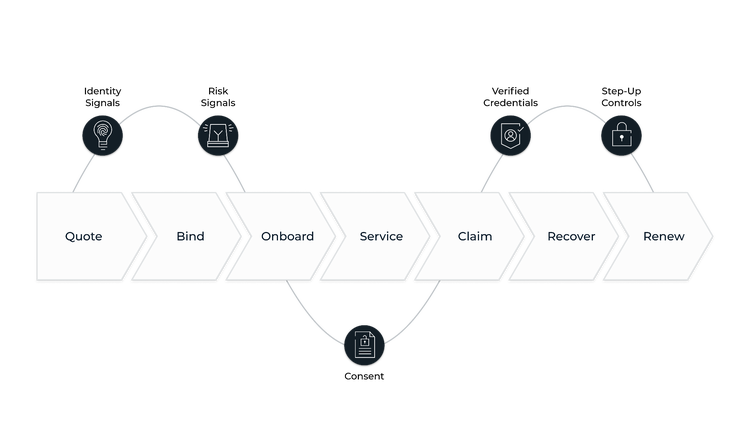
Linear chevron flowchart outlining the seven stages of the insurance customer journey from left to right: Quote, Bind, Onboard, Service, Claim, Recover, and Renew. A thin, undulating line weaves above and below the chevron path, anchoring security and trust icons at key transition points.

Key Identity Capabilities for Insurance Customer Journeys

card-1-image
card-1-title
Adaptive Customer Authentication
card-1-hide-accent-bar
true
card-1-subtitle
card-1-body
Apply the right level of friction based on device, behavior, location, session, risk, journey stage, and action value.
card-2-image
card-2-title
Identity Verification and Reusable Assurance
card-2-hide-accent-bar
true
card-2-subtitle
card-2-body
Verify customers during onboarding, recovery, claims, or high-risk servicing moments, then reuse trusted identity evidence where appropriate.
card-1-image
card-1-title
Zero-knowledge Biometric Assurance
card-1-hide-accent-bar
true
card-1-subtitle
card-1-body
Strengthen high-risk moments with privacy-preserving biometric assurance that helps confirm the genuine customer is present without relying only on passwords, one-time passcodes, or device possession.
card-2-image
card-2-title
Verified Credentials
card-2-hide-accent-bar
true
card-2-subtitle
card-2-body
Enable reusable, customer-centric proofing across products, channels, and wallet-based journeys, reducing repeated verification across quote, bind, claims, recovery, and service.
card-1-image
card-1-title
Consent-aware Orchestration
card-1-hide-accent-bar
true
card-1-subtitle
card-1-body
Connect identity, consent, profile, risk, and journey logic so customers can move across products and channels without unnecessary re-registration or re-keying.
card-2-image
card-2-title
card-2-hide-accent-bar
true
card-2-subtitle
card-2-body

2. Secure Workforce, Broker, Agent, and Partner Access at Runtime

Insurance is a multi-party business. Every carrier depends on employees, claims handlers, underwriters, contractors, brokers, agents, third-party administrators, managing general agents, employers, providers, repair networks, vendors, reinsurers, auditors, and service partners. Each needs the right access for a specific role, relationship, authority, risk profile, and lifecycle. Static roles, broad entitlements, manual provisioning, periodic certification, and fragmented partner portals make that difficult to govern at scale.

Implementing Verified Trust helps insurers secure workforce and ecosystem access at runtime. A claims handler accessing sensitive claims data may require stronger assurance than an employee opening a low-risk application. A contractor should receive access for the right duration and purpose, then be deprovisioned cleanly. A broker should be able to quote, bind, and service only within the right agency hierarchy and delegated authority. A privileged administrator should not hold standing access indefinitely. Identity must respond in the flow of work as device posture, network context, application risk, user privilege, and action sensitivity change.
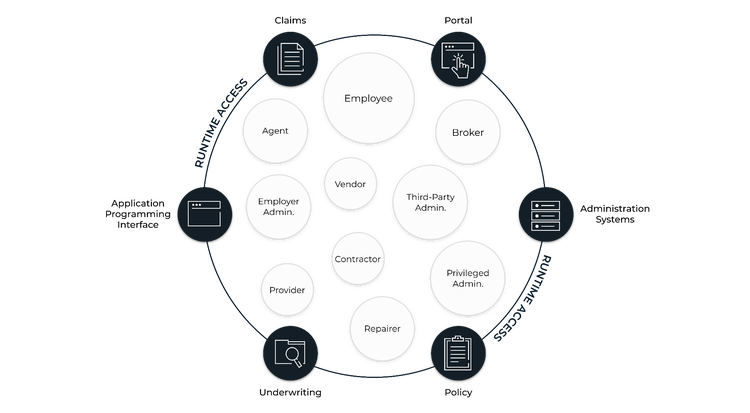
Circular ecosystem diagram showing diverse identities that require secure runtime access. Circles represent different personas: Employee, Agent, Broker, Employer Admin, Third-Party Admin, Privileged Admin, Vendor, Contractor, Provider, and Repairer. The outer ring features the text "Runtime Access" alongside security and system icons representing digital interfaces, documents, and infrastructure.

Key Identity Capabilities for Insurance Ecosystem Access

card-1-image
card-1-title
Workforce Access Management
card-1-hide-accent-bar
true
card-1-subtitle
card-1-body
Secure employees, claims handlers, underwriters, support teams, contractors, and administrators with adaptive access, phishing-resistant authentication, and consistent policy.
card-2-image
card-2-title
Broker And Agent Identity
card-2-hide-accent-bar
true
card-2-subtitle
card-2-body
Support fast, secure access for producer portals, quote and bind workflows, agency hierarchy management, delegated administration, and servicing journeys.
card-1-image
card-1-title
Third-Party Lifecycle Governance
card-1-hide-accent-bar
true
card-1-subtitle
card-1-body
Automate onboarding, changes, access reviews, certification, and deprovisioning for third-party administrators, managing general agents, employers, providers, repair networks, vendors, and outsourced teams.
card-2-image
card-2-title
Runtime Authorization
card-2-hide-accent-bar
true
card-2-subtitle
card-2-body
Enforce access based on user, role, relationship, agency hierarchy, delegated authority, claim, policy, customer, jurisdiction, risk, and action.
card-1-image
card-1-title
Just-In-Time Privileged Access
card-1-hide-accent-bar
true
card-1-subtitle
card-1-body
Replace standing privilege with time-bound, policy-governed access that requires step-up, approval, and audit evidence for sensitive administrative actions.
card-2-image
card-2-title
card-2-hide-accent-bar
true
card-2-subtitle
card-2-body

3. Govern Agentic AI & Headless Identity in Insurance

Agentic AI is becoming the next identity challenge in insurance. AI agents are beginning to retrieve policy data, assist with underwriting, triage claims, summarize customer interactions, support fraud investigation, recommend next-best actions, and coordinate workflows across employees, brokers, partners, and customers. Underwriting AI adoption is expected to rise from 14% today to 70% within three years, but scaling remains difficult, with secondary reporting on Boston Consulting Group's study citing only 7% of carriers successfully scaling artificial intelligence initiatives beyond pilots.⁴

These digital actors cannot be treated as ordinary service accounts or hidden extensions of human users. They need their own identity, authority, lifecycle, scope, monitoring, provenance, and auditability. Headless identity enables this by making identity capabilities available through applications, application programming interfaces, developer workflows, automation, and artificial intelligence agents. Implementing Verified Trust gives insurers a foundation for governing this model with delegation over impersonation, least privilege, human-in-the-loop controls, continuous monitoring, and evidence for every autonomous action.
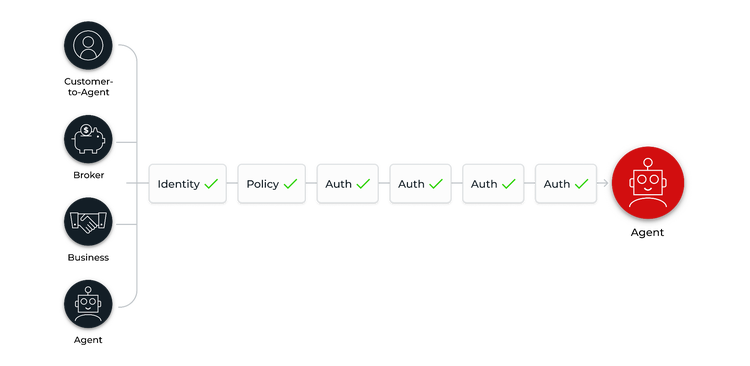
Process flow diagram showing multiple input identities passing through a verification chain of Identity, Policy, and four Auth stages to securely govern a final Agentic AI robot identity.

Key Identity Capabilities for Insurance Ecosystem Access

card-1-image
card-1-title
Agent Identity and Lifecycle Governance
card-1-hide-accent-bar
true
card-1-subtitle
card-1-body
Issue, manage, monitor, review, and retire artificial intelligence agents as governed identities, with clear ownership, approved access, policy controls, and auditability across every autonomous workflow.
card-2-image
card-2-title
Delegation Over Impersonation
card-2-hide-accent-bar
true
card-2-subtitle
card-2-body
Enable artificial intelligence agents to act with clear delegated authority on behalf of customers, brokers, employees, or institutions, while keeping human approval in the path for sensitive or high-risk actions.
card-1-image
card-1-title
Least Privilege and Scoped Access
card-1-hide-accent-bar
true
card-1-subtitle
card-1-body
Limit agent access by task, duration, data type, policy, claim, channel, customer consent, and business purpose.
card-2-image
card-2-title
High-Risk Action Governance
card-2-hide-accent-bar
true
card-2-subtitle
card-2-body
Apply stronger authorization to high-impact insurance actions such as claims payout, beneficiary change, account recovery, underwriting decisions, or cross-border data access.
card-1-image
card-1-title
Evidence and Non-Repudiation
card-1-hide-accent-bar
true
card-1-subtitle
card-1-body
Record the agent identity, owner, principal, policy decision, action, data access, approval, and outcome so every autonomous workflow can be traced, explained, and audited after execution.
card-2-image
card-2-title
card-2-hide-accent-bar
true
card-2-subtitle
card-2-body

Insurance Identity in Action

Leading insurers use Ping Identity to secure customer, workforce, broker, partner, and digital ecosystem access at scale, with measurable impact across fraud reduction, agent productivity, customer experience, and identity modernization.

stat
8B+
body
Number of identities managed by Ping Identity globally.
stat
40M
body
Number of customer and workforce identities managed by Ping Identity for a major US insurer.

Why Achieving Verified Trust in Insurance is Critical

Verified Trust cannot be delivered through isolated identity tools. Insurers need a unified identity fabric that connects customer identity, workforce access, broker and partner identity, privileged access, fraud signals, identity verification, authorization, governance, consent, and artificial intelligence-agent controls without forcing every existing investment to be replaced.

By externalizing identity logic from applications and applying adaptive access where insurance risk and value materialize, a unified identity platform helps insurers standardize secure access across cloud, software as a service, hybrid, legacy, application programming interface, broker, partner, and agentic architectures while simplifying customer journeys, reducing fraud, governing third-party access, modernizing access management, and proving controls are working.
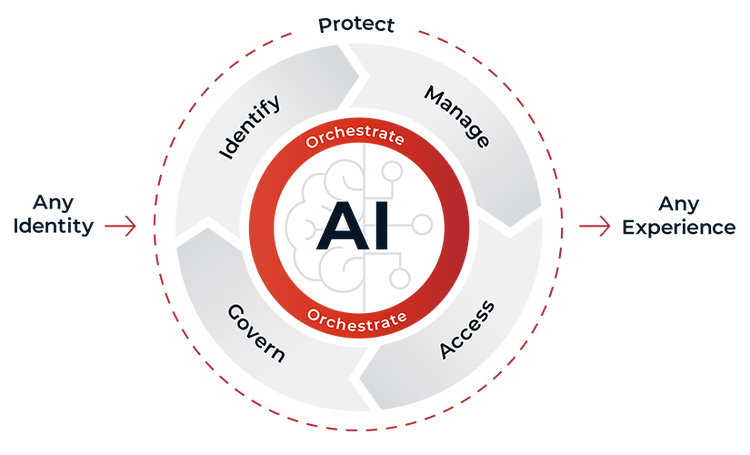
Architectural diagram illustrating Ping Identity's AI-powered identity management ecosystem.

Title
Hear from the Experts
Card Image
Card Title
Hide Accent Bar
Card Subtitle
Card Body
Card Link
Gartner®
false
Magic Quadrant™ for Access Management
Get the Report
Gartner®
false
Critical Capabilities for Access Management
Get the Report
KuppingerCole Analysts
false
From AI Agents to Trusted Digital Workers
Get the White Paper

¹ Swiss Re

² Capgemini

³ Accenture

BCG in Risk and Insurance

At Ping Identity, we make it possible to trust every digital moment across customers, employees, partners, and non-human identities. Whether you’re securing millions of users, fighting fraud, simplifying third-party access, or going passwordless, establishing trust shouldn’t slow you down. Our enterprise-grade identity platform is built for scale, speed, and flexibility and works seamlessly with your existing cloud, hybrid, and on-prem environments. We help you confidently embrace AI and automation with Runtime Identity, so you can continuously verify the identity, context, and intent of every AI agent and control their actions in real time. With Ping, all digital experiences start with trust. Learn more at pingidentity.com.

title
Ready to Build Trust Across Your Insurance Journey?
body
At Ping Identity, we make it possible to trust every digital moment across customers, employees, partners, and nonhuman identities. Whether you're securing millions of users, fighting fraud, simplifying third-party access, or going passwordless, establishing trust shouldn't slow you down.
Supporting text
Explore how Ping Identity helps insurers secure customer, workforce, partner, and AI access.
primary-link
https://www.pingidentity.com/en/company/contact-sales.html
primary-link-text
Talk to an Identity Expert
primary-link-title
Talk to an Identity Expert
use-tertiary-arrow-button-style
secondary-link
secondary-link-text
secondary-link-title
use-tertiary-arrow-button-style-2