What Is UEBA?

Mar 29, 2024
-minute read
Headshot of Maya Ogranovitch Scott Ping Identitys Solutions Architect
Senior Product & Solutions Marketing Manager
Headshot of Itai Zach Ping Identitys Senior Product Manager for PingOne Risk
Senior Product Manager, PingOne Risk

User and Entity Behavior Analytics, or UEBA, is a cybersecurity solution businesses can leverage to prevent account takeover fraud (ATO) and other types of fraudulent activity.


UEBA relies on machine learning and behavioral analytics to detect anomalies in user and device behavior that could indicate a possible security threat.

Understanding UEBA

UEBA is typically part of a company’s overall enterprise security system, using data analytics and machine learning algorithms to process large volumes of user and device behavior data.


In turn, companies can glean important insights about regular behavior patterns of privileged users and devices so it’s easier to identify and flag outliers in real time.


Comparing UEBA and UBA

UEBA is a relatively new term in the cybersecurity space and an updated version of UBA, User Behavior Analytics. 


The biggest difference between the two is that UEBA monitors entity and device behavior, like routers, Internet of Things (IoT) devices, and servers, in addition to user behavior. In other words, UEBA is more advanced than UBA and can detect more types of threats.


Comparing UEBA and NTA

Network Traffic Analysis (NTA) has a primary focus on monitoring activities within a certain network, while UEBA is concerned with specific users, devices, and applications. 


A business may implement both UEBA and NTA as a strategic and layered approach to cybersecurity for better threat detection.

Why Companies Need UEBA

Businesses across all sectors continue to face rising cybersecurity risks. In particular, organizations in retail, ecommerce, finance, and healthcare are attractive targets for cybercriminals given the vast amount of sensitive customer data and information they collect and store.


One of the most common types of fraud these companies must combat is account takeover fraud. According to one report, over a quarter of all businesses, or 26%, face attempted ATO attacks every week, and ATO attempts are up 354% year over year.


These attacks can cause a tremendous amount of damage. For example, if an unauthorized user gains access to an employee’s account, they could come into possession of sensitive customer information, confidential company data, and intellectual property. Companies face costly consequences and loss of consumer trust as a result of such attacks – in fact, an average breach using stolen credentials costs companies $4.2 million to resolve.


When cybercriminals gain access to customer accounts, the results can also cause financial and reputational damage. Although taking over a customer account will not give the criminal access to the entire organization’s data, the way an employee account can, it still opens the door to various types of fraudulent activity, such as fraudulent purchases or money transfers. These sorts of fraudulent activities can cost three to four times the value of the initial transaction to resolve. This adds up to billions of dollars in losses, with the typical organization losing 5% of revenue to fraud annually.


All in all, the threat landscape is constantly evolving. Companies must implement proactive security measures such as UEBA that can adapt to fraudsters’ increasingly sophisticated tactics to avoid potential vulnerabilities in their systems.

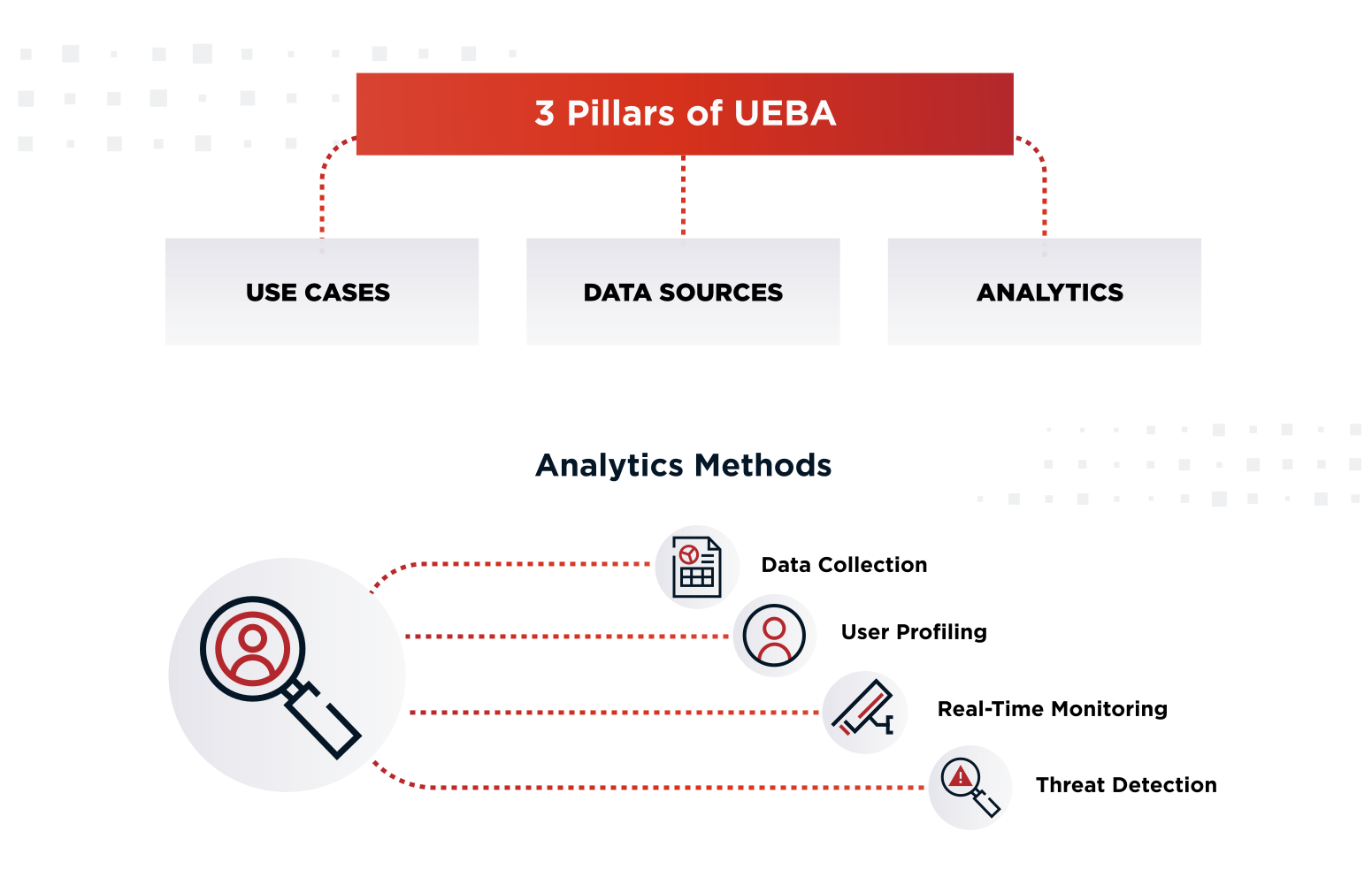
The Three Pillars of UEBA

Use Cases:

UEBA should be relevant for a multitude of fraud prevention use cases, unlike specialized systems that may only focus on trusted host monitoring, employee monitoring, or something similar. 


The key differentiator of UEBA is that it can monitor and assess threats from both user and entity behavior, making it easier for companies to identify suspicious activity and pinpoint it to a specific malicious outsider, internal bad actor, or compromised device or server.


Data Sources:

UEBA assesses diverse data feeds for a more comprehensive view of a company’s threat landscape. This means a UEBA solution can ingest and analyze data from:  


  • General data repositories
  • SIEM integration
  • Log management integration


Analytics:

A core aspect of UEBA solutions is that they use advanced data analytics and innovations like machine learning, deep learning, algorithms, and statistical models to detect anomalies that may evade traditional methods so companies can respond promptly to threats.


How UEBA Works - Analytics Methods

UEBA systems use machine learning algorithms and other analytics methods for user profiling, behavior analytics, pattern recognition, and more, all of which we’ll discuss in further detail below.


Data Collection

First, UEBA systems collect data by integrating with a number of diverse sources including logs, user activity records, and network and IP data.


It’s critical that these systems aggregate data from various channels to create a more holistic view of user and entity behavior rather than being one-dimensional with just a single data source.


User Profiling

With the large volume of data that a UEBA system collects and analyzes, it’s able to create user profiles, or baseline behavior patterns, that are typical to users. Variations from these benchmarks can be flagged as possible security threats that deserve further evaluation. 


These are not static profiles, as the machine learning component of these systems allows for more dynamic profiling that continuously adapts based on evolving behavior patterns.


Real-time Monitoring

UEBA systems work in real time, constantly analyzing new data inputs and behaviors. This enables continuous monitoring of user activities and entity behaviors, giving organizations the ability to respond promptly to threats as they arise.


Threat Detection

Anomaly detection is one of the core functionalities of UEBA systems, which works to identify deviations from established behavioral norms that may indicate a possible threat is underway.


The system can then assign a risk score depending on how severe the behavioral inconsistency is and alert the appropriate security team of the suspicious activity for a swift response.


A higher risk score will signify a greater threat, which helps an organization be more efficient with how they deploy their security resources.

UEBA Use Cases: Business Account Takeover Prevention

UEBA is a versatile cybersecurity solution that can help businesses monitor and assess many types of threats using real-time data analysis.


We’ll now walk you through some of the common use cases of UEBA in several verticals to help businesses prevent fraud attempts.


1. Securing Access to Customer Accounts

When it comes to fraud detection, UEBA is instrumental to ensuring customer accounts – and the PII and payment info they contain – remain secure.


Account takeover fraud is incredibly common in retail and ecommerce, frequently leading to unauthorized purchases with stolen credit cards. At the same time, customers are very sensitive to excess friction in ecommerce, expecting shopping to be quick and painless. UEBA can learn a customer’s behavior to allow for easy, frictionless checkout for legitimate users, adding security steps only in situations where the user behavior deviates from the norm. This helps keep customer satisfaction up and fraud down


2. Finance: Safeguarding Business and Customer Accounts

UEBA also has several use cases to help combat account takeover fraud in financial services. It can help a financial institution protect business accounts and prevent unauthorized access to sensitive customer financial data or business applications.


Regular employee behaviors and activities are recorded by the system, and discrepancies with login times, locations, devices, and systems accessed can be identified as a possible security threat.


Similarly, UEBA is useful in protecting customer acounts as well, ensuring fraudsters can’t gain access to personal accounts to make fraudulent transfers or steal sensitive financial data. When the system knows and understands a customer’s typical behavior, it can help identify situations where an account may have been compromised, stopping cybercriminals before they can cause irreparable financial damage.


3. Credential Misuse: Protecting Corporate Access

Credential misuse poses a serious security risk to organizations in every vertical  UEBA can help detect situations where corporate credentials may have been compromised, allowing for prompt intervention when a cybercriminal attempts to take over an employee account.


Imagine a situation where the credentials of an employee with privileged access are being used in multiple locations at the same time. UEBA can detect this anomaly, as well as other red flags which might include multiple login failures and unusual locations or login times. While these behaviors are concerning regardless of the account, it is possible and even recommended to put stricter policies in place for privileged accounts, adding security measures more frequently when something appears to be amiss.


4. Cross-Channel Fraud Detection

Additionally, since UEBA can integrate and assess data from various channels – for example, a website and a mobile app – it creates more comprehensive and accurate user and entity profiles for proactive threat detection.


This provides the system with contextual information about a given user or entity, offering a more accurate assessment of what types of activities may indicate a security threat, and at what severity level.


5. Unusual Access Patterns

UEBA analyzes access patterns from employees to identify compromised corporate accounts based on the large volume of data that these systems consume and process.


The system creates sophisticated profiles of baseline user and entity behavior patterns, which continuously update as new information and data points are input into the system. Any deviations from the baseline are flagged as an anomaly.


UEBA Best Practices

1. Data Completeness

Make sure you collect multiple types of data about the user to get a strong baseline of “normal” behavior and to improve detection accuracy. This includes device characteristics and settings, location information, IP address and cookie data,, and more.


2. Continuous Monitoring

Your UEBA solution should be built for real-time monitoring to promptly detect and respond to anomalous behavior when it occurs. Rather than being reactive to threats, this system allows you to quickly address possible fraud attempts and mitigate potential data loss.


3. Machine Learning Algorithms

Leverage advanced machine learning algorithms for accurate and adaptive threat detection. Fraudsters’ tactics continue to become more sophisticated with the help of the latest tech innovations, though your organization can adapt accordingly to avoid possible system vulnerabilities in return.


4. User Profiling

Create and continuously update user profiles to understand normal behavior patterns. Even as legitimate users’ and entities’ behaviors change and evolve, the UEBA system can learn and adapt for better protection.


5. Contextual Analysis

Analyze user behavior within the context of their roles, responsibilities, and typical activities. A given pattern of behavior may be deemed normal for one employee based on their unique position and responsibilities. However, the same behavior pattern may appear anomalous for another staff member within the organization who has different responsibilities and habits.


6. Customized Alert Thresholds

Set customized alert thresholds based on your organization’s risk tolerance and specific use cases. This helps your team avoid false positives and prioritize which threats to respond to for better management of your security resources.


7. Privacy Compliance

Ensure your UEBA practices align with the relevant privacy regulations and compliance requirements in your industry and jurisdiction, such as GDPR or HIPAA. Use features to protect personally identifiable information (PII) where possible without detracting from your cybersecurity measures.


8. Auto Tuning and Creating a Feedback Loop

As mentioned, UEBA is a self-learning mechanism that identifies anomalies based on historical behavior of the user or entity. In some cases, something that looks like an anomaly may actually be benign – for example, a user attempting to log in from a device which is new compared to the already learned profile. This is a great place for additional security measures, such as step-up authentication. If the user passes, the learned profile will update and will not alert again on this behavior, which is now known to be legitimate. In this way, the system continues getting smarter and more accurate over time.

In Summary

UEBA is a powerful cybersecurity solution that helps organizations detect and address possible security threats, especially with account takeover fraud. By leveraging data analytics and machine learning algorithms, UEBA performs comprehensive threat detection in real time by flagging when a user or entity’s behavior deviates from their normal baseline.


As such, businesses should consider UEBA an integral part of their cybersecurity strategy. To learn more about online fraud detection and prevention best practices, check out our Ultimate Guide to Online Fraud Prevention.

Share this Article:
Related Resources

Start Today

See how Ping can help you deliver secure employee, partner, and customer experiences in a rapidly evolving digital world.