For security and identity and access management (IAM) professionals, understanding strong authentication means understanding how to balance protection with user experience. The methods and architectures behind strong authentication continue to evolve, driven by new threat vectors, regulatory requirements, and the growing expectation that security should be nearly invisible. Let's break down what strong authentication is, how it works, and how you can put it into practice across industries and use cases.

Strong Authentication: What It Is and How It Works
Oct 27, 2024
-minute read
Last Updated: Jun 2, 2026

Key Takeaways
Strong authentication requires two or more independent verification factors and goes beyond basic multi-factor authentication (MFA) by incorporating adaptive risk signals and continuous session monitoring.
Not all MFA qualifies as strong authentication. Truly strong approaches layer adaptive, risk-based signals on top of multiple factors to verify identity continuously.
Passwordless, phishing-resistant methods (such as device-bound credentials and zero-knowledge biometrics) represent the most effective path toward strong authentication today.
Aligning your authentication strategy with frameworks like the National Institute of Standards and Technology (NIST) guidelines and the Payment Services Directive 2 Strong Customer Authentication (PSD2/SCA) requirements helps ensure compliance readiness while strengthening your overall security posture.
What Is Strong Authentication?
Strong authentication is identity verification that relies on two or more independent factors, drawn from different categories: something you know (a password or personal identification number (PIN)), something you have (a device or security key), and something you are (a biometric). It is a standard that goes well beyond simply requiring a second factor at login.
What distinguishes strong authentication from basic MFA is the depth and adaptiveness of the verification process. Strong authentication encompasses adaptive risk signals, continuous verification throughout a session, and real-time session monitoring. It treats identity as something that must be validated not just at the front door, but throughout the entire user journey.
In the context of IAM, strong authentication is a core control. It protects access to your applications, application programming interfaces (APIs), data, and infrastructure by ensuring that only verified users and identities can proceed. When implemented well, it reduces risk without adding unnecessary friction for your legitimate users.
Strong Authentication vs. Multi-Factor Authentication
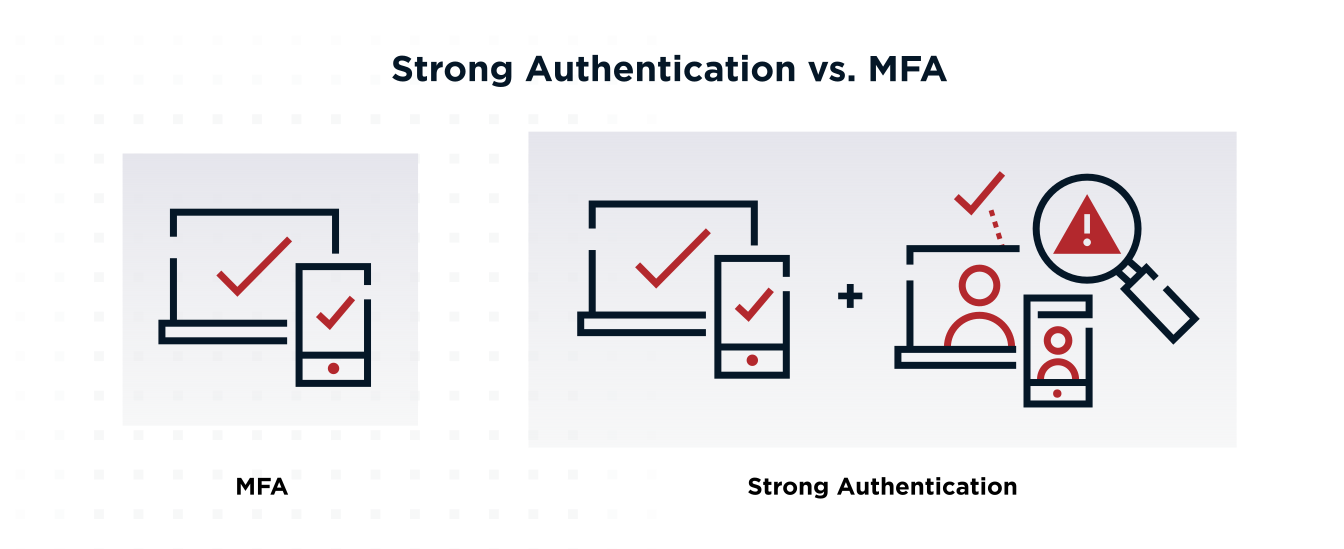
Strong authentication is not the same as MFA, though the two are closely related. MFA is one approach to achieving strong authentication, but not every MFA implementation meets the bar. A system that pairs a password with a basic short message service (SMS) code, for example, uses multiple factors but remains vulnerable to phishing, subscriber identity module (SIM) swapping, and interception attacks.
Strong authentication raises the standard by requiring factors that are resistant to common attack vectors. It also incorporates contextual and adaptive signals (such as device posture, location, and behavioral patterns) to make real-time trust decisions. The table below highlights the key differences.
Criteria | Basic MFA | Strong Authentication |
|---|---|---|
Number of factors | Two or more | Two or more |
Phishing resistance | Not guaranteed | Required (device-bound or biometric factors) |
Adaptive risk signals | Typically absent | Integrated (location, device, behavior) |
Continuous verification | Point-in-time only | Ongoing throughout the session |
Resistance to credential theft | Varies widely | High (passwordless, hardware-bound) |
Compliance alignment | May meet minimum requirements | Designed to satisfy NIST, PSD2/SCA, and similar frameworks |
Types of Strong Authentication Methods
Strong authentication can be achieved through a range of methods, each offering different strengths depending on the use case, risk level, and user population. Understanding these options helps you choose the right combination for your environment. The following are the most widely adopted approaches.
Adaptive MFA and risk-based authentication
Adaptive MFA evaluates contextual signals (such as device type, network, geolocation, and behavioral patterns) in real time to determine the appropriate level of verification. If a login attempt looks routine, the user may pass through with minimal friction. If something looks unusual, the system can step up to stronger verification automatically.
This approach moves authentication from a static, one-size-fits-all checkpoint to a dynamic, risk-aware decision. It reduces friction for trusted users while increasing protection when risk indicators are present.
Biometric authentication
Biometric authentication uses a physical characteristic (such as a fingerprint, facial scan, or voice pattern) to verify identity. When combined with privacy-preserving design, it becomes one of the strongest factors available. zero-knowledge biometrics take this further by re-verifying the person originally onboarded without storing raw biometric data, making the process both secure and privacy-respecting.
Biometric factors are inherently tied to the individual, which makes them resistant to credential sharing and remote attacks. They also support a seamless user experience, completing verification in milliseconds without requiring the user to remember or type anything.
Hardware security keys & FIDO2
Hardware security keys are physical devices (such as Universal Serial Bus (USB) or near-field communication (NFC) tokens) that use public-key cryptography to authenticate users. The Fast Identity Online 2 (FIDO2) standard, developed by the FIDO Alliance, enables passwordless, phishing-resistant authentication by binding credentials to a specific device.2 Even if a user is tricked into visiting a fake site, the key will not respond to an illegitimate challenge.
These keys are widely recognized as one of the strongest authentication factors available today, and NIST 800-63 rates them at the highest authenticator assurance level. They are especially well suited for high-risk environments and privileged access scenarios.
Passwordless authentication
Passwordless authentication replaces fragile passwords with device-bound credentials, biometrics, or cryptographic keys. Because there is no password to steal, phish, or reuse, this method eliminates entire categories of attack. It also removes the burden of password management from users and Helpdesk teams alike.
Truly passwordless approaches are phishing-resistant by design. They bind credentials to a specific device or identity, ensuring that authentication cannot be intercepted or replayed by an attacker.
Push notifications & authenticator apps
Push-based authentication sends a verification prompt to a registered mobile device, asking the user to approve or deny a login attempt. Authenticator apps generate time-based codes or display approval requests, providing a second factor that is more secure than SMS-based codes.
While push notifications improve usability and reduce reliance on passwords, they should be paired with additional protections (such as number matching or contextual prompts) to guard against prompt-bombing attacks where an attacker floods the user with approval requests.
One-time passcodes (OTP)
One-time passcodes (OTPs) are temporary codes delivered via SMS, email, or an authenticator app. They provide a second layer of verification beyond a password. OTPs are widely supported and familiar to most users, making them a practical starting point for organizations building toward stronger authentication.
However, SMS-based OTPs are vulnerable to interception and SIM swapping attacks. For stronger protection, organizations should prefer app-generated OTPs or move toward passwordless and biometric methods as their authentication strategy matures.
How Strong Authentication Works
A typical strong authentication flow combines multiple verification steps, evaluated in real time, to determine whether a user should be granted access. Here is how a modern flow works in practice.
First, the user initiates access by navigating to an application or resource. The authentication system evaluates contextual signals: the device being used, its location, the network, and behavioral patterns. Based on this initial risk assessment, the system determines which factors to require.
If the risk score is low (for example, a recognized device on a trusted network), the user may authenticate with a single step, such as a biometric scan or a device-bound credential. If the risk score is elevated, the system steps up to additional factors: a push notification, a hardware security key challenge, or a one-time passcode. Throughout the session, continuous verification monitors for anomalies, re-evaluating trust as conditions change.
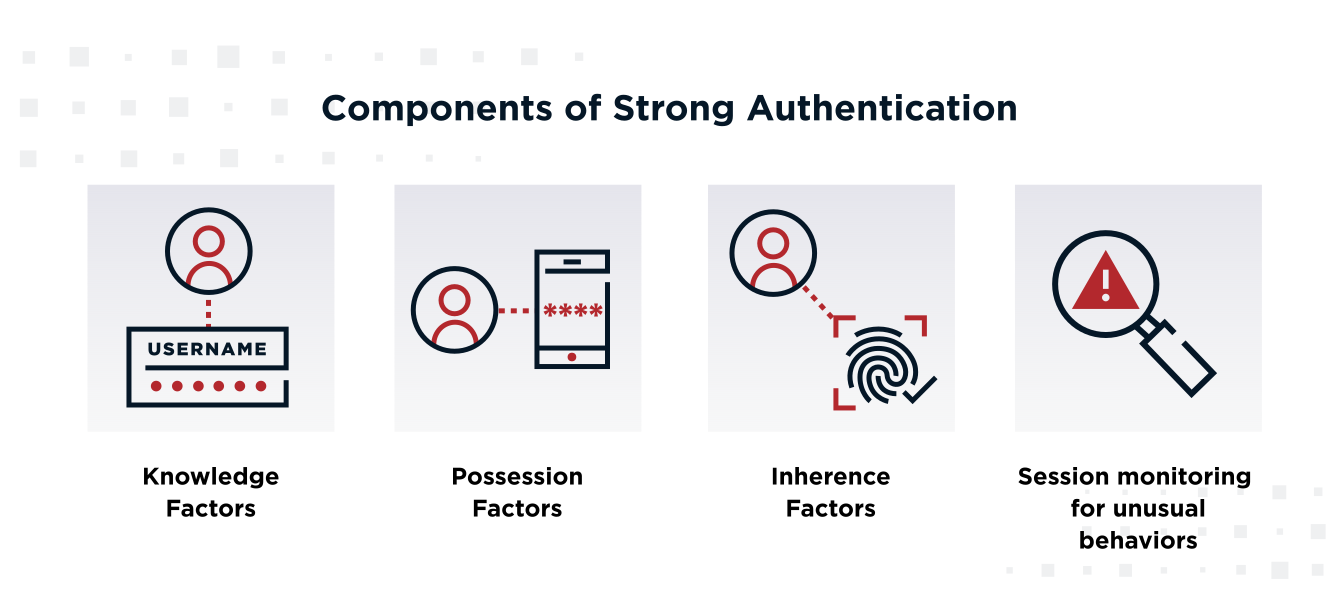
This layered, adaptive approach ensures that strong authentication is not a single gate but an ongoing process. Trust is earned, verified, and re-verified at every step.
Benefits of Strong Authentication
Implementing strong authentication delivers measurable outcomes across security, compliance, and user experience. Here are the primary benefits.
Stronger security posture. By requiring multiple independent factors and incorporating adaptive risk signals, strong authentication dramatically reduces the likelihood of unauthorized access. It neutralizes common attack vectors like credential stuffing, phishing, and session hijacking. According to the Verizon Data Breach Investigations Report, strong authentication directly addresses the most common breach vector: stolen credentials, which played a role in twenty-two percent of all confirmed breaches.1
Compliance readiness. Regulatory frameworks including NIST 800-63, PSD2/SCA, and HIPAA increasingly require or recommend strong authentication. Adopting these practices positions your organization to meet current and emerging requirements without scrambling to retrofit controls.
Better user experience. When done right, strong authentication reduces friction rather than adding it. Adaptive approaches let low-risk users move quickly, while stepping up verification only when warranted. Passwordless methods eliminate the frustration of forgotten credentials and password resets.
Fraud prevention. Continuous verification and real-time risk assessment catch anomalies that point-in-time authentication would miss. This is especially valuable in consumer-facing scenarios like account opening, high-value transactions, and account recovery.
Strong Authentication Best Practices
Putting strong authentication into practice requires more than just enabling additional factors. Based on what we see across our customer base, these five best practices will help you build a strategy that is effective, scalable, and aligned with modern threats. Each one addresses a specific gap that organizations commonly encounter when strengthening their authentication posture.
Implement adaptive MFA with risk signals
Rather than applying the same verification requirements to every user and every session, use adaptive MFA to evaluate risk in real time. Incorporate signals like device posture, geolocation, login velocity, and behavioral analytics. This lets you step up authentication when risk is elevated and reduce friction when conditions are trusted.
Move toward passwordless authentication
Passwords remain the weakest link in most authentication chains. Prioritize phishing-resistant, passwordless methods that bind credentials to a specific device or identity. This eliminates the largest category of credential-based attacks and reduces the operational cost of password resets and helpdesk calls.
Layer biometric verification for high-risk actions
For sensitive operations (account changes, high-value transactions, privilege escalation), layer in biometric verification as an additional factor. Privacy-preserving biometrics, such as zero-knowledge biometrics, verify that the person performing the action is the same person who was originally onboarded, without storing raw biometric data.
Monitor sessions continuously
Authentication should not stop at login. Implement continuous session monitoring that evaluates risk signals throughout the user's interaction. If device context changes, if behavior deviates from established patterns, or if a session token is reused from an unexpected location, your system should respond by stepping up verification or terminating the session.
Align with compliance frameworks
Map your authentication controls to the frameworks that govern your industry. NIST 800-63 provides clear authentication assurance levels.3 PSD2/SCA defines requirements for strong customer authentication in financial services. Aligning to these standards ensures your approach meets regulatory expectations and provides a structured path for continuous improvement.
Strong Authentication Use Cases by Industry
Strong authentication applies across every industry, but the specific requirements and priorities vary. The regulatory landscape, risk profile, and user expectations differ significantly from one sector to another. Here is how organizations in four key sectors put it into practice.
Financial services
Banks and financial institutions face strict regulatory requirements (PSD2/SCA, the Federal Financial Institutions Examination Council (FFIEC)) alongside constant fraud threats. Strong authentication protects customer accounts, secures high-value transactions, and supports compliance with strong customer authentication mandates. Adaptive MFA and biometric step-up verification are especially critical for account opening and transaction authorization.
Healthcare
Healthcare organizations must protect sensitive patient data under regulations like the Health Insurance Portability and Accountability Act (HIPAA) while ensuring that clinicians can access records quickly in time-sensitive situations. Strong authentication balances security with speed, using adaptive approaches that minimize friction for trusted users on recognized devices while stepping up for remote or unusual access attempts.
Enterprise & workforce
For enterprise IT and workforce scenarios, strong authentication protects access to internal applications, cloud services, and privileged systems. Passwordless authentication reduces Helpdesk costs and eliminates password fatigue. Continuous session monitoring ensures that trust is maintained throughout the workday, not just at login. Pairing strong authentication with single sign-on further streamlines access across the application portfolio.
Government
Government agencies must meet some of the most stringent authentication standards, including NIST 800-63 and Zero Trust architecture mandates. Strong authentication supports compliance with these frameworks while securing access for employees, contractors, and citizens across distributed environments. Hardware security keys and phishing-resistant credentials are widely adopted in this sector.
Strengthen Security & User Experience with Adaptive MFA
Strong authentication does not have to mean more friction. With adaptive MFA, you can protect every digital interaction while delivering a seamless experience for your users. By layering risk signals, passwordless methods, and continuous verification, we help you build trust into every moment without slowing anyone down.
Verizon, "2025 Data Breach Investigations Report (DBIR)", 2025.
FIDO Alliance, "User Authentication Specifications Overview", 2025.
National Institute of Standards and Technology, "NIST SP 800-63 Digital Identity Guidelines", 2025.
Ready to Ditch Passwords?
Map out a passwordless strategy using these key steps.
Frequently Asked Questions
Strong authentication is a security approach that verifies a user's identity using two or more independent factors from different categories (something you know, something you have, something you are). It goes beyond basic password protection by incorporating adaptive risk signals and continuous verification. The goal is to ensure that only verified users gain access to protected resources.
Strong authentication is not the same as MFA, though MFA is one way to achieve it. Basic MFA implementations (such as a password plus an SMS code) may not meet the bar for strong authentication because they remain vulnerable to phishing and interception. Strong authentication requires phishing-resistant factors, adaptive risk assessment, and continuous session monitoring.
The strongest authentication methods combine phishing-resistant, device-bound credentials with biometric verification and adaptive risk signals. Hardware security keys (FIDO2), passwordless authentication, and zero-knowledge biometrics are widely considered among the most effective approaches available today. Layering these methods within an adaptive framework provides the highest level of assurance.
An example of strong authentication is a user logging into a banking application using a device-bound passkey (something they have) combined with a fingerprint scan (something they are), while the system evaluates contextual risk signals like device posture and location in real time. If the system detects an anomaly, it may require an additional verification step before granting access. This layered, adaptive approach is what distinguishes strong authentication from a simple password-plus-code flow.


Related Resources
Start Today
Contact Sales
See how Ping can help you deliver secure employee, partner, and customer experiences in a rapidly evolving digital world.