The Bank Fraud Landscape
The banking industry continues to face extensive risks from malicious actors seeking to perpetrate fraud through traditional methods such as bot attacks, new account fraud, and account takeover (ATO) fraud. At the same time, rapid advances in artificial intelligence (AI) and the growth of the fraud-as-a-service (FaaS) ecosystem have seen a sharp rise in more sophisticated fraud techniques, such as AI-driven impersonation attacks, deepfake fraud, and authorized push payment (APP) fraud. To make things more challenging, the fraud attack surface continues to grow as digital banking adoption increases globally, and embedded finance becomes ever more pervasive across and beyond the banking industry.
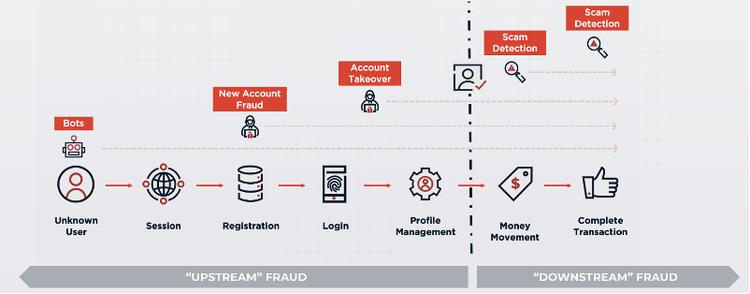
Stringent regulations and supervisory oversight in many parts of the world have forced banks to set aside financial contingencies to offset fraud losses, while putting in place safeguards to detect, respond to, and prevent fraud. Despite these efforts, fraud prevention strategies in banking remain fragmented as growing IT and identity and access management (IAM) teams focus on addressing "upstream" fraud, while fraud teams focus on tackling "downstream" fraud. More often than not, these efforts remain disjointed at strategic and operational levels, resulting in a lack of alignment and potential vulnerabilities exploited by increasingly-emboldened fraudsters.
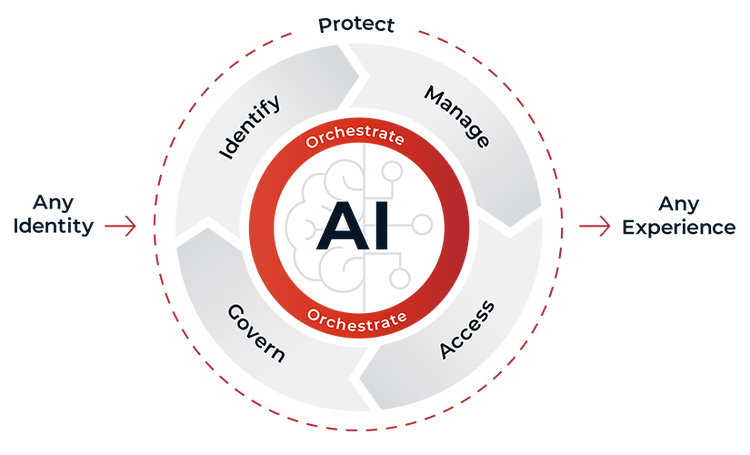
Rising consolidation, convergence, and innovation in the IAM market have, for the first time, created opportunities for banks. By bringing together multiple threat detection, access management, identity verification, verified credentials, and policy-based access control capabilities into a unified, no-code orchestration engine, banks can drive real-time access decisioning across all deployment settings, devices, and channels of interaction. A consolidated approach to bank fraud prevention enabled by the industry-leading Ping Identity Platform is within sight.
Integrate Your Fraud Prevention, Detection, and Response with Ping Identity
Ask the right questions and look for the right answers as you search for a converged customer identity and access management (CIAM) provider.
1. Strengthen "Upstream" Bank Fraud Prevention
"Upstream" bank fraud refers to fraudulent activities that occur early in the customer journey, typically during account registration, identity proofing, onboarding, and authentication. The most common fraud techniques used here include bot attacks, where automated scripts attempt to create fake accounts en masse, as well as new account fraud, where fraudsters use stolen or synthetic identities to open accounts with the intent to commit fraud. Vulnerabilities associated with weak credentials have also resulted in a global surge of ATO fraud where fraudsters gain unauthorized access to legitimate accounts and use these to gain access to customer data and assets.
These types of fraud can cause irreparable damage to customer trust and result in substantial financial losses for banks. Bot attacks not only inflate operational costs but also erode customer confidence, as legitimate users might face unnecessary friction during the account registration, identity proofing, and onboarding journey. Meanwhile, account takeover incidents often lead to direct financial theft and reputational damage, as customers lose faith in the provider's ability to protect their sensitive information.
Ping Identity Platform helps global banks detect and respond to attempted bot attacks, reduce ATO fraud, strengthen identity verification, as well as leverage first- and third-party risk signals to block, step-up, or enable access across all channels of customer engagement.
How Ping Identity Has Helped Leading Banks Prevent "Upstream" Fraud
Learn more about Ping Identity's online fraud prevention capabilities.
Ping Identity Platform is fully extensible through its low-code/no-code orchestration tooling, enabling banks to integrate with thousands of third-party risk management, biometric, and threat prevention capabilities, right out of the box.
2. Strengthen "Downstream" Bank Fraud Prevention
"Downstream" bank fraud refers to fraudulent activities that occur later in the customer journey, typically after an authentication event when a customer is attempting to transact, delegate access, or consent to third-party data sharing. The most common fraud techniques used here have historically included ATO fraud, where weak credentials are exploited by malicious actors seeking to gain access to accounts as a means of initiating fraudulent transactions or enabling access for rogue users.
Advances in AI, FaaS, and legacy IAM constraints have led to a surge in new forms of "downstream" bank fraud, such as APP fraud, AI-driven impersonation attacks, and deepfake fraud. These sophisticated methods fool customers into thinking they are transacting with legitimate financial entities, call center operatives, and chatbots, making detection near indistinguishable to the naked eye. These fraud techniques will become more difficult to detect and prevent as deepfakes become more sophisticated.
Ping Identity Platform helps leading global banks enable dynamic fine-grained authorization to protect customer data, applications, and mission-critical infrastructure from fraud.
How Ping Identity Has Helped Leading Banks Combat "Downstream" Fraud
Learn more about Ping Identity's dynamic authorization capabilities.
Ping Identity was placed as an Overall Leader by the KuppingerCole Policy-Based Access Management Leadership Compass in 2024 for its comprehensive dynamic authorization capabilities.
3. Combine Authentication and Transaction Risk Scores
An integrated fraud strategy that spans the entire customer journey is essential to effectively combating both "upstream" and "downstream" fraud in the banking industry. This requires combining both risk signals and scores at each stage of the customer's journey, including account registration, identity proofing/KYC, onboarding, and authentication, but also extending to post-login events, such as transactional authorization, third-party API access, and delegated access consent.
The reality, however, is that most banks struggle to integrate all these risk signals and scores to drive unified access decisioning, and where they do, rarely is this orchestrated in real-time. Not only does this sustain fraud vulnerabilities that malicious actors continue to exploit, but also creates avoidable overhead associated with managing and integrating multiple fraud vendors.
Relying on role-, attribute-, and relationship-based authorization logic hard-coded into consumer-facing applications does not provide the agility required to rapidly adapt access decisioning logic to emerging fraud risks and techniques. By externalizing policy-based access logic and combining this with first- and third-party risk signals and scores, contextual data, and no-code/low-code orchestration tooling, banks can monitor, evolve, and execute access decisioning across all channels of customer engagement, in real-time.
Learn more about the Ping Identity fraud detection response and prevention capabilities.
Ping Identity Platform helps leading global banks combine first- and third-party risk signals, dynamic multi-factor authentication (MFA), and externalized policy-based access logic into access journeys that can detect, respond to, and prevent fraud. At the core of this solution lies a powerful no-code/low-code orchestration engine that helps banks bring this logic together rapidly to drive real-time access decisioning.
The Ping Identity Platform for Financial Services
Ping Identity's market-leading converged IAM solutions are designed to help global enterprises meet all their consumer, workforce, and third-party identity needs within a single, unified platform. In the financial services industry, this capability is particularly critical, as institutions must protect not only their customers, but also their mission-critical infrastructure and rapidly growing digital ecosystems.
Ping Identity empowers financial service providers to harness cutting-edge IAM innovations that accelerate their digital transformation efforts. The Ping Identity Platform supports every type of identity across the entire identity lifecycle, offering extensibility with over 1,800 third-party biometric, risk management, and identity-proofing technologies. This flexibility allows financial service providers to choose between self-managed, hybrid, and SaaS settings, all orchestrated from a powerful low-code/no-code engine. This approach accelerates agility, reduces costs, and supports financial institutions in achieving their digital roadmaps while staying ahead of emerging fraud threats.
Learn more about the Ping Identity Platform.
Ping Identity Works with Leading Financial Service Providers
1. Cyberedge Group: https://cyberedgegroup.com/cyberthreat-defense-report-2022/
2. iProov: https://www.iproov.com/wp-content/uploads/2020/09/iProov-deepfakes-FS-report.pdf 3. Nasdaq: https://www.nasdaq.com/global-financial-crime-report
4. Nilson: https://nilsonreport.com/
5. LexisNexis: https://risk.lexisnexis.com/global/en/insights-resources/research/cybercrime-report
6. LexisNexis: https://risk.lexisnexis.com/global/en/insights-resources/research/cybercrime-report
7. ACI Worldwide: https://www.aciworldwide.com/wp-content/uploads/2023/11/ACI-SCAMSCOPE-Fraud-Report.pdf
8. Experian: https://www.experian.co.uk/blogs/latest-thinking/fraud-prevention/restore-customer-trust-in-the-deepfake-era/
9. Fraud.net: https://fraud.net/n/the-growing-threat-of-generative-ai-fraud-in-banking-finance
10. The Financial Brand
11. Forrester: https://www.forrester.com/blogs/the-low-code-market-could-approach-50-billion-by-2028/
12. Seon: https://seon.io/resources/global-banking-fraud-index