
IAM FOR THE EXTENDED WORKFORCE
Protect Against
AI-Driven Attacks
Continuously verify workforce and B2B identities to know who’s real, and stop organized attackers from getting in.
We work with the world’s top brands
THE CHALLENGE
Your Extended Workforce
Has Gaps Attackers Love
Organized attackers don’t only target login. From hiring to access to helpdesk, they exploit
every gap across your workforce and third-party partner ecosystem.
Ever-Evolving Regulations
AI-powered attackers impersonate corporate employees, frontline workers, contractors, and partners across hiring, login, and helpdesk flows. More than 300 U.S. companies have unknowingly hired sanctioned foreign adversaries.
User Trust Is Fading
Employees, contractors, frontline workers, and partners all move through different systems and policies. Inconsistent protection means more opportunities for attackers.
Scattered Systems
As identities move through onboarding, access, recovery, and support, attackers look for the moments where trust is assumed instead of confirmed. Trust expires quickly.
THE SOLUTION
Verify Every Identity at Every Interaction
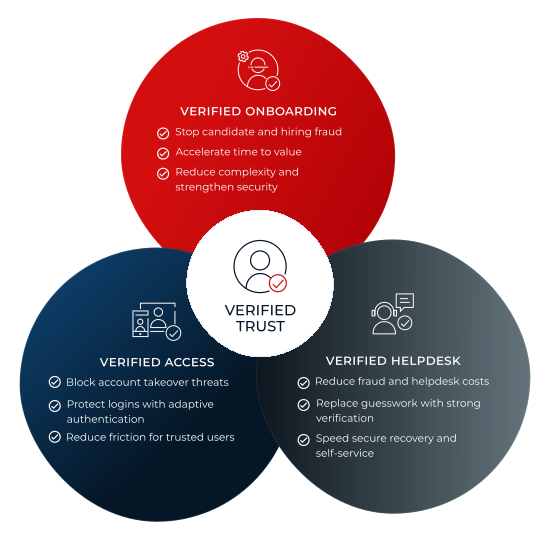
Modern organized attacks on your extended workforce don’t only happen at login. From hiring and onboarding to daily access and account recovery, Ping helps you continuously verify who's behind every interaction so you can block impersonations, reduce risk, and keep work moving.
Instead of assuming trust carries forward, you can evaluate identity, risk, and context when it matters most. The result? Fewer successful attacks, less user friction, faster recovery, and greater confidence at every step.
How We Have Your Back
Stop Candidate Fraud Before Day One
Prevent deepfake interviews, fake candidates, and bait-and-switch hiring before access is ever granted. Use high-assurance document verification, biometric matching, and liveness detection to ensure the same verified person progresses from interview to onboarding.
Protect Access Without Slowing Work
Stop AI-driven phishing, MFA fatigue, credential stuffing, and session hijacking with adaptive authentication that responds to real-time risk, not blanket policies. Use behavioral signals, phishing-resistant MFA, and privacy-preserving biometrics to keep legitimate users moving while stopping attackers.
Secure Every Helpdesk Interaction
Take the guesswork out of your sensitive support activities. Replace manual judgment with biometric, credential-based, and contextual verification before resets, recovery, unlocks, or device changes. More self-service. Less fraud. More confidence.
"To me, verified trust is a way to challenge the user only at the appropriate level to verify who they are, not less and not more.”
75%
reduction in MFA prompts
25,000 Hours
in recovered productivity per month
Stop Assuming Trust.
Start Verifying It.
Take the next step toward protecting your extended workforce and third-party partners with continuous identity verification that adapts to risk, no matter how complex your environment.
Helpful Resources
Frequently Asked Questions
It means identity isn't verified once and forgotten, especially when users operate in different environments under different trust models. Employees, contractors, frontline workers, and partners are continuously evaluated throughout onboarding, access, recovery, and support using identity verification, adaptive authentication, risk signals, and orchestration.
Traditional workforce and B2B IAM often assumes trust after authentication. Ping continuously evaluates identity, device, behavior, and context so high-risk actions receive stronger verification while trusted users experience less friction. Combining real-time threat detection, adaptive authentication, orchestration, privacy-preserving biometrics, phishing-resistant MFA, and verifiable credentials, this is a much stronger approach to combatting modern attacks like impersonation, phishing, deepfakes, MFA fatigue, social engineering, and account takeover that happen well beyond login.
Yes. Ping supports the full extended workforce including shift-based and shared-device environments. With contextual authentication and reusable trust signals, you can maintain accountability without disrupting work.
Absolutely. Ping layers continuous verification onto your existing identity investments, whether you're using Ping or another provider. You can modernize your verification and security controls and expand over time.
Identity verification helps you confirm real people at critical moments like interviews, hiring, recovery, or reverification. From there, privacy-preserving biometrics and verifiable credentials can become reusable trust anchors that make future verification faster, stronger, and more seamless across access, recovery, and other sensitive actions.
The short answer? Start where your biggest risk lives. If you’re concerned about candidate fraud, begin with onboarding. If you’re fighting account takeover, start with adaptive access. If you’re seeing recovery abuse and social engineering in support, secure your helpdesk first. From there, you can expand continuous verification across the rest of the identity lifecycle.