Adam Preis, Director, Product & Solution Marketing, Ping Identity
Mark van der Horst, Director Digital Identity, PwC
Shasta Turney, Director, Product & Solution Marketing, Ping Identity
Executive Summary: The Next Customer Interface
For more than two decades, organisations have competed to create better digital channels. Banks moved services from branches to websites and mobile applications. Insurers introduced digital quotation, policy servicing and claims portals. Retailers connected stores, websites, mobile applications, marketplaces and contact centres into increasingly sophisticated omnichannel experiences.
In the current agentic AI era, customers will increasingly be able to express an intended outcome rather than navigate a provider-defined journey. Instead of visiting several websites, comparing options, completing forms and coordinating fulfilment themselves, customers will instruct an AI agent to research, recommend, negotiate, purchase, service or switch on their behalf. As designed, an AI agent will interpret the customer’s preferences, interact with multiple organisations and execute a series of actions, escalating to the customer only when a decision or approval is required.
The transformation associated with this paradigm will usher in the beginning
of a new customer interface between human intent and enterprise execution.
The transition is gathering pace. Gartner predicts that 40% of enterprise applications will include task-specific AI agents by the end of 2026, up from less than 5% in 2025.[1] Consumer readiness is also beginning to emerge. Research commissioned by the UK Financial Conduct Authority found that 20% of financial services consumers (equivalent to approximately 11 million UK adults) would be likely to use AI capable of acting autonomously within pre-set goals.[2] In retail, Strategy&, part of the PwC network, estimates that agentic shoppers could account for up to 15% of European e-commerce expenditure by 2030, representing more than €100 billion.[3]
These measures address different aspects of adoption, but together they point to the same structural change. AI agents are moving into enterprise applications, customer behaviour and commercial transactions. Providers will increasingly need to serve humans and agents at the same time.
This creates three immediate shifts:
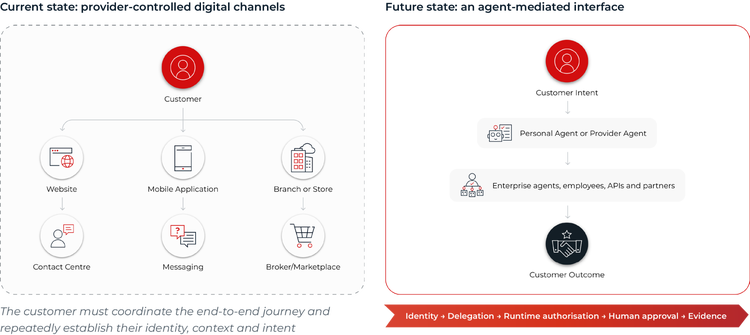
First, the interface changes. The customer’s first point of contact may no longer be the provider’s website, application, branch, store or contact centre. It may be a provider-owned service agent, a personal agent controlled by the customer, an independent comparison agent or an ecosystem agent coordinating several organisations.
Second, the ‘unit of trust’ changes. In today’s digital channels, trust is established primarily around the customer: who they are, how they authenticate and what they are permitted to access. In an agentic channel, that trust relationship expands. The organisation must establish not only the identity of the customer, but also what the agent is, who operates it, on whose behalf it is acting, what authority has been delegated to it and whether each attempted action remains within that authority.
Third, the basis of competition changes. Providers will continue to compete for human preference, but they will also compete for selection by agents comparing products and services against price, suitability, availability, fulfilment, service performance, risk and customer-defined constraints. The organisation’s ability to expose trusted, machine-readable products and services may become as important as the design of its human-facing channels.
The strategic implication is significant. Simply deploying AI agents or adding agentic capabilities to existing customer channels will not be enough. Competitive advantage will come from creating trusted agentic channels in which humans, agents, employees, partners and enterprise systems can interact with appropriate identity, delegated authority, and accountability.

The Customer Journey Is Being Rewritten
From Channel Navigation to Delegated Outcomes
Most digital transformation has taken place within organisational boundaries. Each bank, insurer or retailer has attempted to improve its own website, application, contact centre or physical channel. These investments have delivered substantial benefits, but they have not removed the need for customers to coordinate activities across provider boundaries.
Consider a relatively ordinary travel journey. The customer may seek inspiration through a social platform, research destinations through a search engine, compare flights and hotels through a marketplace, complete separate purchases, authenticate with several providers, manage payment and insurance, check in through different applications and interact with additional services during the trip. Each provider may offer a well-designed customer experience, yet the overall journey remains fragmented.
Today, even a relatively simple journey can require customers to move between multiple organisations, applications and authentication steps. They must repeatedly provide context, compare options and manage the hand-offs between providers. Agentic channels change this operating model. An agent can retain the customer’s intent, coordinate activity across different services and reduce the need for continuous human involvement. This drives the following evolution:
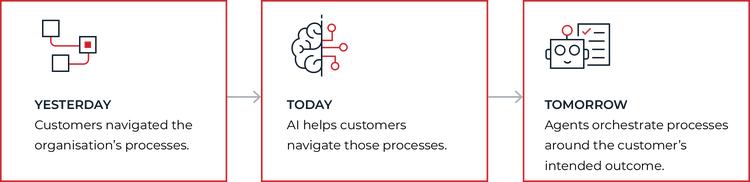
This is the defining difference between conversational AI and a genuinely agentic channel. A conversational assistant primarily responds: it answers questions, retrieves information or recommends a next step. An agent can plan and execute a sequence of activities, interact with applications, APIs and other agents, assess changing conditions and adapt its approach as the task develops.
The result can be a significant change in customer relationships. The customer no longer needs to remain present for every stage of the journey. Instead, they define the outcome, preferences and boundaries, while the agent undertakes the work and returns to the customer when a material decision, exception or approval is required.
This also changes how loyalty and existing customer relationships are expressed. An agent may approach the market primarily to optimise for the customer’s stated outcome, such as the best price, most suitable product or fastest service, without initially revealing whether the customer already has a relationship with a particular provider. That creates a new challenge for organisations: how to recognise and appropriately reward an existing customer, preserve the value of loyalty and influence the journey before the agent has fully disclosed the identity or context of the person it represents. In the agentic channel, loyalty may therefore depend not only on persuading the customer directly, but on making relevant benefits, preferential terms and relationship value discoverable and usable by the agent acting on their behalf.
The Evolution of the Customer Journey
Gartner describes a related progression within enterprise applications: from embedded assistants, to task-specific agents, collaborative agents and eventually agent ecosystems operating across applications. It predicts that by 2028 one-third of user experiences could shift from native applications to agentic front ends.[1] Table 1, below, illustrates the evolution to agentic channels from inception:
Table 1. The Evolution of the Customer Journey.
Naturally, these stages will overlap during the evolutionary trend described above. Some customers will continue to prefer a branch, store or human adviser for significant decisions. Others will adopt provider-owned agents but remain reluctant to delegate authority to an independent personal agent. Different journeys will progress at different speeds according to their value, complexity and sensitivity.
Three changes nevertheless stand out.
From Synchronous Interaction to Asynchronous Execution
Digital journeys remain largely synchronous. The customer searches, compares, enters information, responds to prompts and confirms each stage. Agents can operate asynchronously. They may monitor a price, wait for an account balance or eligibility condition to change, gather missing evidence, compare multiple options and act once agreed conditions are met.
The customer moves from being the continuous operator of the journey to defining the intended outcome, setting constraints and managing exceptions. The agent then interprets that intent, develops a course of action, connects to the required applications, services or specialist agents, and executes the task within the agreed boundaries. Human involvement is reserved for material decisions, unexpected conditions or actions requiring explicit approval.
From Single-Company Journeys to Cross-Company Outcomes
A customer outcome rarely fits neatly within one organisation. A home-buying journey may involve an estate agent, lender, insurer, surveyor, solicitor and utility provider. A financial-wellness journey may involve several banks, savings products, pension providers and insurers. A complex insurance claim may include the policyholder, broker, repairer, medical provider and payment service.
Agents can orchestrate these interactions around an outcome rather than around the boundaries of an application. This creates significant convenience, but it also raises the strategic stakes for providers. Organisations that cannot recognise, trust and transact with agents risk becoming inaccessible to customers who increasingly choose to engage through agentic channels.
This is where business model reinvention becomes tangible. Competing in an agent-mediated market may require organisations to redesign not only the customer interface, but also how products are exposed, how services are transacted, how loyalty is recognised and how trust is established across organisational boundaries. Identity, authority and accountability must therefore travel with the customer’s intent as agents coordinate activity across the wider ecosystem.
From Human Persuasion to Machine-Evaluated Value
Advertising, brand and emotional preference will remain important. However, agents are likely to evaluate a broader set of structured signals before recommending or selecting a provider, including:

An AI agent positioned between the customer and provider can substantially reduce the influence of traditional touchpoints. It may compare several products, assess suitability and begin an application without the customer engaging directly with the provider’s advertising, website or digital experience.
The competitive battleground therefore shifts. Organisations must remain compelling to human customers while also ensuring their products and services are discoverable, understandable and transactable by agents.
Understanding the Agentic Channel Landscape
The term “AI agent” covers several materially different relationships. For example, an agent built by a retailer to assist its customers does not present the same identity, liability or governance model as a personal agent controlled by a consumer. Nor does either operate like an agent representing a broker or commercial partner.
Two agentic-channel patterns are emerging. In the first, organisations deploy digital assistants to support and serve their customers directly. In the second, organisations must respond to external agents acting on behalf of customers.
These patterns create four interaction models that are likely to coexist:
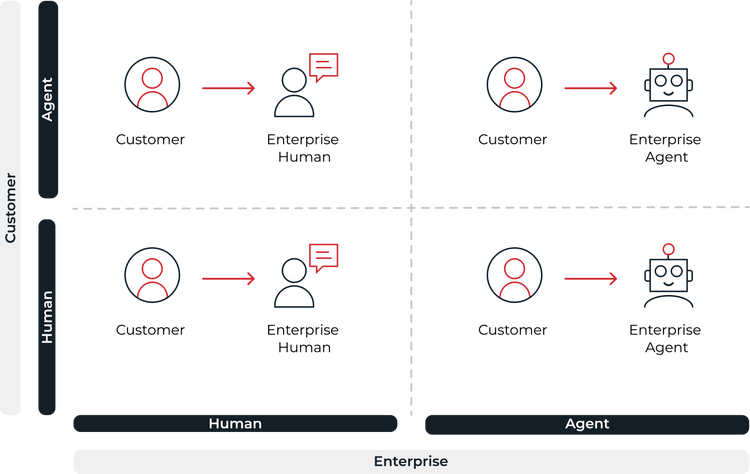
Together, they show that agentic channels are not a single use case. They represent a broader set of relationships between customers, providers, employees and autonomous systems. The following five agent archetypes provide a practical way to understand how those relationships may develop.
Provider-Owned Service Agent
A provider-owned agent is built, commissioned or operated by a bank, insurer or retailer. It acts within the provider’s environment and within the boundaries defined by that organisation, whether it is serving an existing customer or engaging with a prospect.
It may help a prospect explore products, assess eligibility or prepare an application, while an existing customer might use it to replace a payment card, service an insurance policy, assemble a basket, update personal information, initiate a claim or coordinate a product return. Because the provider owns the agent, it has greater control over its design, permissions and lifecycle.
Personal Customer Agent
A personal agent is selected or controlled by an individual and acts across providers on their behalf. It may compare products, manage routine financial activities, monitor prices, purchase goods, renew policies or submit service requests.
This model creates a more complex trust relationship. The provider did not create the agent, but the customer may expect the provider to recognise it and respect the authority they have delegated to it. That delegated authority does not, however, automatically determine what the provider must allow. It forms one part of the provider’s own authorisation decision.
The provider must establish that the agent is legitimate, determine which customer it represents and validate the scope of the mandate. It must then apply its own policies, risk controls and regulatory obligations to determine which actions the agent may perform. An agent may therefore be authorised by the customer to perform an activity but still be restricted, denied or required to obtain additional human approval by the provider.
This distinction is important for accountability and liability. The customer defines what the agent is permitted to do on their behalf; the provider remains responsible for deciding what it will permit within its own environment and for providing a safe route back to the customer when an attempted action exceeds either boundary.
Independent Comparison or Marketplace Agent
An independent agent evaluates several providers and recommends or selects an option using the customer’s preferences and the agent platform’s own ranking model.
Such an agent could compare insurance coverage, identify a suitable bank account, assess lending offers, source a retail product or optimise subscriptions. It may create value through convenience and breadth of comparison, but it could also become a powerful intermediary controlling discovery, recommendation and customer preference data.
The central question is not only whether the agent has authority to act. Providers and customers must also understand who operates it, how its incentives work and whether its recommendation is consistent with the customer’s interests.
Ecosystem or Orchestration Agent
An ecosystem agent coordinates several organisations or specialist agents to deliver one outcome. It might organise an end-to-end holiday, coordinate a house move, manage a significant life event or orchestrate a complex insurance claim.
Authority may be passed through several layers. A primary agent could engage a payment agent, booking agent and delivery agent. Each sub-agent may require different data and permissions.
The identity problem therefore expands from a relationship between one customer and one agent into a chain of delegated actors. The organisation must understand not only who presented the request, but how that agent obtained its authority.
Partner, Broker or Adviser Agent
A partner agent acts for a broker, financial adviser, merchant, distributor, employer or service provider. It represents an organisation and may also be acting indirectly for an underlying customer.
Examples include an insurance broker’s agent accessing several carriers, an adviser agent preparing suitability evidence, a repairer agent updating a claim or a merchant agent initiating fulfilment and payment.
This model requires organisational relationships, delegated administration and customer authority to be represented together. It cannot be governed safely through a single shared partner account or an unqualified machine credential.
Autonomy Is a Continuum, Not a Binary Choice
The same agent archetype may operate at different levels of autonomy.
At an assist level, the agent retrieves, explains or recommends; the human takes the action. At an act with approval level, the agent prepares or initiates an activity, but a human approves it before execution. At an act within a mandate level, the agent can operate independently inside customer- or organisation-defined constraints.
This distinction is essential. Governance that is suitable for a read-only information agent will be inadequate for an agent capable of making payments or changing insurance coverage. Equally, controls designed for the highest-risk agent may make a low-risk assistant unnecessarily difficult to use.

The Standards and Protocols Shaping the Channel
Agentic channels will not operate on one proprietary platform. Customer, provider and partner agents will be built on different models, frameworks and clouds. Interoperability standards are therefore becoming strategically important.
Model Context Protocol
The Model Context Protocol, or MCP, provides a standard way for agents to connect to tools, data and enterprise services. Instead of creating a bespoke integration for every resource, an MCP-compatible agent can discover and invoke exposed capabilities through a common interface.
For organisations, the significance is that MCP can make products, services and operational capabilities far easier for agents to access and combine. This can accelerate the development of agentic channels and allow customer outcomes to span multiple systems without requiring a new integration for every journey. At the same time, it creates a new business consideration: making a capability technically accessible to an agent is not the same as deciding that the agent should be allowed to use it.
MCP’s authorisation specification uses OAuth-based mechanisms for protected HTTP resources, including audience-bound access tokens and token validation.[7] However, the protocol does not by itself determine whether an agent is acting for a legitimate customer, whether the requested activity reflects that customer’s intent or whether the provider is willing to permit the action. Those decisions remain the responsibility of the organisation and become increasingly important as agents move from retrieving information to initiating transactions and other consequential actions.
Agent2Agent
Agent2Agent, or A2A, is designed to allow agents created on different platforms or frameworks to discover capabilities, exchange information and coordinate work. The protocol was moved into Linux Foundation governance in 2025 to support open, cross-platform agent communication.[8]
A2A becomes particularly important when a customer agent interacts with a provider agent or when one agent delegates part of a task to a specialist agent. It is important to distinguish the protocol from the ecosystem agent described earlier: A2A is the communication standard that enables agents to work together, while an ecosystem agent is a specific type of agent that orchestrates multiple providers or specialist agents to deliver an end-to-end outcome.
Universal Commerce Protocol
The Universal Commerce Protocol, or UCP, provides common constructs for commerce journeys between customer surfaces, businesses and payment providers. It covers capabilities such as product discovery, checkout and fulfilment and can operate through APIs, A2A or MCP.[9]
UCP is significant because it moves agentic commerce from proprietary experiments towards a more interoperable model in which merchants can expose their capabilities consistently to multiple agent platforms.
Agentic Commerce Protocol
Agentic Commerce Protocol, or ACP, provides a common interface through which an agent application can create and complete a merchant checkout. The agent can own more of the customer interaction while the seller retains control of its catalogue, order management and fulfilment environment.
This can reduce the need for an agent to imitate a human browsing a website, but it also makes identity, payment authority and transaction evidence more important.
Agent Payments Protocol
Agent Payments Protocol, or AP2, addresses the question of who authorised an agent to spend. It uses structured, cryptographically signed mandates to record customer intent, merchant restrictions, spending limits, expiry and transaction-specific approval.[8]
UCP may describe what is being purchased and how checkout proceeds; AP2 adds evidence of who authorised the transaction and under which conditions.
OAuth, OpenID Connect and AuthZEN
OAuth and OpenID Connect provide established foundations for identity, authentication and delegated access. AuthZEN is developing interoperable patterns between policy-enforcement and policy-decision systems.
Recent AuthZEN work addresses agent-specific requirements, including MCP tool authorisation and cases where an action cannot yet be approved because consent, human approval, attestation or another prerequisite is required.[9]
Standards make cross-platform interaction possible. They do not remove the need for the enterprise to decide whether an agent is trustworthy, whether it holds valid authority or whether a particular action should be permitted.
Growth, Trust and Disintermediation: What Changes for the Enterprise?
Agentic channels create a dual strategic effect. They can reduce customer effort, accelerate service and create entirely new sources of demand. At the same time, they can weaken the provider’s direct relationship with the customer and introduce new forms of fraud, overreach and accountability risk. The same properties that make agents commercially valuable, including autonomy, speed, scale and access to rich context, also make them difficult to govern.
The Opportunity: A Lower-Effort Customer Relationship
Agents can remove many of the administrative burdens that customers currently accept as part of a digital journey. They can gather information, pre-populate forms, identify suitable products, monitor conditions and coordinate activities across departments or organisations.
This can improve conversion because fewer customers abandon long or fragmented journeys. It can reduce service costs because routine activity no longer requires a human employee to coordinate every step. It can create more continuous relationships because the agent can monitor customer needs between traditional interaction points.
Personal agents may also introduce providers that customers would not otherwise find. A specialist product buried in search results may become the agent’s preferred option because it is demonstrably better aligned with the customer’s needs. Smaller organisations could therefore gain access to demand that was previously captured by dominant advertising, search or marketplace channels.
The opportunity is not limited to external personal agents. Provider-owned agents can use customer history, current context and enterprise data to deliver more relevant service. They can move beyond answering questions to resolving the underlying need.
The Risk: Loss of the Customer Interface
The organisation may no longer control how customers discover, compare or select its products. An independent agent could decide which options are surfaced, which information is prioritised and which provider is ultimately chosen.
In financial services, for example, a customer could ask an agent to identify the most suitable small-business loan and begin applications across several banks. The customer’s view of those institutions may be shaped almost entirely by the agent’s interpretation, with little or no direct exposure to their advertising, brand experience or digital channels.
The same dynamic applies across sectors. An insurer could become an anonymous capacity behind a comparison agent. A retailer could be reduced to a fulfilment endpoint selected primarily on price, availability and delivery performance. In each case, the provider may complete the transaction without establishing a meaningful relationship with the human customer behind it.
This creates both a disintermediation risk and a growth opportunity. Organisations can respond in several ways: they may block external agents, accept them as anonymous traffic, optimise for efficient machine-led transactions, or establish a trusted relationship with both the agent and the customer it represents.
The final option offers the strongest long-term position. By recognising the agent, associating it with a consenting customer and understanding the scope of its authority, the organisation can support agent-led convenience while preserving visibility, trust and a meaningful connection to the customer.
The Trust Gap
Existing digital controls were designed primarily around a human accessing an application. Agentic interactions challenge several of their assumptions.
An agent may be indistinguishable from a bot or malicious automated script. It may use a human customer’s credentials rather than its own identity. The consent granted to it may be broad, persistent or difficult for the customer to understand. It may undertake several individually permitted actions that collectively create an inappropriate outcome. It may delegate tasks to other agents without preserving a clear chain of authority.
The trust gap is not only technical but also behavioural and ethical: agents can take individually permitted actions that collectively produce outcomes misaligned with intent, risk appetite, or fair customer outcomes.
Even a legitimate agent can become compromised, over-privileged or misaligned with the customer’s intent. At machine speed, such failures can scale much more rapidly than a conventional manual error.
The trust gap therefore extends to some of these questions:
Table 2. The Agentic-Channel Value Equation.
Identity for AI: Agent Identity Architecture
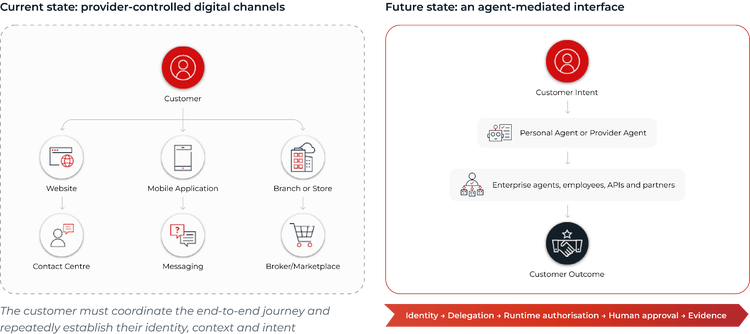
Traditional identity and access management (IAM) logic establishes whether a user may enter an application. Agentic systems require a more continuous form of control. Agents can decide which step to take next, invoke APIs and tools, interact with other agents and act over extended periods. A credential or access token issued earlier in a journey cannot be treated as unlimited evidence that every later action is appropriate.

This shift from one-time authentication to continuous control requires two things: runtime control (the continuous, contextual evaluation of identity, delegated authority, risk and policy at the moment an action is attempted) and lifecycle management. Agents should be treated as first-class identities, rather than operating behind human credentials or shared accounts. This allows organisations to apply explicit delegation, least-privilege access, per-action controls and clear accountability to the people or organisations the agent represents.
Recognise and Classify Agents
Before an organisation can apply the right controls, it must understand what is interacting with its channel.
A customer, declared personal agent, enterprise-managed service agent, computer-using agent and credential-stuffing bot should not follow the same identity journey. The organisation needs signals capable of identifying agentic behaviour, differentiating legitimate agents from malicious automation and determining which type of agent is present.
Recognition is especially important for external agents. Provider-owned agents can be controlled but a customer’s agent may arrive through a website, application, protocol or browser-based interaction that the enterprise does not control.
Agent detection allows the organisation to move the interaction from unknown to known and determine what should happen next. Once the interaction has been classified, it can be routed into an appropriate identity journey according to the type of actor, the customer relationship and the action being requested.
For a recognised agent, this may mean initiating an agent-aware authentication and consent journey that establishes who the agent represents and the authority it has been granted. Where the customer needs to be identified, authenticated or asked to provide consent directly, the interaction can pivot from the agent to the human through an identifier-first journey and an out-of-band verification or approval event. The objective is to preserve the convenience of the agentic channel without assuming that every automated interaction should inherit the same level of trust.
AI Agent Identity Ownership
Every managed agent should have a distinct identity, just as a person, application or workload does. Its identity record should include:
This creates accountability. Without explicit agent identity, actions may appear to have been completed by the customer or by an undifferentiated application. Security teams cannot determine which agent was involved, governance teams cannot certify its access and customers cannot understand how their authority was used.
Use Delegation, Not Impersonation
An agent should not sign in using the customer’s password, reuse a browser session or present an unrestricted credential that makes its activity indistinguishable from the human’s.
Instead, the customer should delegate specific authority to an agent with its own identity. The resulting token or entitlement should preserve both actors: the person or organisation granting authority and the agent exercising it.
Delegation supports precise limitations. A financial agent could read account balances and prepare a transfer but be prohibited from creating a new payee. A shopping agent could use a saved delivery address but not access the customer’s full account history. A claims agent could collect evidence without being authorised to change settlement instructions.
This separation also improves auditability. The organisation can prove that the customer granted authority, that a named agent exercised it and that the action fell inside (or outside) the permitted scope.
Capture Consent, Intent and Mandate
Conventional consent often asks whether an application may access a category of information. Agentic channels require a more precise model in which the human defines the boundaries within which an agent is permitted to act.
Rather than granting broad or indefinite access, consent should be translated into a scoped mandate that can be understood by the customer and enforced by the organisation. Depending on the journey, that mandate may specify:
An instruction such as “find and purchase suitable travel insurance for under £100, but ask me before completing the purchase” contains considerably more information than a broad permission to access a customer profile. The organisation must be able to translate that human intent into constraints that can be enforced throughout the agent’s activity.
Protocols such as AP2 can provide structured evidence of payment authority, while OAuth-based delegation can express technical access. Enterprise policy is still required to determine how that authority applies to a particular customer, agent, resource and action.
AI Agent Authorization
Authentication establishes who or what is present; consent and delegation establish the boundaries within which the agent may act; runtime authorisation determines whether a specific action is permitted at the moment it is attempted.
Static roles and broad scopes are poorly suited to agents that move between tasks, resources and levels of risk. Each material action should therefore be evaluated against both the mandate defined by the human and the organisation’s own policies, using context such as:
The same agent may therefore be permitted to retrieve information, required to return to the customer for approval before changing account data, and denied access to another resource entirely. The decision can also change as context changes: a transaction that falls within the mandate at one value, location or risk level may require additional approval at another.
Runtime authorisation allows these decisions to be applied consistently across provider agents, personal agents, MCP servers, APIs and existing enterprise systems. Crucially, the authority granted to an agent is not treated as a one-time decision made at login. The human defines the boundaries; the organisation evaluates those boundaries, together with current context and policy, each time the agent attempts a consequential action.
Trust is not granted once at login. It is continuously evaluated as the agent acts.
Control APIs, Tools and MCP Resources
Agents become useful when they can access tools and enterprise services. Those connections also create a new attack and control surface.
If each API or MCP server implements identity and authorisation separately, organisations will accumulate inconsistent controls, duplicated integration work and fragmented audit records. A gateway between agents and resources provides a common point to validate tokens, enforce policy, transform credentials and record activity.
A dedicated runtime enforcement layer can standardise how agents access MCP servers, APIs and traditional enterprise services. It provides a consistent point at which requests can be validated, fine-grained authorisation policies applied, and activity monitored and recorded for audit.
This does not remove the need for resource-level security. It ensures that every agent request reaches those resources through a consistent trust boundary.
Human Oversight of AI Agent Decisions
Human-in-the-loop control should not mean placing a human approval step in every workflow. Doing so would remove much of the value of agent autonomy. Approval should be triggered when the action’s risk or impact exceeds the agent’s mandate. Examples include:
The approval process should present the human with sufficient context to make an informed decision: what the agent proposes, why it proposes it, what information it used and what the consequence will be. Human-in-the-loop design is also a governance decision, requiring clear ownership and accountability structures. For example, accountability must be clearly assigned in advance: if an agent takes an incorrect action, the ownership and accountability must be clearly defined.
Detect and Respond to Threats
Agent behaviour must be monitored continuously because even a legitimate agent can be compromised, manipulated or begin to behave unexpectedly. Organisations also need to distinguish trusted agentic activity from malicious bots, credential attacks and other forms of hostile automation.
Relevant signals may include abnormal tool use, unusual data retrieval, repeated policy denials, suspicious transaction patterns, unexpected sub-agents, changes in device or environment and attempts to bypass approval or exceed the customer’s mandate.
Ping Identity’s capabilities can provide the detection and risk signals needed to identify and classify agent and non-human traffic, distinguish legitimate interactions from suspicious automation and inform the appropriate response. Depending on the level of risk, the organisation may allow the interaction to continue, route it into an appropriate authentication or consent journey, require additional human verification, restrict access, stop an individual action or revoke the agent’s authority entirely.
Detection and response must operate at machine speed because the agent itself does. The aim is not simply to determine whether automation is present, but to continuously assess whether that automation remains trusted for the activity it is attempting.
Govern Lifecycle, Privilege and Credentials
Agent governance extends beyond access at runtime. Organisations must discover which agents exist, classify them, assign accountable owners, review their entitlements and remove them when no longer needed.
Access should be short-lived, purpose-bound and least-privileged. Where agents require sensitive credentials, those credentials should be injected or brokered at runtime rather than exposed directly to the agent.
Governance should also cover MCP servers, tools and agent-to-agent relationships. An organisation that governs the primary agent but cannot see the resources or sub-agents it can reach retains a significant blind spot.
Create Evidence and Accountability
Every material action should produce an evidential chain showing:
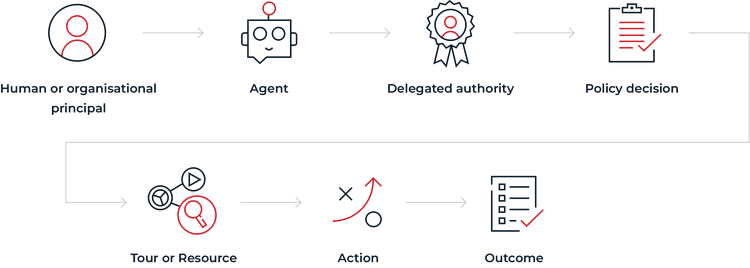
This record supports incident investigation, customer disputes, regulatory reporting and internal governance. It also provides the data required to improve policy and decide where greater autonomy may be appropriate.
The objective is not simply to prove that an authenticated identity accessed a system. It is to demonstrate why the action was allowed, whose authority was used and whether the resulting outcome was consistent with the intended mandate.
Three Industries, One Structural Change
The same agentic-channel principles apply across financial services, insurance and retail, but the most valuable journeys, commercial incentives and risk thresholds differ.
FINANCIAL SERVICES | From Digital Banking to Delegated Finance
Current State
Financial institutions have invested heavily in mobile banking, open banking, digital onboarding and AI-enabled service. AI adoption is already widespread: 75% of firms responding to the Bank of England and FCA’s 2024 survey said they were using AI, with a further 10% planning adoption within three years. Respondents expected the median number of AI use cases to rise from nine to 21 during that period.[10]
Yet many customer journeys remain fragmented across products and systems. Customers may have access to extensive financial data without receiving coordinated support to act on it. Product selection and lending journeys remain complex, service processes often require manual intervention and fraud controls can introduce significant friction.
Financial crime, regulatory compliance, customer engagement and lending are among the most immediate areas of agentic value. In each, agents can coordinate complex, multi-step and decision-intensive activities while preserving human oversight for high-risk or high-impact outcomes.
Priority Agentic-Channel Use Cases
The most relevant customer-facing opportunities include:
Provider-owned agents may be the first to scale. A banking agent could help a customer understand their financial position, gather information from several accounts, recommend a course of action and complete an approved transfer.
Personal agents create a more disruptive model. Personal agents create a more disruptive model. A customer might ask an independent agent to find the most suitable savings account, compare mortgage options or move surplus cash between providers. The bank may not own the customer’s interface or preference data.
The Value Equation
From a cost perspective, agents can reduce routine service demand, assemble cases, coordinate back-office workflows and support financial-crime investigation.
From a growth perspective, they can improve product discovery, reduce application abandonment, deliver more contextual guidance and support more continuous customer engagement.
From a risk perspective, agents can monitor behaviour and surface anomalies, but they also introduce new payment, fraud and conduct risks. A customer’s instruction must not become an unrestricted authority to move money or expose data.
The Paradigm Shift
Identity Priorities
Financial service providers must be able to bind the agent to the customer, restrict authority at transaction level and preserve a complete record of delegation. Payment actions require controls that can account for value, recipient, device, behaviour and customer intent at the moment of execution.
The institution must also distinguish a genuine customer agent from malicious automation. Trust cannot be transferred to an external agent merely because the customer initially authorised it.
INSURANCE | From Policy Administration to Continuous Orchestration
Current State
Insurance combines complex products, infrequent customer interaction, sensitive information and multi-party value chains. Customers may engage directly, through brokers or through partners. Claims can involve repairers, medical providers, assessors and payment services.
European insurers are already experimenting extensively with AI. EIOPA’s 2026 survey of 347 undertakings across 25 countries found that nearly two-thirds were actively using generative AI, although most remained at the proof-of-concept. Efficiency and cost reduction were the leading drivers, while more than half also identified customer experience and improved decision-making.[11]
Agentic AI is beginning to move beyond experimentation. Allianz’s Project Nemo uses seven specialist agents to automate parts of low-complexity catastrophe claims, including coverage checks and fraud analysis, while retaining a human decision for final payment. Allianz reports an 80% reduction in processing and settlement time.[12]
Priority Agentic-Channel Use Cases
Relevant journeys include:
A provider agent could guide the policyholder through a claim, gather photographs and documents, validate basic coverage and coordinate repair. A broker agent could compare products across insurers or prepare evidence for several customer applications. A personal agent could monitor changes in the customer’s circumstances and identify coverage gaps.
The Value Equation
From a cost perspective, agents can automate repetitive claims activity, accelerate evidence collection, reduce manual underwriting work and coordinate external service providers.
From a growth perspective, they can make complex cover easier to understand, improve quote completion, support advisers and enable more relevant protection recommendations.
From a risk perspective, they can strengthen evidence and detect anomalies, but they may also automate unsuitable recommendations, expose health or financial data or make high-impact decisions without appropriate oversight.
The Paradigm Shift
Identity Priorities
Insurance requires relationship-based identity. The policyholder may not be the insured person, claimant or beneficiary. An agent acting for a broker should not receive access to every policy managed by that broker’s organisation. A claims agent may collect information but have no authority to change settlement instructions.
Consent and purpose are especially important when sensitive health, lifestyle or financial data is involved. The identity control plane must enforce why information may be used, not merely whether a technical connection exists.
RETAIL | Retail Transition to Agentic Commerce
Current State
Retail is currently the most visible external-agent market. Product discovery is already moving from conventional search towards AI-generated recommendations and comparison. Strategy&, part of the PwC network, estimates that agents could drive up to 15% of European e-commerce expenditure by 2030.[3] Adobe found that referral traffic from AI sources to US retail sites rose by 693.4% during the 2025 holiday period compared with the previous year. Its subsequent consumer research found that 39% of surveyed consumers had used AI for online shopping and that 85% of those users believed it improved the experience.[13]
Retailers and marketplaces are moving from recommendation into execution. Amazon’s Buy for Me enables its shopping service to complete purchases on selected external brand websites on behalf of the customer.[14] Walmart’s Sparky is being developed to progress from product information and comparison into activities such as reordering and service booking.[15]
The significance is not merely that retailers are adding smarter assistants. Agent platforms can increasingly control product discovery, comparison and purchase across several merchants.
Priority Agentic-Channel Use Cases
Agentic commerce in retail is likely to develop across a broad set of customer, transaction and service interactions, including:
The most important agentic-commerce use cases are likely to be those that intersect directly with identity, loyalty, payment authority and personal data. For example, a provider-owned retail agent may help a customer plan meals, identify products and complete a basket, but it may also need permission to access loyalty entitlements or apply personalised offers. A personal shopping agent may compare several retailers, monitor prices and make an automatic purchase once agreed conditions are met, which raises questions about delegated payment authority and the use of saved credentials. An independent marketplace agent may become the primary product-discovery layer, while also needing appropriate controls around customer data access, consent and post-purchase service interactions.
The Value Equation
From a cost perspective, agents can reduce repetitive service interactions, automate returns journeys and help coordinate fulfilment.
From a growth perspective, they can capture agent-originated demand, improve discovery, support replenishment and reduce checkout abandonment.
From a risk perspective, retailers must distinguish legitimate customer agents from scraping, inventory abuse, credential attacks and automated fraud. They must also prevent inappropriate use of saved payments, loyalty balances and personal data. The risk equation also includes GDPR obligations around consent, transparency, access rights and breach response, especially where agent-led interactions influence decisions or process personal data.
Identity Priorities
Against the backdrop outlined above, retailers need to recognise when an agent is present, determine whose agent it is and decide what it is authorised to do. For example, a trusted customer agent may be allowed to retrieve product and availability information freely, but would require delegated authority before accessing loyalty data or account information and explicit step-up approval before using a saved payment method or completing a purchase.
Identity is what allows retailers to connect an agent to the human customer behind it. That link helps create a more seamless experience by carrying preferences, loyalty status, consent and context across journeys, so customers do not have to repeat the same steps across web, mobile, in-store and contact-centre interactions. It also improves security by reducing anonymity and helping retailers apply the right controls before account, loyalty or payment actions are allowed.
Creating the Operating Model for Trusted Agentic Channels
Agentic-channel adoption is not solely an AI programme or an IAM programme. It changes customer strategy, product design, data use, technology architecture, risk management and operating processes. A successful approach therefore requires business transformation and trusted execution to be designed together.
PwC: Business Strategy and Transformation
PwC’s role is to help organisations determine where and how to participate in an agent-mediated economy. This includes:
Ping Identity: The Identity Control Plane for Trusted Agentic Channels
The Ping Identity Platform, including its Identity for AI capability stack, provides the identity capabilities required to implement those strategies safely:
The Ping Identity Platform also allows organisations to connect the agentic channel to established customer, workforce, partner, authentication, orchestration and fraud-control capabilities rather than creating a separate identity silo through its converged identity fabric.
The Joint Ping Identity and PwC Proposition

The operating model should bring together several functions that are often managed independently: customer experience, AI transformation, identity, cybersecurity, fraud, product, operations, data, compliance and legal. Without a common model, organisations risk building compelling agent experiences that cannot be governed, or imposing controls that prevent the channel from delivering value.
A Practical Roadmap for Decision-Makers
Organisations should not attempt to open every customer journey to agents at once. They should establish a maturity path in which autonomy expands as identity, policy and operational confidence improve.
The Agentic-Channel Maturity Model
The maturity model below describes how an organisation’s agentic-channel capabilities can evolve over time, from established human-led digital channels through to interoperable ecosystems in which multiple agents coordinate activity across organisational boundaries. It is not intended as a mandatory sequence for every journey, but as a framework for assessing current capability, target ambition and the corresponding trust requirements.
Table 3. The Agentic-Channel Maturity Model.
Maturity does not mean that every organisation or journey must reach Stage 5. A high-value, high-risk activity may remain at “act with approval”, while a low-risk service process becomes more autonomous. The appropriate target depends on customer need, business value, regulation, risk appetite and technical readiness.
Phase 1: Discover, Prioritise and Govern
The first step is to create visibility and shared ownership. Organisations should inventory existing and proposed agents, including agents already embedded in software platforms. They should classify them by ownership, principal represented, autonomy and resources accessed.
The organisation should then select a small number of journeys where agentic execution addresses a genuine customer or operational problem. A high-volume, bounded process is usually a better starting point than a complex, irreversible decision.
During this phase, it’s important to:
- Identify provider, personal, partner and workforce agents
- Map customer intent, data, APIs, MCP servers and systems
- Assess channel and disintermediation exposure
- Define which actions may be assisted, approved or autonomous
- Assign accountable business and technical owners
- Document regulatory, conduct and customer-protection requirements
- Establish measures of value, experience and control
Leadership Priorities




Phase 2: Establish the Identity and Trust Foundation
Before granting agents material authority, organisations need a consistent control plane.
During this phase, it’s important to:
- Identify provider, personal, partner and workforce agents
- Map customer intent, data, APIs, MCP servers and systems
- Assess channel and disintermediation exposure
- Define which actions may be assisted, approved or autonomous
- Assign accountable business and technical owners
- Document regulatory, conduct and customer-protection requirements
- Establish measures of value, experience and control
Leadership Priorities
Phase 3: Launch Controlled Provider-Agent Journeys
Before granting agents material authority, organisations need a consistent control plane.
During this phase, it’s important to:
- Launch one or two high-volume provider-agent journeys
- Measure completion, abandonment and escalation
- Test transitions between agent and human support
- Integrate real-time fraud and risk decisions
- Validate customer understanding and perceived control
- Exercise incident response and emergency revocation
- Review policy denials and unexpected agent behaviour
- Compare customer and business outcomes with the previous journey
A provider agent should not be judged only by how many contacts it automates. It should also improve the customer’s time to outcome, reduce repeat interaction and preserve appropriate protection.
Leadership Priorities
Phase 4: Open and Scale the External Agentic Channel
Once the organisation has established internal agent identity and runtime control, it can begin supporting personal, comparison and partner agents more broadly.
During this phase, it’s important to:
- Define methods for recognising and onboarding approved external agents
- Publish machine-readable products, capabilities and service policies
- Support relevant agent, commerce and payment standards
- Connect customer identity, loyalty and personalisation through explicit consent
- Establish agent or ecosystem certification
- Define dispute, liability and recourse processes
- Govern sub-agents and chains of delegation
- Monitor concentration in external agent platforms
- Optimise human and agent experiences together
Opening the channel does not require trusting every external agent. Organisations may expose different capabilities according to the agent’s provenance, certification, mandate and risk.
Leadership Priorities
Competing for the Next Customer Interface
Agentic AI is moving the market beyond conversational assistance and towards delegated action. Customers will increasingly ask agents to research, compare, transact and service on their behalf. Provider-owned agents will transform customer operations in the near term, while personal and ecosystem agents will progressively reshape discovery, distribution and market power.
The organisations that move early can reduce customer effort, accelerate revenue and create more continuous service relationships. Those that move without an adequate trust foundation risk fraud, consumer harm, loss of accountability and disintermediation.
Trusted agentic channels require organisations to recognise agents, relate them to accountable principals, model delegated authority, authorise actions at runtime, protect the resources agents use and evidence the complete chain of activity. These capabilities must operate across customers, employees, partners, APIs and agents rather than creating another isolated identity domain.
The agentic-channel race will not be won by the organisation that deploys the greatest number of agents. It will be won by the organisation that makes itself easiest for trusted agents to discover and transact with, while preserving customer choice, accountability and control.
A joint PwC and Ping Identity assessment can help organisations:
- Identify priority agentic customer journeys
- Understand the relevant agent archetypes and autonomy levels
- Assess disintermediation and commercial opportunity
- Evaluate identity, governance and protocol readiness
- Define customer, risk and regulatory controls
- Design the target operating model and architecture
- Create a phased implementation roadmap
Contact us today to begin your journey with us.
At Ping Identity, we make it possible to trust every digital moment across customers, employees, partners, and non-human identities. Whether you’re securing millions of users, fighting fraud, simplifying third-party access, or going passwordless, establishing trust shouldn’t slow you down. Our enterprise-grade identity platform is built for scale, speed, and flexibility and works seamlessly with your existing cloud, hybrid, and on-prem environments. We help you confidently embrace AI and automation with Runtime Identity, so you can continuously verify the identity, context, and intent of every AI agent and control their actions in real time. With Ping, all digital experiences start with trust. Learn more at pingidentity.com.
Endnotes
[1] Gartner, Inc. (2025) ‘Gartner predicts 40% of enterprise apps will feature task-specific AI agents by 2026, up from less than 5% in 2025’, Gartner Newsroom, 26 August. Available at: https://www.gartner.com/en/newsroom/press-releases/2025-08-26-gartner-predicts-40-percent-of-enterprise-apps-will-feature-task-specific-ai-agents-by-2026-up-from-less-than-5-percent-in-2025 (Accessed: 4 August 2026). (Gartner)
[2] Financial Conduct Authority (2026) ‘FCA publishes landmark review into impact of AI on retail financial services’, 6 July. Available at: https://www.fca.org.uk/news/press-releases/fca-publishes-landmark-review-impact-ai-retail-financial-services (Accessed: 4 August 2026). (FCA)
[3] Strategy& (2026) The agentic AI revolution in retail: From vision to process reality. 4 March. Available at: https://www.strategyand.pwc.com/de/en/industries/consumer-markets/agentic-ai-revolution-retail.html (Accessed: 4 August 2026). (PwC)
[4] Gartner, Inc. (2026) ‘Gartner says applying uniform governance across AI agents will lead to enterprise AI agent failure’, Gartner Newsroom, 26 May. Available at: https://www.gartner.com/en/newsroom/press-releases/2026-05-26-gartner-says-applying-uniform-governance-across-ai-agents-will-lead-to-enterprise-ai-agent-failure (Accessed: 4 August 2026). (Gartner)
[5] Model Context Protocol (2025) ‘Authorization’, specification dated 18 June 2025. Available at: https://modelcontextprotocol.io/specification/2025-06-18/basic/authorization (Accessed: 4 August 2026). (Model Context Protocol)
[6] Linux Foundation (2025) ‘Linux Foundation launches the Agent2Agent Protocol Project to enable secure, intelligent communication between AI agents’, 23 June. Available at: https://www.linuxfoundation.org/press/linux-foundation-launches-the-agent2agent-protocol-project-to-enable-secure-intelligent-communication-between-ai-agents (Accessed: 4 August 2026). (Linux Foundation)
[7] Google Developers (2026) ‘Under the Hood: Universal Commerce Protocol’, 11 January. Available at: https://developers.googleblog.com/under-the-hood-universal-commerce-protocol-ucp/ (Accessed: 4 August 2026). (Google Developers Blog)
[8] Google Developers (2026) ‘Developer’s Guide to AI Agent Protocols’. Available at: https://developers.googleblog.com/en/developers-guide-to-ai-agent-protocols/ (Accessed: 4 August 2026). (Google Developers Blog)
[9] OpenID Foundation (2026) ‘OpenID Foundation advances authorization for the agent era with new AuthZEN Working Group Drafts’, 15 June. Available at: https://openid.net/openid-foundation-advances-authorization-for-the-agent-era-with-new-authzen-working-group-drafts/ (Accessed: 4 August 2026). (OpenID Foundation)
[10] Bank of England and Financial Conduct Authority (2024) Artificial intelligence in UK financial services – 2024. 21 November. Available at: https://www.bankofengland.co.uk/report/2024/artificial-intelligence-in-uk-financial-services-2024 (Accessed: 4 August 2026). (Bank of England)
[11] European Insurance and Occupational Pensions Authority (2026) Generative AI Market Survey: Outlook, Use Cases and Risk Management. 2 February. Available at: https://www.eiopa.europa.eu/publications/generative-ai-market-survey-outlook-use-cases-and-risk-management_en (Accessed: 4 August 2026). (EIOPA)
[12] Allianz (2025) ‘When the storm clears, so should the claim queue’, 3 November. Available at: https://www.allianz.com/en/mediacenter/news/articles/251103-when-the-storm-clears-so-should-the-claim-queue.html (Accessed: 4 August 2026). (Allianz.com)
[13] Adobe (2026) 2025 Holiday Shopping Statistics, Trends & Insights. Available at: https://business.adobe.com/resources/holiday-shopping-report.html (Accessed: 4 August 2026). See also Adobe (2026) ‘AI traffic grows but retail sites lag in AI search visibility’. Available at: https://business.adobe.com/uk/blog/ai-traffic-surge-retail-sites-not-machine-readable (Accessed: 4 August 2026). (Adobe Business)
[14] Amazon (2025) ‘Amazon’s new “Buy for Me” feature helps customers find and buy products from other brands’ sites’, 3 April. Available at: https://www.aboutamazon.com/news/retail/amazon-shopping-app-buy-for-me-brands (Accessed: 4 August 2026). (Amazon News)
[15] Walmart (2025) ‘The future of shopping is agentic. Meet Sparky’, 6 June. Available at: https://corporate.walmart.com/news/2025/06/06/walmart-the-future-of-shopping-is-agentic-meet-sparky (Accessed: 4 August 2026). (Walmart Corporate News)