What is Verified Trust for the Extended Workforce?
Verified Trust is a framework for moving beyond point-in-time authentication to continuous, adaptive identity assurance. It replaces implicit trust, where access is assumed after authentication, with explicit trust by continuously verifying identity across onboarding, access, and helpdesk interactions for the extended workforce.
Built for an extended workforce spanning corporate employees, frontline workers, contractors, partners, third-party ecosystems, and increasingly automated interactions, Verified Trust addresses varying assurance needs and risk profiles. In this environment, identity cannot be assumed, trust cannot be static, and identity assurance must extend beyond initial authentication.
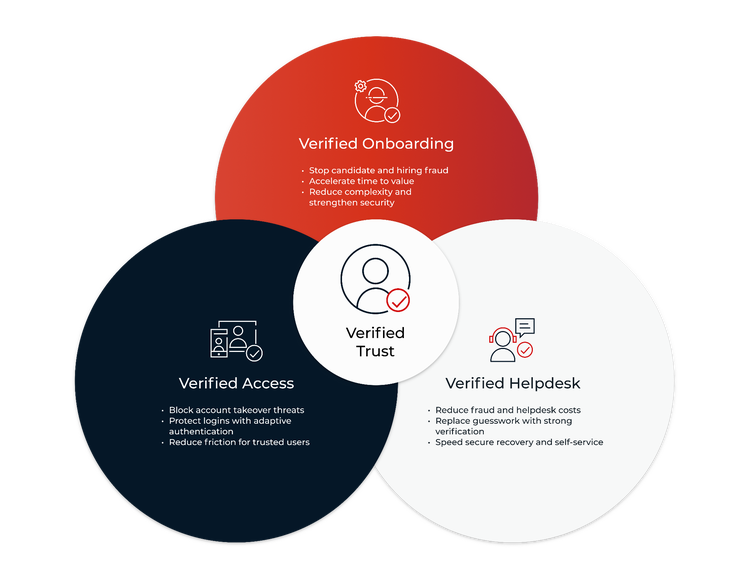
Through three modular use cases — Verified Onboarding, Verified Access, and Verified Helpdesk — organizations can deploy each solution independently to address specific pain points without changing existing infrastructure. Together, they establish trust before access exists, maintain trust during access, and re-establish trust securely when needed.
At its core, Verified Trust ensures every high-risk workforce interaction is verified, not assumed.
Key Capabilities to Protect Against Organized Attacks
Achieving Verified Trust requires more than standard authentication alone. It demands advanced capabilities like identity verification, threat protection, phishing-resistant multi-factor authentication (MFA), zero-knowledge biometrics, verifiable credentials, orchestration, and reusable trust anchors working together across workforce interactions.
*Choose at least one optional item to establish a trust anchor for later reuse in Verified Access and Verified Helpdesk workflows
Verified Onboarding
- Prevent hiring fraud and insider risk by verifying workers before interviews, offers, or Day 1 access.
- Lower onboarding costs and wasted effort by stopping unverified candidates earlier in the process.
- Revalidate existing workforce populations to create a verified baseline when risk, incident response, or audit requirements warrant it.
Verified Access
- Reduce AI-driven credential attacks, phishing, MFA fatigue, and session hijacking with real-time, risk-aware access controls.
- Improve productivity and reduce friction for legitimate users while stepping up verification for sensitive actions and elevated mid-session risk.
- Apply consistent, adaptive policy enforcement across identity providers, applications, and workforce environments.
Verified Helpdesk
- Re-establish trust during password resets, MFA re-enrollment, device changes, account recovery, and other high-risk support interactions.
- Reduce social engineering and helpdesk attacks with high- assurance proofing for every support request, tied to the originally verified identity.
- Lower call center volume and operational cost with secure self-service verification and recovery while maintaining strong, consistent assurance.
Verified Trust delivers measurable business value by reducing operational risk, strengthening identity assurance, and improving productivity and user experience across the workforce lifecycle.
2 2024 State of Cloud Account Takeover Attacks, Abnormal AI
3 Scattered Spider: Who They Are, How They Attack, and How to Defend Against Them, AbnormalAI, June 2026
At Ping Identity, we make it possible to trust every digital moment across customers, employees, partners, and non-human identities. Whether you’re securing millions of users, fighting fraud, simplifying third-party access, or going passwordless, establishing trust shouldn’t slow you down. Our enterprise-grade identity platform is built for scale, speed, and flexibility and works seamlessly with your existing cloud, hybrid, and on-prem environments. We help you confidently embrace AI and automation with Runtime Identity, so you can continuously verify the identity, context, and intent of every AI agent and control their actions in real time. With Ping, all digital experiences start with trust. Learn more at pingidentity.com.