Understanding Insider Threats
The Most Dangerous Attack Vector
Insider threats have emerged as a significant challenge in the modern cybersecurity landscape. Unlike external attacks, insider threats originate from within an organization—from employees, contractors, digital workers, or trusted third-party partners. These threats are often more difficult to detect and can cause devastating damage to a company’s reputation, finances, and operational stability. Insider-related incidents remain a significant breach driver, with internal actors accounting for nearly one out of every five incidents and costs averaging $4.44 million per breach.1, 2
In this guide, we’ll explore the nature of insider threats, why traditional identity access management (IAM) systems fail to address them effectively, and how a modern workforce identity platform that combines IAM, identity governance and administration (IGA), just-in-time (JIT) privileged access, and verified trust services, provides a more complete approach. By understanding and addressing these risks, organizations can safeguard their sensitive data and maintain trust with their stakeholders.
Types of Insider Threats
Insider threats are security risks that originate from individuals within an organization who have access to sensitive systems or data. These threats fall into three main categories:
- Malicious Insiders: Individuals who intentionally misuse their access to harm the organization.
- Negligent Insiders: Employees, contractors, or partners who inadvertently cause security breaches through careless actions.
- Compromised Insiders: Users whose credentials have been stolen and are being exploited by external attackers.
- AI Agents & Digital Workers: These new identity types frequently have access to sensitive resources and act autonomously within organizational systems, creating unique security vulnerabilities.
The motivations behind insider threats vary, ranging from financial gain and espionage to simple human error. Furthermore, in today’s world, AI agents and digital workers, if overprovisioned, can be exploited by bad actors, leading to lateral movement within enterprise systems. Regardless of intent, the consequences can be severe: data breaches, intellectual property theft, regulatory fines, and reputational damage. Warning signs often include unusual login patterns, unauthorized data downloads, or attempts to access restricted areas.
Recognizing these signs is crucial for early intervention, and it requires a workforce identity platform that applies Zero Trust principles—least privilege, just‑in‑time access, and continuous verification—across IAM, IGA, JIT privileged access, and verified trust services.
Why Siloed IAM Can’t Stop Insider Attacks
Traditional IAM systems often operate in distinct silos, separating access, governance, and privilege, so they:
Ping’s Role in Identifying Insider Threats
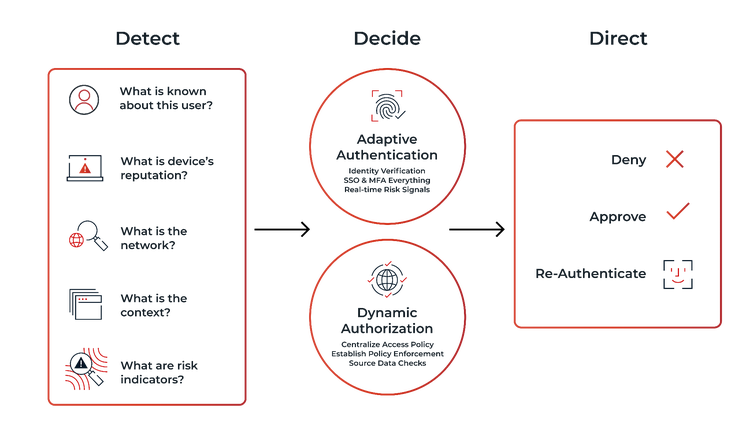
Ping helps organizations address insider threats through the “Detect, Decide, Direct” framework. First, Ping’s advanced threat protection capabilities detect potential threats in real time by identifying unusual patterns such as unexpected login attempts or anomalous data access. Second, our decision engine assesses the severity of the threat to determine whether an action requires immediate intervention. Finally, Ping’s orchestration capabilities direct appropriate responses, such as re-verifying against a high-assurance credential, escalating incidents to security teams or enforcing stricter access policies. This end-to-end approach ensures organizations can act swiftly and effectively to mitigate risks and protect sensitive assets.
Thwarting Insider Threats
Ping Identity offers a unified approach to identity and access management, equipping organizations with the tools needed to detect and mitigate insider threats effectively. Here’s how Ping can help:
Identity & Access Management

Identity Governance & Admin
Verified Trust
JIT Privileged Access
Ready to Plan Against Insider Threats?
Insider threats pose a unique and significant challenge to organizations, but they are not insurmountable. By understanding the nature of these threats and addressing the limitations of siloed IAM systems, businesses can take meaningful steps toward safeguarding their sensitive data and systems.
Ping Identity provides the tools and expertise to help organizations detect, prevent, and respond to insider threats through a workforce identity platform that unifies access, governance, JIT privileged access, and verified trust services across human and AI agent identities. With centralized visibility, advanced threat detection, and seamless integration capabilities, Ping delivers a comprehensive solution that empowers businesses to stay ahead of evolving risks.
¹ Verizon - 2025 Data Breach Investigations Report
² IBM - 2025 Cost of a Data Breach Report
At Ping Identity, we believe in making digital experiences both secure and seamless for all users, without compromise. That’s digital freedom. We let enterprises remove passwords, prevent fraud, support Zero Trust, and more. That’s why more than half of the Fortune 100 choose Ping Identity. Learn more at pingidentity.com.