PingOne Recognize
PingOne Recognize is Ping Identity's biometric authentication solution. It combines true identity assurance, proprietary liveness, privacy-preserving technology, and device-agnostic architecture to reduce fraud, improve UX, and lower authentication costs.
Features
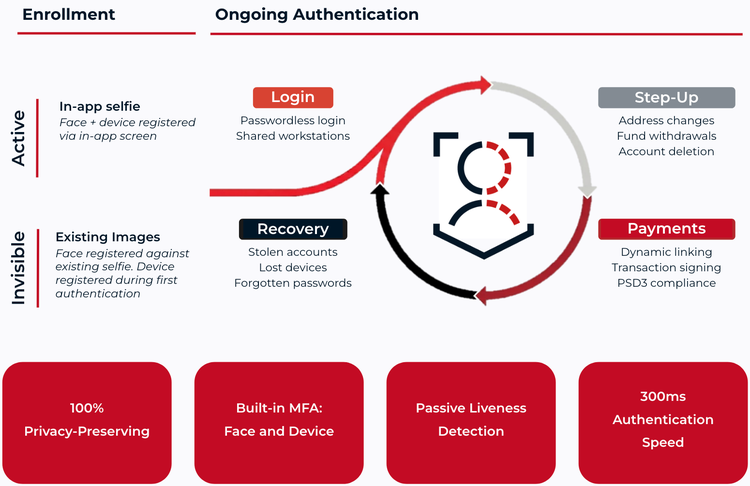
- Native, web, and mobile browser deployments via multi-tenant cloud or self-managed software.
- Active enrollment available via a customizable screen.
- Invisible enrollment available via IDV Bridge—users are bulk-enrolled using previously verified identities.
- Multi-factor by design—face and device—for flows where the device is not shared.
- Passive liveness—no blinking or head movements.
- Certified presentation and injection attack prevention.
- 300ms authentication speed.
- Works on any device (phone, shared tablet, desktop) with a front-facing camera.
- Multiple users can share the same device, and one user can authenticate on multiple bound devices.
- Can be combined with PingOne DaVinci, PingOne Verify, and PingOne Protect for verified trust flows.
Feature Detail
Icon

Heading
Flexible Deployment & Integration
Description
Deploy PingOne Recognize wherever it’s needed—without re-architecting.
- SDKs for native mobile (iOS, Android, React and Flutter) as well as web (for desktop and mobile browsers).
- Available as multi-tenant SaaS or self-managed software.
- Deployable alongside PingOne or any third-party IdP or CIAM platform.
- Apply selectively to specific journeys (e.g., transactions or account recovery).
Icon

Heading
Risk-Based & Orchestrated Authentication
Description
Apply biometric authentication dynamically based on context and risk.
- Integrates with Ping’s orchestration layers.
- Trigger authentication based on risk signals, behavior, and transaction context.
Icon

Heading
Deepfake-Resistant
Description
Prevent presentation and injection attacks with layered defense.
- When the device is not shared, both face and device are needed to authenticate; remote deepfake attacks fail without the original device.
- Certified liveness detection stops presentation attacks by ensuring a real user is present, not a mask or deepfake.
- Injection attack prevention checks for device compromise e.g. spoofing tools.
- Behavioral signals detect unnatural device movement.
Icon

Heading
Privacy-Preserving Architecture
Description
Prevent presentation and injection attacks with layered defense.
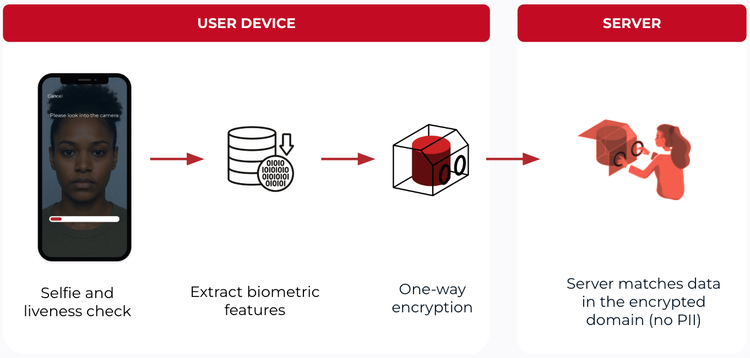
- The mobile/web SDK captures a selfie.
- Certified liveness and anti-injection checks are run on-device.
- The resulting template is transformed into a cryptographic representation and sent to the PingOne Recognize server (AWS Nitro for web).
- The PingOne Recognize server validates the match without storing any PII or biometric data in retrievable or reconstructable form.
Title
Identity Assurance Use Cases Across the Full User Lifecycle
Card Image
Card Title
Hide Accent Bar
Card Subtitle
Card Body
Card Link

Verified Opening
true
Active enrollment via a standalone Ping screen, or invisible enrollment using previously verified identities or employee images—eliminating user-driven enrollment entirely.

Verified Access
true
Protect logins and critical account changes (CIAM), secure employee access on any shared workstation (Workforce & B2B), and dynamically link transactions to the amount and account details (Payments).

Verified Recovery
true
Dramatically reduce the cost of account recovery with instant, self-service re-verification. Marry new devices to existing accounts with one glance at the camera.

Shared Devices (Frontline Workers)
true
Authenticate employees on any shared terminal without needing a token or unique device.
Title
Certifications
Card Image
Card Title
Hide Accent Bar
Card Subtitle
Card Body
Card Link

NIST FRVT 1:1
true
One of the highest commercially available face matching models.

ISO/IEC 30107-3 Evaluation
true
Detects biometric fraud (photos, masks, videos). Strong protection against spoofing and ID fraud.

CEN/TS 18099 Certified
true
High-level certification against injection attacks.

Privacy-Preserving
true
Validated ability to operate without explicit user consent. Not a data processor under GDPR.