Balancing Regulatory Compliance & Security
Digital identity management presents complex challenges across both commercial enterprises and government sectors as they navigate evolving security, privacy, and compliance mandates. For most organizations, frameworks from the National Institute of Standards and Technology (NIST), like NIST SP 800-63-3, have long established the foundation for digital identity governance, serving as authoritative commercial guidance since its release in June 2017. However, with the emergence of NIST SP 800-63-4, the traditional monolithic model has become modular, requiring adherence to distinct assurance levels.
This shift reflects the broader need for flexible, resilient, and scalable identity and access management (IAM) that can support dynamic integrations and continuous and adaptive verification within a unified platform. These capabilities are essential not only for regulatory compliance, but also for enabling a secure, Zero Trust architecture that supports modern digital transformation initiatives.
Addressing the NIST SP 800-63-4 Assurance Levels
Identity solutions empower organizations across public and commercial sectors to meet the technical requirements of NIST SP 800-63-4 by directly addressing its three interdependent assurance levels:
- Identity Assurance Level (IAL) — 800-63A-4
- Authenticator Assurance Level (AAL) — 800-63B-4
- Federation Assurance Level (FAL) — 800-63C-4
NIST SP 800-63A, "Identity Proofing and Enrollment," focuses on the technical requirements for a user to prove their real-life identity and become a valid subscriber. This process, known as identity proofing, is a foundational element of a Zero Trust architecture, as it establishes the initial trust in an identity. Ping Identity helps organizations meet the requirements of NIST SP 800-63A with a single platform that supports the collection of necessary identity attributes and their associated assurance levels.
Each of the three assurance levels represents a critical dimension of digital identity trust. Together, they form the backbone of NIST SP 800-63-4 compliance by ensuring that users are accurately identified, securely authenticated, and seamlessly federated across systems. By addressing these layers in tandem, organizations can establish a comprehensive identity foundation that not only meets compliance requirements but also strengthens the Zero Trust posture. Let’s explore how each assurance level contributes to building this trusted framework.
IAL Guideline Compliance
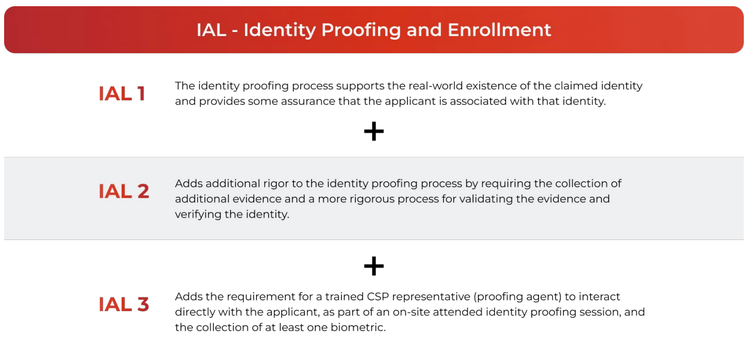
Identity platforms support all three IALs:
- IAL1 (Self-asserted): Collects self-asserted attributes from an applicant.
- IAL2 (Remote or in-person): Gathers more robust identity evidence, allowing for remote or physically-present scenarios as described in NIST SP 800-63A.
- IAL3 (In-person or remote attended): Supports the rigorous identity-proofing processes required for the highest assurance level.
User Registration & Profiling
Capabilities for user registration, onboarding, progressive profiling, and self-service that work with major identity-proofing services (i.e., Ping Verify, ID.me, Socure) and IDP’s (i.e., Login.gov) and capture and record assurance levels for each attribute are critical to complying with IAL guidelines. Ping can store attributes with metadata that indicates the asserted IAL from the authoritative source.
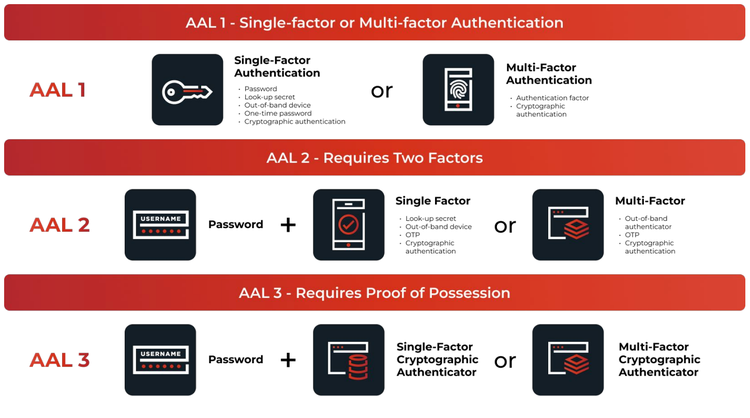
NIST SP 800-63B, "Authentication and Authenticator Management," defines the technical requirements for establishing confidence that a claimant is in control of the authenticators bound to their digital identity. These AALs are crucial for assessing the robustness of the authentication process. In a Zero Trust architecture, AALs are a foundational element, providing strong identity signals as a foundation to build continuous verification policies.
- AAL1: Enforce restricted access and ensure communication channels are protected, while continuously evaluating other contextual signals in a Zero Trust context.
- AAL2: Orchestrate a multi-factor journey by requiring a FIDO compliant and/or biometric authentication after a username/password.
- AAL3: Enforce hardware-backed authenticators like PIV/CAC cards, which provide FIPS 140-level protection and verifier impersonation resistance. Ping supports passwordless solutions that can even further extend these authentication methods. Even with the strongest authenticators, Ping maintains continuous authorization policies, ensuring that trust is never static.
AAL Guideline Compliance
A modern identity platform provides all the necessary components and flexible architecture to achieve NIST SP 800-63B compliance across all AALs. The platform provides over 100+ nodes to support authentication, authorization, and lifecycle management of identities, including OTP, multi-factor authentication (MFA), FIDO and WebAuthN.
Adaptive authentication and policy orchestration capabilities can create dynamic, risk-based authentication journeys by evaluating digital signals like known location and device fingerprint. This enables a step-up authentication to be automatically triggered if a high-risk signal/anomaly is detected, reinforcing the Zero Trust principle of continuous verification. For example, Ping can enforce added AAL levels based on signals or behavior for additional authentication decisions.
Extensive Authenticator Portfolio
A unified identity platform can support a wide range of authenticator types as permitted by NIST SP 800-63B, including memorized secrets, out-of-band devices, and various cryptographic authenticators and FIDO-based tokens.
Adaptive Authentication & Policy Orchestration
A cornerstone of both NIST guidelines and Zero Trust is orchestration. Ping's low-code/no-code orchestration engine allows administrators to design custom and compliant user experience (UX). Ping's platform utilizes an advanced policy engine to create dynamic, risk-based authentication journeys. It can evaluate a wide array of contextual digital signals, such as device posture, geolocation, and IP reputation. It can also enforce both RBAC and ABAC authentication decisions based on real-time analysis. Decision nodes within customizable authentication journeys can automatically trigger a step-up authentication for high-value applications and/or if a high-risk signal is detected.
Federation & Assertions
NIST SP 800-63C, "Federation and Assertions,” provides requirements to identity providers (IdPs) and relying parties (RPs). Ping Identity is an active participant in developing and modifying the standards around federation.
The Ping Identity Platform natively incorporates robust federation capabilities that are fundamental to extending Zero Trust principles across an organization's distributed applications and partner ecosystems.
FAL Guideline Compliance
It’s important that your IAM platform offers a powerful federation engine that supports open standards such as SAML 2.0, OpenID Connect (OIDC), and OAuth 2.0. This ensures assertions are generated and protected in strict accordance with NIST SP 800-63C. All assertions are cryptographically signed to ensure integrity and authenticity. For FAL2 and FAL3, the platform encrypts the contents of assertions.
Modern capabilities ensure that assertions are generated and protected in strict accordance with NIST SP 800-63C, including:
- Digital Signatures: Assertions are cryptographically signed using keys or Message Authentication Codes (MACs) to ensure their integrity and authenticity.
- Encryption: For FAL2 and FAL3, and whenever assertions pass through untrusted intermediaries, assertion contents are encrypted. This protects sensitive attributes in transit, upholding Zero Trust's data protection principles.
- Audience Restriction: Generated assertions include explicit audience restrictions, preventing the injection and replay of assertions intended for one relying party at another, which strengthens the security policy tenet.
Back- and Front-Channel Presentation
It’s important that your identity platform enables both back- and front-channel presentation models as described by NIST. The back-channel model is recommended for FAL2 and above because it minimizes information leakage through the user's browser. Zero Trust requires trusted assertions to be continuously evaluated, and Ping's granular attribute consumption and policy enforcement ensure that access decisions are made with the latest contextual information, even across federated boundaries.
Privacy-Enhancing Techniques
IAM solutions should support privacy-enhancing techniques aligned with Zero Trust's least privilege and data protection principles, including:
- Attribute Minimization: Enables requesting only the minimum necessary attributes or derived attributes to minimize exposure of personally identifiable information (PII), aligning with Zero Trust's "least privilege access to data." Identity APIs allow for attributes to be fetched only when needed, reducing unnecessary data exposure.
- Explicit Consent & Notice: Support mechanisms for explicit user consent before transmitting attributes to relying parties, ensuring predictability and manageability throughout the process. This gives users control over their data, building the trust critical to the adoption of secure Zero Trust environments.
- User-Controlled Wallets: Support for user-controlled wallets (digital wallets) aligns with NIST SP 800-63C's focus on this emerging model. These wallets, acting as identity providers controlled by the subscriber, enable selective disclosure of attributes from a provider to a relying party. This gives the subscriber direct control and consent over the disclosure of their attributes.
Table 1 — Federation Assertion Levels
Table 2 — NIST Special Publication 800-63C
Legacy Application Support
Legacy application support is provided for systems that rely on header authentication or forms-based authentication, ensuring compliance without requiring full modernization of existing environments.
Zero Trust & Critical Assurance
The NIST SP 800-63-4 Digital Identity Guidelines are not just complementary to Zero Trust, they are essential to it. As one of the most authoritative frameworks in digital identity, NIST 800-63-4 lays the technical foundation for implementing Zero Trust by formalizing the three critical assurance components: strong identity proofing (IAL), MFA (AAL), and secure federation (FAL). These elements directly align with, and reinforce, Zero Trust’s core principles: “Verify Explicitly” and “Continuous Verification.”
Ping Identity Supports NIST SP 800-63-4 with Modern IAM
Ping Identity provides a unified platform designed to meet the requirements of NIST SP 800-63-4 through the following key capabilities.
Intelligent User Registration & Self-Service
Robust capabilities for user registration, forgotten username/password reset, and progressive profiling are key components in ensuring security and experience are working in tandem. These features are designed to be integrated directly into authentication journeys, minimizing user friction and confusion while simultaneously gathering essential identity attributes. By collecting these attributes within the user journey, Ping establishes initial trust signals and enriches the user profile, which can then be leveraged for adaptive authentication and continuous authorization in a Zero Trust model.
Adaptive Authentication & Policy Orchestration
Modern IAM solutions utilize advanced policy engines and orchestration capabilities to create dynamic, risk-based authentication journeys. This involves:
Evaluating Digital Signals
Your system needs to be able to ingest and evaluate a wide array of contextual digital signals, such as device posture (e.g., whether a device is managed, patched, or jailbroken), geolocation, IP reputation, and behavioral analytics (e.g., unusual access patterns or user behavior deviations).
Decision Nodes
Decision nodes process these signals in real time within customizable authentication journeys. This allows for dynamic adjustments to the authentication requirements. For instance, if a high-risk signal is detected, a step-up authentication (requiring an additional factor) can be automatically triggered.
Risk Scoring
The platform assigns a dynamic risk score, based on the aggregated contextual information, to each access attempt or ongoing session. This score is pivotal for informing explicit authorization decisions in a Zero Trust framework.
Informing Downstream Applications
The accumulated knowledge and derived risk scores from the authentication journey can be asserted to RPs and other downstream applications. This provides critical context to make granular, real-time access decisions and enforce Zero Trust policies like least privilege.
Comprehensive Federation & API Security
Ping provides robust support for all major federation and authorization standards, enabling secure, interoperable identity across diverse ecosystems, including:
- SAML 2.0: For secure exchange of authentication and authorization data between disparate identity domains, facilitating single sign-on (SSO).
- WS-Federation: Primarily for enterprise identity federation within Microsoft-centric environments.
- OAuth 2.0: As a widely adopted authorization framework for delegated access, allowing users to grant third-party applications limited access to their resources without sharing credentials.
- OpenID Connect (OIDC): Builds on OAuth 2.0 to provide an identity layer, enabling verification of authentication performed by an Authorization Server and the retrieval of basic profile information about the end-user. This is key for enabling SSO and verifiable identity claims.
Benefits for NIST SP 800-63-4 Compliance & Zero Trust Implementation
Modern IAM platforms deliver compelling benefits for government agencies and enterprises seeking to achieve NIST SP 800-63-4 compliance while simultaneously building and strengthening a Zero Trust architecture.
Deployment Flexibility
By maintaining feature parity across IL5, FedRAMP High, and traditional software deployments, agencies can configure once and deploy anywhere, even in DDIL environments. This adaptability ensures identity can serve as a cornerstone of any Zero Trust architecture.
Simplified, Granular Compliance
Advanced identity ecosystems are engineered to directly map to NIST's componentized IAL, AAL, and FAL framework, providing granular control and clear, auditable pathways to compliance and significantly reducing the burden and complexity. By providing the detailed assurance levels and technical mechanisms required by NIST, Ping delivers signals necessary for precise Zero Trust policy enforcement.
Enhanced Security Posture & Continuous Verification
Elevate your overall security posture by mandating and enforcing strong authentication factors, leveraging approved cryptographic techniques, and ensuring secure communication protocols (e.g., TLS/HTTPS, FIPS 140-validated modules). Leverage an identity platform with adaptive authentication capabilities to enable verification of users, devices, and context throughout the session, mitigating risks from sophisticated attacks such as impersonation, replay, phishing, and insider threats.
Improved UX & Adoption
Despite the underlying technical rigor, Ping delivers a frictionless and intuitive UX. Adaptive authentication journeys, streamlined self-service capabilities (self-registration and password reset), and seamless federation (SSO) reduce friction points. This not only enhances satisfaction, but also fosters greater adoption of secure identity practices, reducing the temptation for users to find insecure workarounds and decreasing helpdesk needs.
Adaptability for Evolving Threats
By taking an open standards-based approach, you can ensure interoperability and avoid vendor lock-in. Ping’s highly configurable policy engine allows organizations to rapidly adapt to new threats, integrate emerging authenticator technologies (e.g., future FIDO standards), and meet changing regulatory requirements. This built-in agility provides long-term compliance and future-proofing in a dynamic threat landscape.
Privacy by Design
With integrated capabilities for data minimization, pseudonymity, and explicit user consent management, Ping helps organizations embed privacy into their identity architecture from the ground up. This aligns directly with NIST's emphasis on protecting personal information and reinforces Zero Trust's "least-privilege" principle of access, ensuring that sensitive information is only accessed and processed when necessary and with user awareness.
Never Trust, Always Verify
As a recognized leader in IAM and identity governance, Ping Identity empowers organizations to confidently navigate the intricacies of digital identity. The platform is purpose-built to address the three assurance levels mandated by NIST SP 800-63-4: IAL-A, AAL-B, and FAL-C.
By aligning with the core tenets of Zero Trust, “never trust, always verify,” and continuous verification, Ping enables organizations to enhance their security posture, simplify compliance, and improve the UX through adaptive, risk-based identity journeys. Its extensible and standards-based architecture ensures long-term agility and interoperability, making it a future-proof solution in the face of evolving requirements.