Product Overview
PingOne Privilege redefines privileged access management (PAM) by moving beyond vault-centric password control to just-in-time (JIT), passwordless privileged access. It eliminates static credentials for the majority of human privileged access use cases by issuing ephemeral, policy-driven access that automatically revokesd at session end, enforcing Zero Standing Privilege as an operating model.
Designed for administrators, developers, DevOps, security teams, contractors, and workloads, it unifies privileged access across multi-cloud, hybrid, and on-prem environments while cryptographically binding sessions to verified identities and trusted hardware using TPM-backed assurance. Instead of assuming trust at login, PingOne Privilege continuously verifies identity, device, and context during the session, reducing attack surface without compromising productivity.
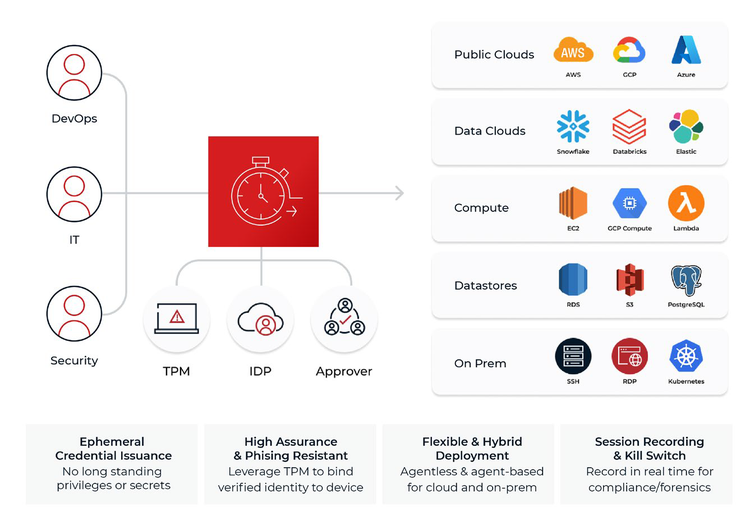
Business & Technical Value

Reduced Attack Surface Across Hybrid Environments

Lower Breach Impact & Blast Radius

Phishing-Resistant, Hardware-Bound Privileged Access

Unified, Risk-Aware Privileged Control

Improved Operational Efficiency Without Sacrificing Security
Key Features
Runtime Privileged Access Enforcement
- Issues ephemeral, task-scoped privileged access at runtime, not at login
- Automatically revokes access at session end with no residual elevation.
- Enforces session-level controls, monitoring, and real-time policy validation.

95/5 Credential Elimination Model
- Eliminates static credentials for approximately 95% of human privileged access use cases.
- Removes password checkout and long-lived SSH keys from the human access path.
- Integrates with existing vaults for narrow bootstrap or break-glass scenarios.
Zero Standing Privilege as an Operating Model
- Removes persistent administrator accounts and always-on elevated roles.
- Grants time-bound, granular access aligned to specific tasks or intent.
- Enforces automatic privilege expiration without manual cleanup cycles.
TPM-Backed, Hardware-Bound Assurance
- Cryptographically binds privileged sessions to a verified identity and a specific physical device.
- Protects private keys within tamper-resistant TPM hardware (ISO/IEC 11889 standard, widely FIPS-validated).
- Prevents credential replay, session hijacking, and unauthorized device access even if OS or file systems are compromised.
Unified Identity-Native Privilege Control
- Integrates with identity verification, governance, orchestration, and risk engines across the Ping Identity platform.
- Ingests contextual signals (device posture, anomaly detection, behavioral risk) into runtime authorization decisions.
- Enables adaptive policies and step-up authentication for sensitive actions.
Integrations

Identity Providers & Directories

Infrastructure

Authentication & MFA