Introduction
Unlock the potential of the Ping Identity Platform to create digital experiences that engage customers, accelerate business growth, and decrease fraud losses, while improving operational efficiency and accelerating your time to market. This guide outlines the capabilities required to help your retail business deliver seamless, secure customer identity journeys.
This guide will demonstrate how to:
- Attract new customers
- Grow loyalty and customer lifetime value
- Reduce ecommerce fraud
- Personalize at scale
You will also find solution diagrams and identity experiences that highlight best practices and showcase the power of Ping Identity in helping deliver exceptional digital experiences.
Each identity experience includes an out-of-the-box template that is ready to use and built on security best practices. These templates can be used as examples or customized for your specific use case.
Identity Overview for Retail
This overview can be used as a foundation for your identity initiatives. You'll be able to map common retail business goals to different stages of the customer identity journey and uncover capabilities that matter most for your success.
This identity overview breaks down the entire customer identity journey, from an anonymous visitor all the way to a loyal, repeat buyer.
This guide is aimed at helping you understand the core identity platform features that will drive your digital identity strategy. You will be able to identify new opportunities to scale by leveraging identity solutions that differentiate your retail business.
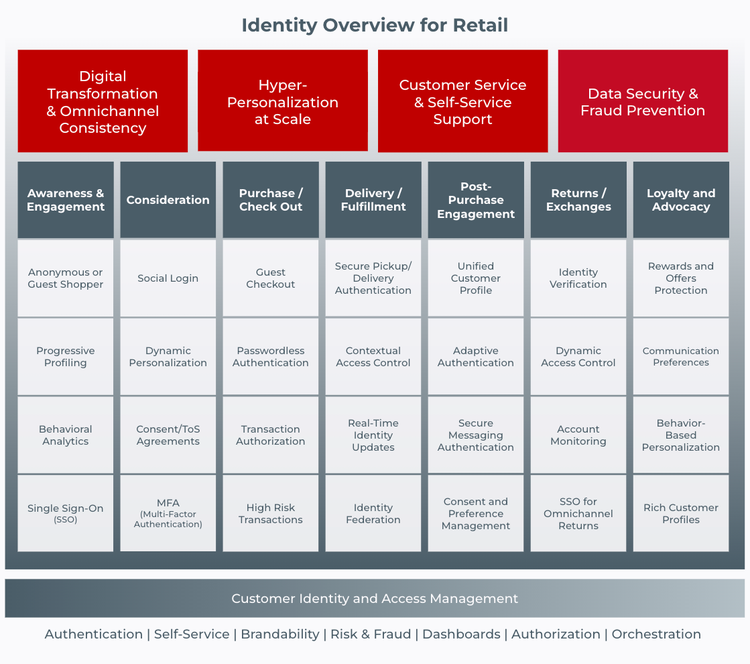
The Identity Overview offers a holistic approach to understanding core identity functions relevant for most retail businesses.
The customer identity journey can be broken down into several critical phases, each demanding specific identity solutions:
- Awareness and Engagement: Allow customers to explore products anonymously or with minimal friction while enabling retailers to gradually build customer profiles for future personalization through progressive profiling.
- Consideration: Simplify access for consumers by letting them log in with social accounts, making it easy for them to browse and compare products securely across multiple devices and platforms without friction.
- Purchase / Check Out: Enable secure and streamlined checkout experiences through passwordless authentication or multi-factor authentication (MFA) for sensitive transactions, reducing friction and securing payment processing while protecting against fraud with passive security checks.
- Delivery / Fulfillment: Guarantee that the right person picks up orders or receives deliveries securely through identity verification. Leverage threat signals to detect risky behavior and prevent unauthorized changes to delivery options.
- Post-Purchase Engagement: Ensure secure access to order histories, tracking information, and ongoing post-purchase engagement through preferred communication channels, all while maintaining data privacy.
- Returns / Exchanges: Verify identities during return or exchange processes to validate that the right person initiates the request. Secure customer accounts from fraud during this phase by monitoring for unusual behavior.
- Loyalty and Advocacy: Secure access to loyalty programs and rewards via SSO or federated identity to ensure that customers can easily redeem offers and participate in loyalty programs, while also protecting their accounts from unauthorized access.
These phases can be grouped into four strategic focus areas:
- Digital Transformation and Omnichannel Consistency: Drive digital transformation with a unified, secure, and scalable approach to managing customer identities across all channels. Centralize identity and authentication processes to deliver seamless, personalized experiences whether customers are shopping online, via mobile, or in-store. Easily integrate your identity solution with existing systems, and adapt quickly to changing market demands while maintaining robust security and compliance.
- Hyper-Personalization at Scale: Retailers can offer personalized experiences tailored to individual customer preferences through data analytics and identity-driven insights by creating targeted marketing campaigns and reward programs that encourage repeat purchases, resulting in higher lifetime customer value.
- Customer Service and Self-Service Support: Allow customers to resolve common issues on their own with features like self-service account recovery, password resets, profile updates, and more. Streamline identity verification and authentication during support interactions, minimizing wait times and operational costs.
- Data Security and Fraud Prevention: Prevent identity fraud and secure customer data by offering features like multi-factor authentication (MFA), adaptive risk-based authentication, and real-time threat detection. Ensure that only legitimate users can access sensitive information, while suspicious activities are quickly flagged and mitigated — protecting against account takeovers, new account fraud, coupon and rewards abuse, automated attacks, and other threats.
Identity is fundamental across all stages of the customer journey and ensures a robust security framework that adapts to evolving retail needs. This overview gives a foundational introduction into how identity solutions can support your business needs.
Reference Architecture for Retail
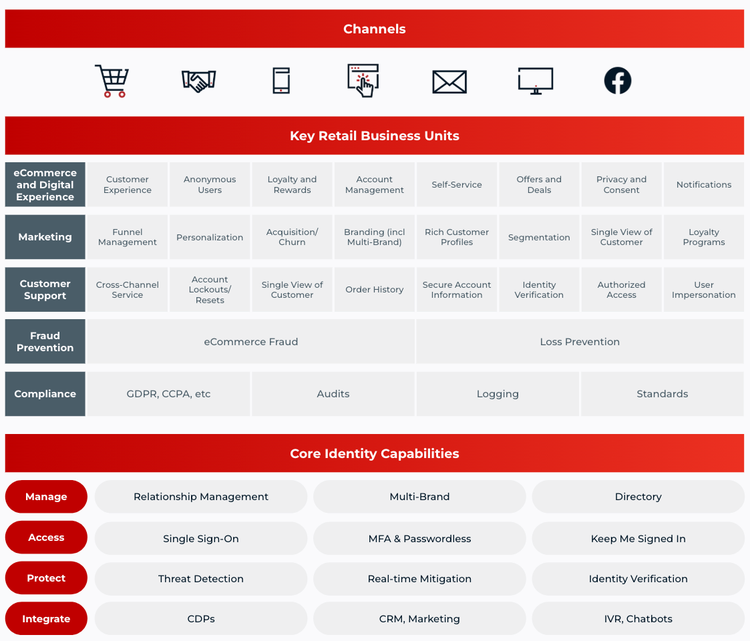
To build comprehensive identity solutions that support shoppers throughout their journey, retailers need to deliver integrated solutions across different business units and systems. This Identity Reference Architecture serves as a strategic communication tool, helping you articulate the identity vision to both business leaders and technical stakeholders across your organization.
Align the Ping Identity Platform with the key business units that shape your customers' digital experiences to understand how a customer identity and access management solution can effectively drive meaningful results.
Core Identity Capabilities
These core capabilities create the essential foundation for realizing your identity objectives. Each layer of the Ping Identity platform builds on top of the next. Retailers typically rely on these core functions for their customer identity needs. Additionally, there are other considerations that are required in an end-to-end customer identity solution, including:
Manage
Relationship Management
The power of identity goes beyond just securing access — it's about understanding and managing the complex relationships between linked users, such as parent/child, family, friends, or other similar relationships. A robust customer identity platform must effectively recognize and maintain these relationships to ensure the right access controls are in place. For example, a parent should be able to manage a child's account access with appropriate permissions, and a friend should only have access to shopping lists. By linking these identity relationships, your brand can provide seamless, secure, and personalized access.
Multi-Brand
Granting the right users access to the right digital properties needed to complete their purchases in a timely manner is a growing challenge when an organization owns multiple retail brands that need to present unique digital experiences. Leverage multi-brand functionality to provide a consistent experience across multiple brands, while still maintaining distinct brand identities. For example, present a highly personal shopping experience on a preferred brand, introduce a loyalty program for users of a particular brand, or strategically micro-target products and services that the consumer may be interested in.
Directory
Enable secure and real-time access to unified customer profiles across all channels to deliver more personalized experiences while enhancing compliance and reducing fraud risks through centralized identity management.
Access
Single Sign-On
SSO streamlines customer access across multiple services, enhancing security and convenience while reducing reliance on passwords, increasing user engagement, and providing a frictionless customer experience.
MFA & Passwordless
Enhance security and reduce the reliance on passwords — a common vulnerability — while offering customers a seamless and convenient way to verify their identities, preventing fraud and strengthening trust.
Keep Me Signed In
Increase the likelihood of repeat purchases by making it easier for customers to access their account without having to re-enter their credentials. Retailers can offer secure extended session experiences by leveraging passive risk and fraud signals to keep active user sessions open longer — allowing legitimate customers to easily return to their accounts and their shopping carts without friction.
Protect
Threat Detection
Safeguard against modern cyber threats, like bots, account takeovers, and new account fraud. Incorporate threat detection throughout the user journey and create composite risk scores in real time to enable mitigation, protecting both customer data and institutional assets from breaches and financial loss.
Real-Time Mitigation
Fraud attacks can happen in a split second. Create real-time decisioning and mitigation policies that introduce additional security measures, like step-up multi-factor authentication (MFA), in situations where risk is high. Prevent account takeovers, new account fraud, loyalty and coupon abuse, and automated attacks before the bad actor can reach checkout.
Identity Verification
Guarantee the legitimacy of customer identities during high-risk transactions and verify identities in real-time through methods like biometric checks and documentation authentication, or implement voice verification before connecting with a support agent during a risky event.
Integrate
IVRs
Interactive Voice Response systems (IVRs) are automated telephony systems that interact with callers, gather information, and route calls based on the responses received. Integrate these systems with your CIAM solution to enhance security and improve the customer experience during support calls. This integration allows for secure identity verification and authentication with automated systems — reducing manual steps and enabling frictionless support.
Chatbots
Users interact with chatbots to seek convenience, access their information quickly, and easily resolve and troubleshoot issues, like account lockout. Integrating your chatbot with your CIAM platform can introduce secure authentication and verification services within your chatbot interactions.
Marketing, CRM, CDPs
Integrating your CIAM platform with your marketing, CRM, and CDP systems enables syncing of customer identity and behavior to deliver more personalized services and create richer user profiles.
Identity Experiences for Retail
Identity experiences can help bridge the gap between your organization's strategic objectives and the identity solutions required to meet them. The most common identity experiences in retail are outlined below, providing a clear path to achieving your goals.
Retail Identity Experiences
Improve the Guest Experience and Increase Conversions
Exceed customer expectations and deliver personalized guest experiences by creating new accounts during a checkout event. When a user enters their details (name, email, shipping address, etc.) and agrees to create an account, easily pass that user information to Ping to create their account along with prompting the user to create a password or enrolling them in a passwordless authentication experience.
Keep Bad Actors From the Buy Button
Incorporate passive fraud checks earlier in the session, as well as softer mitigation measures, to improve legitimate user experiences while stopping fraudsters before they even get to checkout.
Sync New Users Across Systems
Unlock the full potential of customer data by ensuring real-time synchronization of user profiles from your identity platform with your CRM/CDP and marketing systems. For example, a user may update their preferences in their account. When updated, capture this information about the user in your marketing platform to deliver personalized recommendations.
Migrate Social Users to Your Identity Platform
Seamlessly transition users while preserving their login experience. Gain better control over customer data, deliver more personalized marketing and shopping experiences, and enhance security — all without disrupting user engagement or loyalty.
Stop Coupon and Reward Abuse
Protect legitimate customers and their hard-earned rewards from bots and bad actors who have taken over their account or have created a new account with their personal information.
Keep Customers Signed In
Drive engagement and repeat purchases by extending active user sessions to a day, week, month, or full year. By leveraging threat detection, user sessions can securely remain active for a customizable period of time. Make it easy for customers to get back into their accounts and continue shopping without having to re-enter their password.
Deliver Seamless Passwordless Experiences
Remove passwords altogether by offering more secure authentication methods that don't require the saving or remembering of passwords. For example, magic links offer a quick way for users to log back in. For a more secure method, opt for FIDO2 Passkeys that use secure biometric authentication.
Enable Simple Social Login
Customers might prefer to create a new account with their existing social identity from platforms like Facebook, Apple, or Google. By offering social authentication, customers can quickly create new accounts by linking them to their social identity — another preferred way to sign up and sign on without creating another account and password.
Create Smoother Customer Service Experiences
Make it easy for customers to quickly get the help they need by offering simple self-service account recovery. Free up users and support agents, reduce call hold times, and help customers get back into their accounts easily.
Solution Architecture for Retail
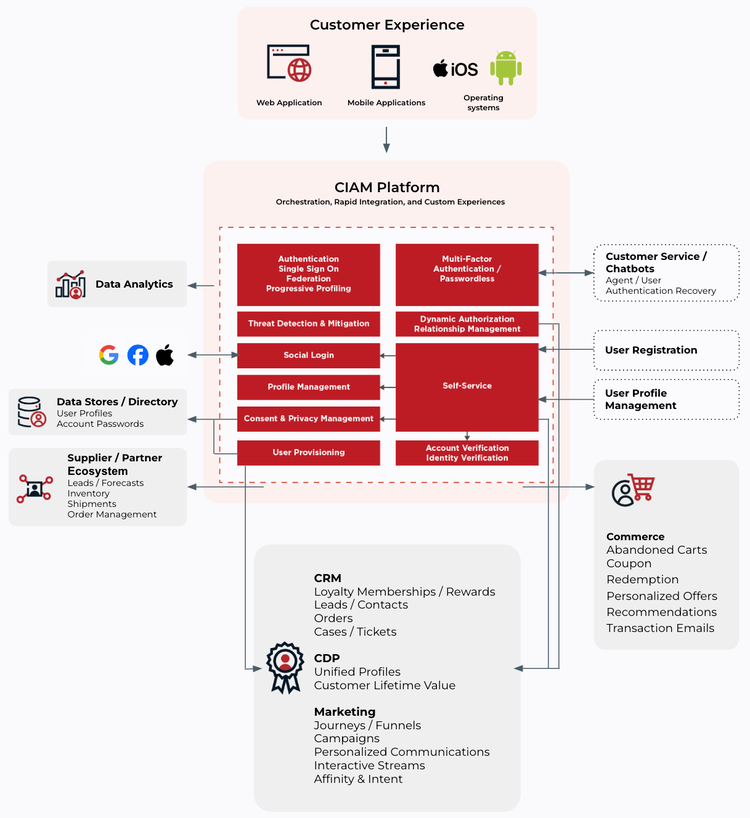
Experience Templates for Retail
Elevate your retail digital experiences with ready-to-use identity experience templates. These out-of-the-box solutions are aligned to each identity experience for retail, with comprehensive flow templates and clear guidance on how to implement from the very beginning.