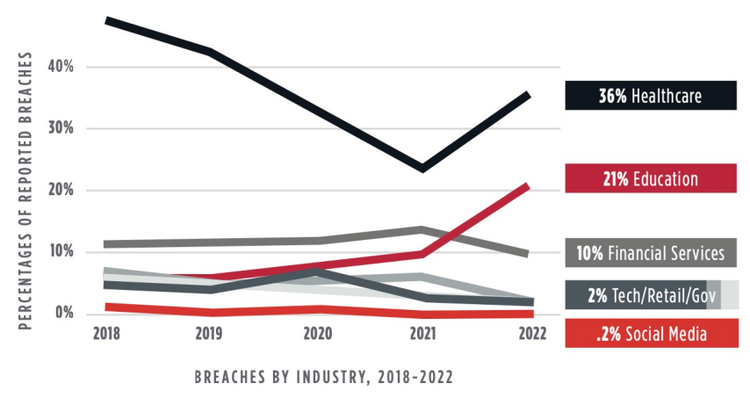
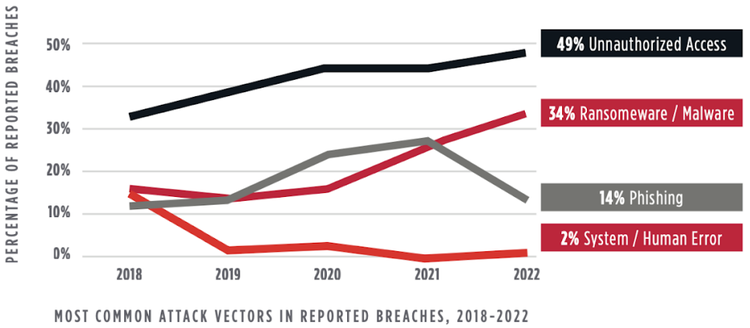
Healthcare organizations face an increasingly complex risk landscape shaped by the rapid adoption of digital technologies, rising cyber threats, and stringent regulatory demands. The industry remains a top target for cybercriminals due to the valuable nature of health data1, with a 128% increase in healthcare breaches between 2022 and 2023 alone. Unauthorized access is the leading cause of breaches1. Insider threats, whether through malicious intent or negligence, are the second highest source of healthcare breaches. Additionally, third-party vendors, essential to the healthcare ecosystem, represent significant risks. In fact, “58% of the 77.3 million individuals affected by data breaches in 2023 were due to an attack on a health care business associate — a 287% increase compared to 2022.”2 And, in 2022, 90% of the largest data breaches were linked to partner-related security failures.
BREACHES BY INDUSTRY, 2018–2022
As healthcare environments increasingly adopt new digital tools and expand their ecosystem to include third parties, it becomes more challenging to manage and scale access permissions appropriately for employees, contractors, and partners. Excessive access permissions can lead to data breaches because they increase the risk of unauthorized or inappropriate access to sensitive information. When users—whether employees, contractors, or partners—have more access than they need, it becomes easier for both malicious insiders and external attackers to exploit those permissions.
Identity Governance and Administration (IGA) is a critical component of identity and access management (IAM) that focuses on managing and controlling who has access to what within an organization, ensuring that the right individuals have the appropriate access to resources and data at the right time. IGA encompasses a set of policies, processes, and technologies designed to manage digital identities and ensure compliance with internal and external regulations.
Unauthorized access is the leading cause of breaches.
Why Traditional Identity Governance Systems Fail
Legacy IGA systems, while once effective, have become increasingly inadequate in meeting the demands of modern businesses. As organizations grow and adopt more advanced technologies—particularly cloud-based solutions—legacy IGA solutions struggle to keep up. These older systems were designed in an era when most enterprise applications were on-premises, and they simply weren’t built with today’s dynamic, multi-cloud environments in
mind. As a result, healthcare organizations relying on these outdated platforms face several critical challenges that hinder their ability to manage access securely, efficiently, and at scale.
Legacy IGA systems fall short in several crucial areas:
- Limited Flexibility and Integration: Legacy IGA systems often struggle to easily connect with newer applications, especially cloud-based systems. They were designed in an era where most systems were on-premises, so integrating with modern, multi-cloud environments is challenging.
- Slow and Error-Prone Manual Processes: Manual tasks involved in granting access and revoking permissions make legacy systems slow and prone to human errors, which is not ideal for businesses needing fast, automated processes.
- Poor User Experience: Both end-users and IT teams can find legacy systems cumbersome, leading to inefficiencies and frustration.
- Limited Analytics and Reporting: Modern organizations need real-time insights and advanced analytics to identify unusual access patterns and potential security risks. Legacy IGA systems often lack sophisticated reporting and monitoring capabilities, making it harder to ensure proper access governance.
- Scalability Issues: As organizations grow and adopt new technology, legacy IGA systems struggle to scale. They weren't built to handle the vast number of users, devices, and data that today's businesses need to manage.
- Weak Cloud Support: Many older IGA systems don't have native support for cloud applications, which means they can't effectively manage access to cloud-based platforms or services—a critical need for modern organizations that rely heavily on cloud infrastructure.
The Risks Associated With Over-Provisioning and Entitlement Creep
Overprovisioning occurs when organizations grant users more access and permissions than they actually need. This can stem from a lack of visibility into what access is truly required for specific roles, outdated or manual processes that don't regularly review and revoke unnecessary permissions, or systems that struggle to enforce least-privilege principles. For example, a traveling nurse who works at multiple hospitals during a 6-month contract. After her contract ends, she’s supposed to lose access to all hospital systems, but without proper identity governance, she could retain access to sensitive data long after her work is done.
Legacy systems, in particular, may not be able to automate access reviews or handle dynamic role changes efficiently, leading to lingering permissions even when they are no longer necessary. Instead, most legacy IAM systems rely on cumbersome manual processes, which are a significant security risk for organizations. In many cases, access reviews are performed as a routine spreadsheet exercise without thoroughly evaluating whether users still need the permissions they have. Manual IGA processes rely heavily on human intervention, often leading to rushed or unchecked approvals during user provisioning, access reviews, or permission changes. Over time, this creates a situation where employees, contractors, or third parties accumulate unnecessary or excessive access rights, increasing the risk of unauthorized access to sensitive data. In complex healthcare org structures and environments where users regularly move across departments or take on new responsibilities, access can accumulate and result in what’s called "entitlement creep", further contributing to excessive access.
Consider a scenario where a third-party claims processor retains access to a payer’s internal systems after their contract ends. This could lead to unauthorized access to financial data or health claims, resulting in compliance violations. Without the right governance in place, payers risk both regulatory fines and data breaches.
How Excessive Access Can Lead to Breaches
Excessive access permissions can lead to data breaches because they increase the risk of unauthorized or inappropriate access to sensitive information. When users—whether employees, contractors, or partners—have more access than they need, it becomes easier for both malicious insiders and external attackers to exploit those permissions. Here are several ways this can happen:
- Insider Threats: Employees or contractors with excessive access may intentionally misuse their privileges or inadvertently cause permissions to be misused.
- Compromised Accounts: If an employee's or contractor's account is compromised, attackers can use their excessive permissions in ways that are particularly dangerous in healthcare where patient data is highly valuable. Attackers can use these permissions to move laterally within the organization, increasing the scope and impact of the breach.
- Phishing and Social Engineering: Users with elevated access are prime targets for phishing attacks. If attackers succeed in tricking these users into providing login credentials, they can gain access to critical systems. With overprovisioned accounts, attackers can bypass many layers of security, accessing sensitive databases and internal systems that should be restricted.
- Lack of Visibility and Control: Excessive access permissions make it harder for IT and security teams to monitor and control who is accessing what data. Without strict access controls and governance, it becomes difficult to detect anomalies or unauthorized access in real-time, allowing breaches to go unnoticed for extended periods.
- Human Error: Employees with access to more systems or data than necessary are more likely to accidentally expose sensitive information. For example, they might share data with the wrong person, store it in insecure locations, or inadvertently delete critical information. This type of data leakage is particularly risky in healthcare, where compliance regulations like HIPAA impose strict rules on how patient data should be handled.
With potential outcomes including breaches that lead to crippling fines, legal challenges, and a loss of trust that is difficult, if not impossible, to regain, the cost of inaction far exceeds the investment in modernizing IGA systems with a unified identity and access management (IAM)platform.
Traditional IGA's Impact On User Experience
When modernizing IGA platforms, healthcare leaders should be mindful that user experience isn’t sacrificed by security and compliance. Security versus experience is not a one or the other scenario. Focusing solely on security risks without considering user experience can have negative impacts. Traditional IGA capabilities, heavily reliant on manual processes, can significantly hinder employee, contractor, and partner experiences, especially in fast-paced healthcare environments where access to critical systems must be seamless, secure, and adaptive to different user needs.
The Systemic Effects Of Manual IGA Processes
Traditional IGA systems often rely on manual processes and outdated capabilities that can severely hinder employee, contractor, partner, and even consumer experience. For both providers and payers, these manual processes can slow down access to critical systems, frustrate users, and negatively impact care and service delivery. Traditional IGA systems often involve manual provisioning and de-provisioning of user access, which can delay clinicians’ access to critical patient records, medical applications, or diagnostic systems. These delays create friction in their workflows, contribute to clinician burnout, and impact patient care. For instance, if a doctor switches departments or gets promoted but access rights aren't updated promptly due to manual processes, they might face frustrating delays in accessing necessary systems.
Payers often interact with sensitive data, including claims processing and member records. In traditional IGA setups, members can face difficulties accessing their information due to outdated authentication methods or slow access changes due to manual processes during the enrollment process. These friction points can increase member dissatisfaction and even lead to churn as members look for more seamless experiences from other providers. Manual processes can also slow down the ability to meet regulatory compliance or audit requests, leaving payers exposed to fines or operational inefficiencies.
Third-party vendors or contractors face even greater hurdles with manual IGA processes. Healthcare providers and payers increasingly rely on contractors for specialized services. However, slow onboarding and offboarding processes can lead to security vulnerabilities and breaches, particularly when access to systems isn’t revoked in a timely manner. This also strains operational efficiency, as contractors may struggle with inconsistent access to necessary systems.
Do IGA Right With Ping Identity's Unified Platform
Modern identity governance is a must, particularly in a highly regulated industry like healthcare where data security and privacy is paramount. The ever-evolving landscape of cyberattacks necessitates a modern approach where access is continuously evaluated through advanced IGA solutions. It is crucial for healthcare leaders to adopt a unified IAM platform complete with IGA to secure their operations, protect sensitive data, and adhere to regulations and guidelines.
The Ping Identity Platform’s governance capabilities are industry-leading with enterprise-proven scalability, robust third-party integrations, and comprehensive user-friendly admin interfaces. With Ping, healthcare leaders can manage, secure, and govern identities throughout their entire lifecycle all from a single platform. Whether managing the identities of a healthcare workforce, contractors, supply chain partners, or vendors, the platform scales to ensure secure, compliant, and efficient identity management across the entire healthcare ecosystem.
Ping Identity Governance
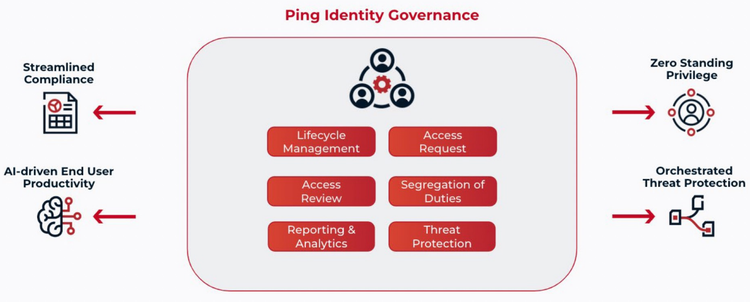
- Modernize and Consolidate to a Single Platform: Consolidate legacy and point IGA and IAM solutions onto one converged platform for all identity use cases.
- Reduce Operational Costs: Save money and eliminate long deployments by simplifying application onboarding, access request reviews, and periodic certification.
- Improve Efficiency: Reduce the high volume of extraneous access certification tasks, enable managers to make faster access decisions, eliminate manual processes, and use AI to automate workloads and evaluate millions of permissions per minute.
- Enjoy Deployment Flexibility: Transition from self-managed or hybrid deployments to cloud at a pace that is right for the organization and gain cost, resilience, and scale benefits of cloud.
Close The Door On Insider Threats
A growing number of attacks on large organizations are driven by social engineering and other internal threats. These attacks exploit vulnerabilities in workforce, contractor, and partner access policies. Implementing modern IGA solutions across the organization is now more critical than ever to mitigate these insider threats.
The Ping Identity Platform empowers organizations to effectively mitigate common insider threats by securing the entire identity lifecycle for their workforce, contractors, and partners. By automating identity governance and access management processes, and ensuring real-time oversight, the platform enforces least-privilege access – minimizing the risk of unauthorized actions or data breaches. This approach aligns seamlessly with a comprehensive zero-trust security strategy, ensuring that access to critical systems and sensitive data is only granted when absolutely necessary. By continuously validating identities and their access rights, healthcare security and governance leaders can significantly reduce vulnerabilities and strengthen their organization’s overall security posture against both internal and external threats
With Ping Identity you can:
• Enable Lifecycle Management: Use a combination of automated workflows, integration capabilities, role-based access control, and policy enforcement, ensuring that identities and access rights are managed efficiently and securely throughout their lifecycle.
• Reduce Access Vulnerabilities: Strengthen security across all workforce, contractor, and partner access requests by eliminating error prone manual processes.
• Decrease Workforce Access Costs: Automate role engineering and governance along with self-service access requests to reduce workforce access costs.
• Gain Organization-Wide Visibility: Spot anomalous behavior before it represents a threat and enable solutions to proactively identify access risks and highlight excessive privileges. Achieve a complete understanding of all your identity provisioning, administration, compliance, and employee access management landscapes and needs.
• Enforce Zero Trust Security: Leverage workforce identity security to solidify enterprise-wide security at the perimeter.
Reduce Costs
Modernizing IGA with Ping Identity offers significant cost-saving benefits for healthcare organizations. Prior to implementing a modern IGA solution, many organizations rely heavily on manual processes for managing user access, provisioning, and deprovisioning. This leads to inefficiencies, particularly in the areas of employee onboarding and offboarding, where human errors can result in delayed access to critical systems or excessive access being granted. Excessive access directly increases the risk of costly breaches.
Healthcare workers and partners waiting for access to be granted get frustrated by delays in their ability to perform critical tasks. It also creates unnecessary bottlenecks. This inefficiency can lead to employee dissatisfaction, contributing to burnout and increasing the likelihood of turnover, particularly in high-pressure healthcare environments where quick access to systems is essential for delivering quality care.
Additionally, legacy systems often lack automation and integration capabilities, causing IT departments to invest more time and resources in maintaining security and compliance with healthcare regulations. These inefficiencies not only increase operational costs but also expose the organization to heightened security risks, such as unauthorized access to PII and PHI data, which can result in costly data breaches.
By adopting Ping’s modern IGA platform, healthcare organizations can drastically reduce these operational inefficiencies. Automated provisioning, role-based access control (RBAC), and continuous access monitoring minimize the need for manual intervention, reducing administrative overhead and the potential for human error. For example, instead of spending hours manually granting and revoking access across multiple systems, the new IGA system automates these processes, freeing up valuable IT resources.
Example of Savings From Ping's Automated Access Review
For example, within a 12-month period, an organization needs to add entitlements for 1,000 new employees and make modifications for existing employees. If that work is handled by an administrator who's paid $50/hour, taking three hours to manually add, modify, or remove that access, the total cost would be $150,000.
- Number of new identities added per year: 1,000
- Number of entitlement changes per year: 1,000
- Resource hours required to accurately grant, modify, or revoke access manually: 3 hours per review
- Administrator compensation: $50 per hour
Annual Cost of Manual Access Review With Traditional IGA = $150,000
However, if an organization implements Ping’s unified IGA platform with automated access review capabilities, it can alleviate the administrator’s manual entitlement workload by an estimated 90%, saving the organization $135,000.
The example above only accounts for the cost savings in regard to the administrator’s time. Consider all of the other associated savings, such as an employee’s increased productivity due to more timely access, in addition to reduced risks associated with lingering access after a contractor leaves the organization.
Another area for savings is around compliance. Ping’s IGA solutions provides real-time auditing capabilities, ensuring that access controls are always in line with regulatory standards, reducing the risk of fines and reputational damage from non-compliance. The HITECH Act, which strengthens HIPAA, emphasizes the importance of safeguarding ePHI. It requires healthcare organizations to implement access controls and audit trails, making identity and access governance essential for compliance. Another example is PCI DSS, or Payment Card Industry Data Security Standard. Healthcare organizations that process payment card transactions must comply with PCI DSS standards, which require strict access controls and encryption for payment information. A healthcare organization that fails to secure its payment systems and experiences a breach due to inadequate access controls could face a monthly fine of up to $100,000 from card networks.
Ping Identity’s unified IGA solution not only lowers operational costs, but also leads to better security and more efficient regulatory compliance management, all contributing to long-term financial savings.
Deliver Great User Experiences
Ping Identity's IGA solution helps organizations deliver a better experience for both workforce and external partners by streamlining access management and ensuring employees and partners can access the right resources quickly and securely. From the moment a new employee joins the organization, Ping IGA enables automated provisioning based on predefined roles, ensuring that they have access to the systems and tools they need from day one. This improves operational efficiency by reducing delays caused by manual provisioning processes.
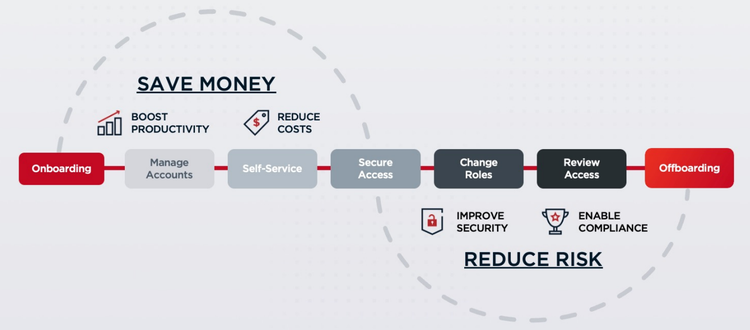
Ping IGA also simplifies the access request process. Employees can make access requests through a self-service portal that reduces the need for IT intervention. Managers, empowered by delegated administration features, can review and grant access requests quickly, further speeding up workflows. Additionally, contextual access controls allow organizations to quickly grant temporary access when needed, such as a doctor performing unexpected duties in an emergency situation.
For partners, Ping IGA ensures that external vendors or contractors have secure access to only necessary systems, ensuring compliance and reducing the risk of unauthorized access to sensitive data. This seamless, automated approach to managing both workforce and partner identities reduces administrative overhead, improves security, and enhances the overall user experience.
With Ping Identity you can:
- Improve Workforce and Partner Experience: Give workforce members and partners a high degree of confidence around access, an easy access request portal, and fewer access-related interruptions.
- Increase Productivity: Reduce inhibitors to user productivity by enabling workers with the access they need when they need it. Eliminate time-consuming manual processes for administrators.
- Reduce Costs: Streamline processes, minimize manual tasks, decrease errors, and reduce cases of under-provisioning that frustrate employees and impact care delivery.
Embrace the Evolving Regulatory Landscape
Large healthcare organizations need a unified view of user access to understand who has access to what resources and how they are being used. This visibility is essential for periodic access reviews to ensure compliance with evolving regulations, including healthcare-specific mandates like HIPAA, HITECH, TEFCA, PCI DSS, and the 21st Century Cures Act. As global regulatory demands for privacy, information security, and technology accelerate, businesses continue to invest heavily in compliance. Staying ahead of these changes and leveraging them to drive innovation is crucial for maintaining a competitive edge, especially in regulated sectors like healthcare.
The Ping Identity Platform accelerates compliance-driven growth for healthcare organizations by delivering robust security, enhanced privacy controls, and improved digital resilience. By providing a comprehensive and unified set of IGA and IAM capabilities, it enables organizations to meet regulatory requirements more efficiently, reduce the risk of breaches, and safeguard sensitive data. This, in turn, helps organizations build and maintain long-term trust with both customers and regulators. By staying ahead of evolving regulations and implementing proactive security measures, healthcare organizations can foster a reputation of reliability and compliance, ultimately driving growth and operational efficiency.
With Ping Identity, you can:
- Comply With Security Standards: Automatically audit and track user access to all applications to ensure compliance.
- Use Dynamic Dashboard and Reports: Access logs with robust data inputs that can be reviewed manually, streamed via webhook, or pushed via API.
- Gain Comprehensive Visibility: Gain full visibility into the identity provisioning, administration, compliance, and employee access management landscapes and needs.
- Leverage AI for Access Reviews: AI-driven remediation and confidence scoring for certification campaigns.
Improve Healthcare Security, Compliance, and Experience With Ping's Unified IGA Solution
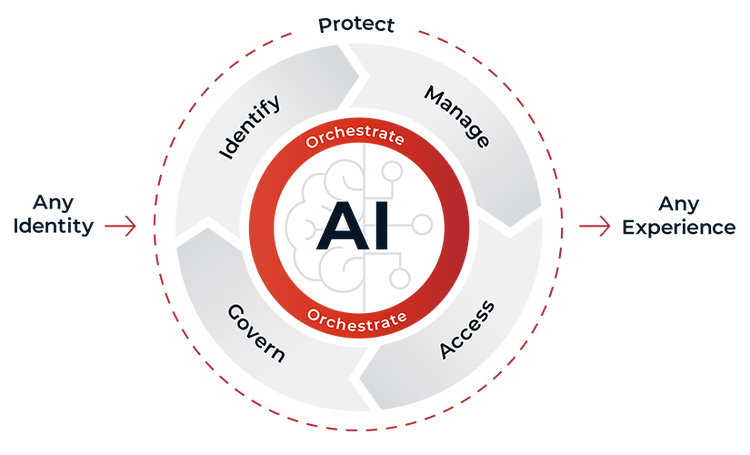
Improving your organization's security, compliance, and user experience is easier with Ping's unified IGA and IAM platform.
SOURCES:
- 2023 Forgerock Identity Breach Report
- https://www.aha.org/news/aha-cyber-intel/2024-08-05-third-party-cyber-risk-impacts-health-care-sector-most-heres-how-prepare
- https://www.hhs.gov/about/news/2023/06/15/snooping-medical-records-by-hospital-security-guards-leads-240-000-hipaa-settlement.html
- https://www.healthcaredive.com/news/ascension-cyberattack-impact-ehr-pharmacy-ambulancediversion/719139/
- https://www.hipaajournal.com/cost-healthcare-data-breach2024/