Are You Still Managing Your Own Infrastructure?
If yes, we recommend you get out of managing and hosting your identity infrastructure. While that type of work is essential, it's not unique to your business, so it's a perfect candidate for handing over to a partner you already trust, like Ping Identity.
It's time to shift your Ping software to Ping's cloud. Many long-time enterprise users of PingAM, PingIDM and PingDS or PingFederate and PingDirectory are upgrading to Ping's cloud. Whether you want to accelerate your digital transformation efforts, enhance the security and resiliency capabilities of your identity services, or decrease your total cost of ownership, you've come to the right place to learn about shifting your Ping software to Ping's cloud.
Making the Case for Upgrading to Ping's Cloud
3 Business Challenges Driving Moves to the Cloud
1. Hiring, Training, and Retaining Identity Expertise When 30% of Your Team Will Quit This Year
The brain drain is real, meaning IT professionals and leaders like you need to focus your top talent and resources on the most value-added and rewarding activities for your business. Infrastructure and product operations are not the best use of your limited resources — your team should focus on adding value in experience management.
2. Strategic Focus on Speed, Vendor Consolidation, and Cost Optimization
Organizations spend between $50K and $300K annually on data center storage, maintenance, and upgrades. Leveraging managed hosting of any digital services, wherever possible, helps achieve operational efficiency and allows you to do more with less.
3. Keeping Up with the Increasing Threat Landscape: 40,077 Software Security Flaws and Counting2
The number and type of identity attacks grow daily. Since IAM is the front door to your business, when vulnerabilities emerge, you need to quickly analyze the threat, run an impact analysis, and mitigate the danger. Keeping up with the threat landscape generally halts your other business operations.
3 Main Benefits of Moving to the Cloud
1. Reclaim Your Time
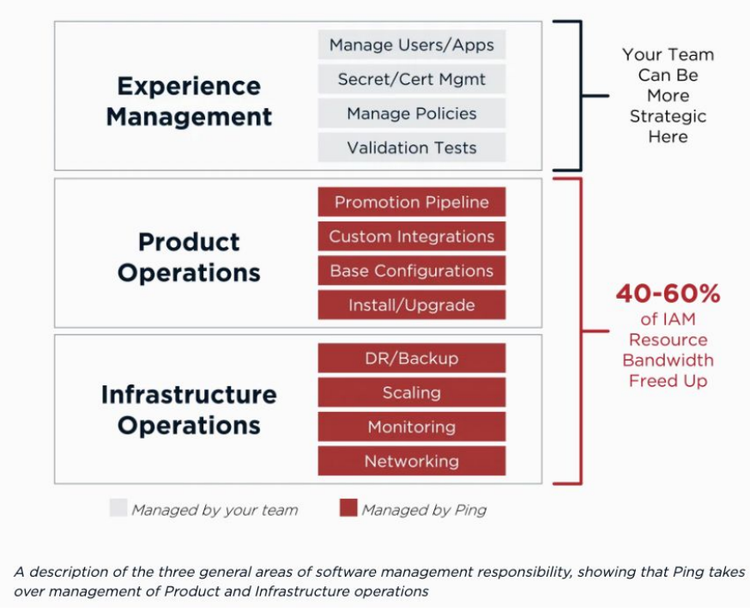
Free up 40–60% of your team's time to support your business by tackling other value-added projects. When you move to Ping's cloud, Ping takes over responsibility for Product Operations and Infrastructure Operations so your team can focus on strategic efforts that improve workforce and customer experiences.
2. Reduce Your Total Cost of Ownership
Save significant IT operational costs without compromising support for your challenging use cases. Your cost of operation is much lower when you consume it as a cloud service from us compared to somebody having to build and maintain everything from scratch.
3. Improve Your Security Posture
We ensure you’re protected effectively with the latest automatic bug fixes and upgrades and optimal cloud security postures managed. Based on thousands of existing customers in our cloud, we build in best practices for cloud security and software configuration. Automatic upgrades also mean that, without any effort from your team, you’re taking advantage of the latest versions with bug fixes and new security features.
We can help put together a more detailed analysis of how much cost savings you’ll experience by moving to Ping’s cloud. Talk to your account executive for a business value calculation.
How Does Ping's Cloud Solve These Challenges?
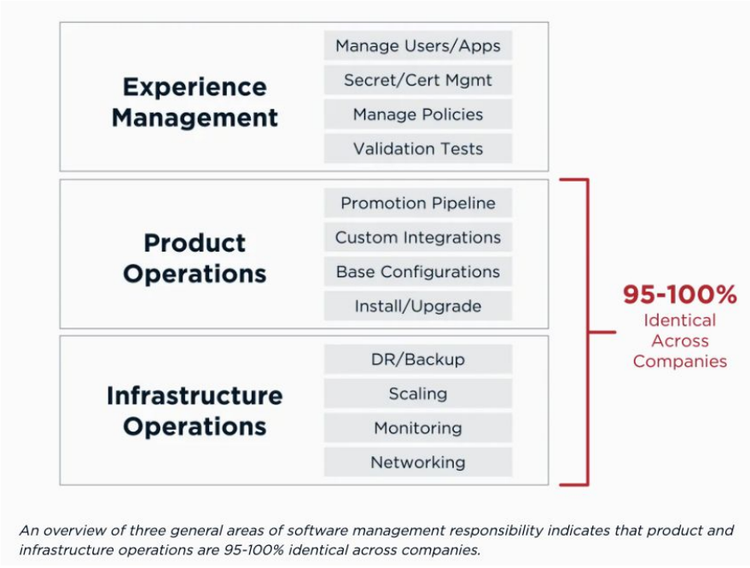
Managing and hosting your Ping software requires three general areas of responsibility.
You need somebody to do your administration configuration, which we call “Experience Management.” These folks design the user journeys, manage users, applications, secrets, certificates, and policies, and validate testing.
You also need somebody to ensure “Product Operations” run smoothly by promoting across environments, managing custom integrations, understanding base configurations, and managing installation/upgrades.
Finally, you need somebody to manage your “Infrastructure Operations,” including backups, CPU monitoring, and networking. This person is especially critical when you have a production alarm in the middle of the night.
Because we work across the spectrum of global enterprises, we have noticed that this top layer of “Experience Management” is unique to each business. But in the bottom two layers of “Product Operations” and “Infrastructure Operations,” 95-100% of your organization’s steps are identical to those of any Ping customer running that capability. Most of Ping’s customers say these bottom two maintenance and operations layers consume about 40-60% of their resource bandwidth.
Addressing Your Upgrade Fears
Many organizations have concerns about moving to the cloud. Common fears include:
- The fear of the "rip-and-replace"
- The fear of downtime
- The fear of loss — including loss of functionality, data, and more
We have great news – these fears were shared by the over 1,000 customers that have upgraded to Ping’s cloud already. YOU ARE NOT ALONE. Our experience in cloud migrations has culminated in an approach and toolsets that address all your cloud upgrade fears.
Alleviating your fears involves addressing two key areas: flexibility and control. We take a methodical, just-in-time phased migration approach. Leveraging our orchestration service, we can move apps, users, and data from one identity system to another in a slow and action-driven way. There is no need to “rip-and-replace” anything.
That same orchestration service helps alleviate other fears, like the fear of downtime. Our approach reduces migration risk and makes change management easy. We address the fear of functionality loss by ensuring you can automate changes, easily assess and audit, and quickly heal inadvertent outcomes.
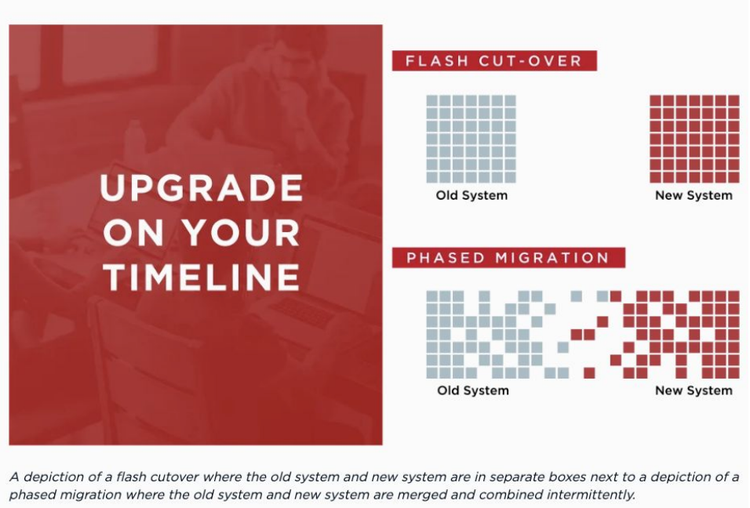
You don't have to worry about immediate cut-overs. You can plan a timeline of how and when the migration will happen. Then, we give you the capabilities to automate those migration events (and roll them back, if needed).
The graphic below shows the two types of migration: flash cut-over, where you have an old system and a new system and instantly switch over from your self-managed software to Ping’s cloud, and phased migration, where you do a just-in-time migration of users with much-limited risk and much more flexibility in terms of timelines.
The Choice: Dedicated or Multi-Tenant
What's Ping's Cloud Offering?
We offer two cloud options for you: our multi-tenant SaaS platform, PingOne, and our dedicated tenant SaaS platform, PingOne Advanced.
- PingOne: This multi-tenant SaaS offering allows you to deploy fast, get rapid value, and use it extremely simply and easily. It's great because you onboard quickly, start using the multi-tenant service, and get up and running fast.
- PingOne Advanced: This dedicated tenant SaaS platform offers all the benefits of hosting but also grants enterprises much more control in the cloud, whether that control is central to security compliance, data residency, or networking. These controls are often required for enterprises in regulated industries like financial services and health care.
Both PingOne and PingOne Advanced provide you with the same benefits as detailed above. And all of our core platforms are integrated with our universal services, which you see at the top of this graphic.
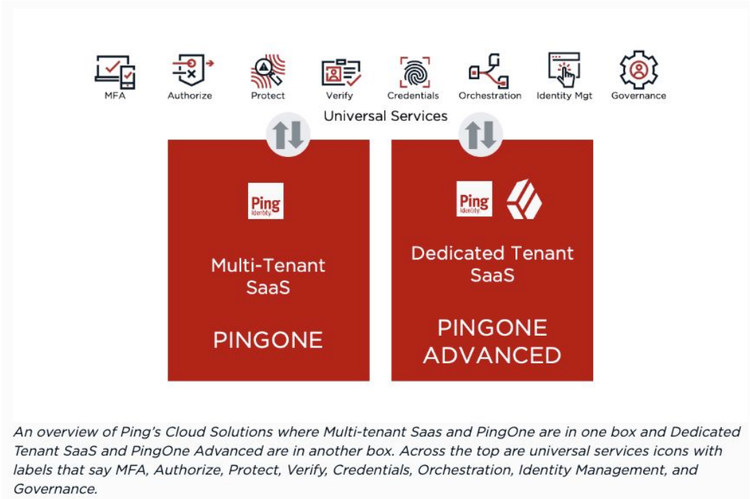
The universal services bring you best-of-breed capabilities in the cloud and encompass MFA, authorization, threat protection, identity verification, digital verifiable credentials, orchestration, identity management, and identity governance.
These capabilities augment your existing IAM core services, and we offer this entire suite of services to help you create enriching and secure experiences for your customers, workforce, and beyond.
Six Migration Steps to a Smooth Transition
The Path
We can make your path to the cloud easy and very predictable through flexibility and control. Ping’s six migration steps to ensure a smooth transition to the cloud:
- Migration: Determine which cloud platform best suits your needs: the multi-tenant SaaS offering, PingOne, or the dedicated tenant SaaS offering, PingOne Advanced. As noted above, this decision depends on factors like security requirements, compliance needs, and data residency concerns.
- Discovery: Analyze your current infrastructure and environment using automated tools. The goal is to identify key components, applications, workloads, and configurations that need to be migrated and whether certain elements need to be reimagined with new capabilities.
- Executive Buy-In: Share all findings and the business value calculator with top leaders and stakeholders to set expectations and clarify the timeline.
- Assessment: Evaluate the feasibility of migrating various components to the cloud and identify areas requiring reimagining to leverage cloud-native capabilities effectively.
- Cloud Upgrade: Create and execute the plan. Yep, this is the scary part. The part with all the fear we talked about above. It seems grossly simplistic that it’s only one step, but the phased migration approach makes it much easier, less risky, and more automated than ever. This plan outlines the timeline, milestones, and approach for migrating each component to Ping’s cloud. It also considers factors such as risk mitigation, resource allocation, and contingency planning. Automated tools and playbooks facilitate the seamless transfer of data, configurations, and workloads from your current environment(s) to Ping’s cloud. Once the upgrade is complete, thorough validation and testing are conducted to ensure that all components are functioning as expected and help identify and address any issues or discrepancies before transitioning to production.
- Go-Live: Begin leveraging the benefits of your new Ping cloud infrastructure, which also includes optimization and continuous improvement through fine-tuning and monitoring.
What's the ROI?
While Ping's cloud requires a financial investment greater than your current software-only licenses, the return on investment comes from business value captured in three areas:
- Hardware infrastructure savings
- Maintenance and operations savings
- Business agility from accelerating the launch of new IAM services to more applications
Most customers break even on their initial investment in PingOne Advanced within 6–10 months — in other words, the investment should pay for itself within ten months. When looking out at three years, a 200–300% return on investment is typical.
How Much Staff Time Will it Take?
The Path
Below is a typical project resource map. Assume the black line refers to your average IAM bandwidth on a day-to-day basis for operating your existing Ping software.
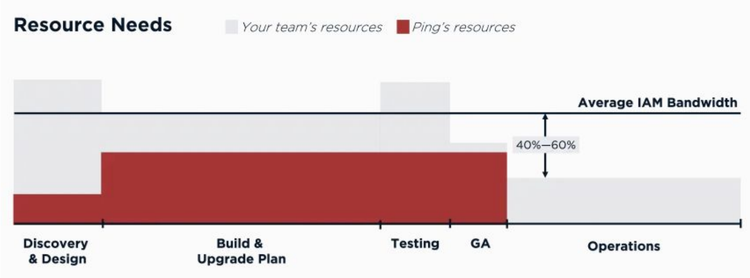
To make you the IAM hero of your cloud migration, Ping has three essential acceleration toolsets that streamline the migration process, minimize downtime, and maximize efficiency, ensuring a seamless transition to the cloud.
Configuration Accelerator
Speed. Discover. Drive. The Configuration Accelerator includes a library of standardized best practice configurations tailored for cloud environments. By leveraging pre-configured settings and templates, you can expedite the deployment, eliminating the need for manual configuration and reducing the risk of errors. This makes cloud deployment more rapid while ensuring adherence to industry best practices and compliance standards and discovering new capability offerings.
Deployment Accelerator
Automate. Validate. Heal. The Deployment Accelerator involves frameworks and tools designed to automate the deployment process with capabilities such as Terraform and Continuous Integration/Continuous Deployment (CI/CD). Automate environment promotions, audit changes, understand your state management, remedy inadvertent changes, and leverage drift correction through this accelerator toolset.
Migration Accelerator
Discover. Assess. Migrate. The Migration Accelerator helps run a discovery, connects to and analyzes your self-managed software, and then gives you confirmation translations to automate deployment. It supports phased migration approaches and includes a library of just-in-time migration flows that make the change over incrementally while minimizing disruption to business operations. Track the progress of migration activities and ensure compliance with migration objectives and timelines.
Navigating the complexities of migration necessitates expert guidance and support. Ping's experts offer invaluable insights and assistance throughout the migration journey, from initial assessment to post-migration validation. We will develop tailored migration strategies aligned with your unique business objectives, ensuring a seamless transition and maximizing ROI. Our commitment to your success extends beyond migration, encompassing ongoing support, optimization, and innovation, fostering a collaborative partnership centered around your mission-critical Ping tech stack
Ping Cloud Upgrade Success Story
Honeywell's Cloud Upgrade Experience
Honeywell, a Fortune 100 company, had a successful experience upgrading to PingOne Advanced, according to Davis Arora, Senior Director of Cybersecurity on the Honeywell global security team. In a webinar called Increase Efficiency: Migrate Your Ping Software to Our Cloud, Arora describes himself as the “one throat to choke for identity” and shares how Honeywell leverages Ping Identity for authentication/authorization for both their workforce and customer revenue-generating apps. As of 2022, they had ~1,000 applications integrated with PingOne Advanced.
The company had several drivers for moving its Ping software to Ping’s cloud. The biggest C-level and business stakeholder concern was to improve resilience and redundancy and to support customer revenue-generating applications and services with 99.99% availability. Although it was not impossible, the security team previously found it challenging to avoid outages for upgrades and patches and sometimes experienced outages due to dependencies on other on-premises services. Additionally, they wanted to solve the problem of resource constraints on the SSO team by forgoing bug fixes, patches, upgrades, and in-depth knowledge needed to keep the on-premise software live, available, and meeting business stakeholder demands. Another major driver was that they simply wanted to get out of the business of hosting such a critical service in their on-premises global data centers.
One of the biggest challenges was overall change management across the business. Honeywell has four distinct business groups in aerospace, building technologies, performance materials, and safety solutions. This means that the global security team caters to the diverse needs of each business group, each with its own specific set of products, services, and customer base to ensure that global identity services are scalable and flexible enough to meet their specific requirements. In preparation for this migration, the Honeywell global security team partnered with all their application teams within each of the different businesses and enterprise IT to understand their needs. They used those requirements to streamline their standard code patterns and intake forms for application owners to easily onboard apps and enroll their apps in centralized, adaptive risk-based MFA services. They delivered these instructions with significant training that helped application owners understand how they could have modern IAM services and higher availability, redundancy, availability, and security with MFA everywhere.
Honeywell took a phased approach, spinning up and down different levels of support with migration for different application teams, depending on their expertise or support model. In just 90 days, they got the environment up and ready for production. Starting in January 2022, they stopped allowing any new applications to be onboarded to the on-premises PingFederate environment, and instead, all new applications were onboarded to PingFederate in the PingOne Advanced environment. Since then, they have migrated 700-750 applications previously leveraging the on-premises service. They also put in place an enterprise-wide request for application owners to integrate with the SSO service every time they roll out a new app to the enterprise or customers, making it easy for applications to deliver seamless authentication services using integrations like Windows Hello for business.
Honeywell completed their journey in 2022 by deprecating the on-premises PingFederate instances. The next evolution for Honeywell is currently around cross-connecting specific technologies to build a Zero Trust ecosystem, leveraging PingOne DaVinci as that orchestration layer to effectively deal with device, network, and user validation continuously.
Dive deeper into Honeywell’s cloud migration and discover why this leading company made the move
Ready to Make the Move
In conclusion, when you move to Ping's cloud, you become the IAM hero of your enterprise. It’s a way to save time, save money, move faster, and focus your top talent on the things that will improve your bottom line. You already trust us to provide you with identity software that solves your business challenges; trust us to host it for you, too.
Whether you want to accelerate your digital transformation efforts, enhance the security and resiliency capabilities of your identity services, or decrease your total cost of ownership, shift your Ping software to Ping’s cloud. With our flexible cloud offerings, you can reset your teams' bandwidth, maximize ROI, and unlock significant cost savings. As the digital landscape changes and evolves, let Ping help position you for future success and sustainable growth.
At Ping Identity, we believe in making digital experiences both secure and seamless for all users, without compromise. That's digital freedom. Ping enables enterprises to combine best-in-class identity solutions with third-party services they already use to remove passwords, prevent fraud, enable Zero Trust, or anything in between — all with a simple drag-and-drop canvas. That's why more than half of the Fortune 100 choose Ping Identity to protect every single digital interaction from their users, while making experiences frictionless. Learn more at www.pingidentity.com.
1 Cloud Migration Optimizes Identity and Access Management, Forrester Research, Inc. November 2023